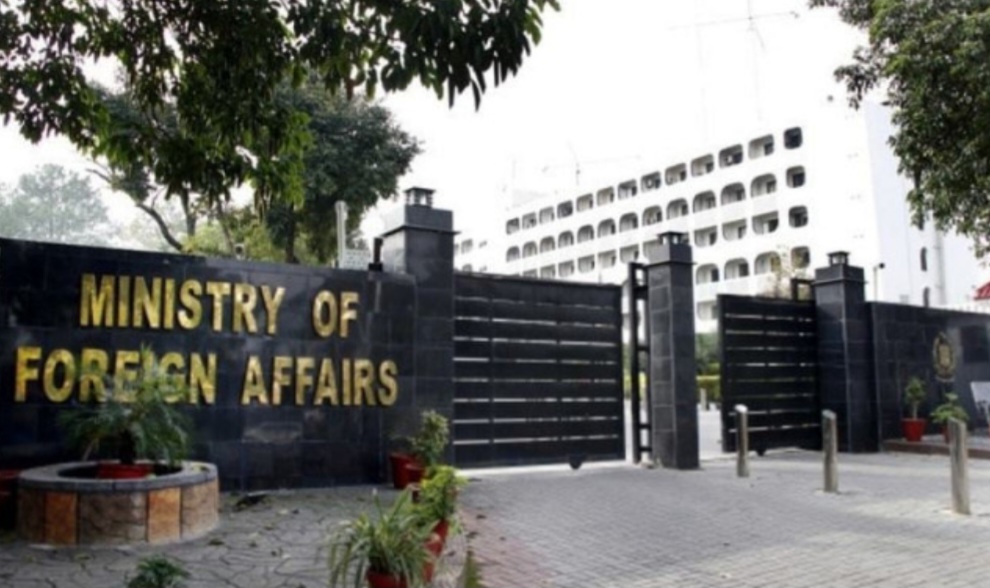
Foreign Ministry responds following Defence Minister’s claim that Simla Agreement is ‘dead’Pakistan’s Foreign Ministry clarified on Thursday that no decision has been made to revoke any bilateral agreements with India. This statement came a day after Defence Minister Khawaja Asif described the 1972 Simla Agreement as a “dead” document in light of recent Indian actions.Addressing media inquiries, a senior Foreign Office representative stated that while India’s recent unilateral measures and rhetoric have sparked internal deliberations, Pakistan has not taken any formal steps to annul existing accords with New Delhi.“There is currently no official decision to terminate any bilateral agreement,” the official said, affirming that all such agreements, including the Simla Agreement, remain in place.The ministry’s clarification followed remarks by Defence Minister Khawaja Asif during a television interview, where he said India’s conduct—particularly the 2019 revocation of Article 370 in Jammu and Kashmir—had rendered the Simla Agreement obsolete.“The Simla Agreement has lost its relevance. We’ve reverted to the 1948 scenario, where the UN recognized the Line of Control as a ceasefire line,” Asif claimed, arguing that the bilateral framework set in 1972 had collapsed. He suggested that future disputes would now have to be addressed through multilateral or international forums.Referring to the first Indo-Pak conflict and the UN-brokered truce that followed, Asif emphasized that India’s unilateral steps had fundamentally undermined the bilateral engagement structure. He also questioned the status of other key agreements, including the Indus Waters Treaty, stating: “Whether the Indus Waters Treaty is active or not, the Simla Agreement is already defunct.”Commenting on regional tensions, Asif warned that the threat of conflict with India remained real. “Pakistan does not seek war, but if one is forced upon us, our response will be stronger than ever,” he cautioned.The Simla Agreement, signed after the 1971 war between India and Pakistan, aimed to resolve disputes through peaceful, bilateral means. It formalized the Line of Control in Jammu and Kashmir and bound both nations to uphold each other’s sovereignty and avoid the use of force.Asif’s statements came in the wake of escalating tensions, particularly following India’s recent announcement to unilaterally suspend the Indus Waters Treaty. This move was accompanied by reported cross-border strikes, further straining relations between the two nuclear-armed neighbours.Pakistani officials noted a significant drop—91,000 cusecs—in water flow from India into the Chenab River after these developments. Meanwhile, Indian Prime Minister Narendra Modi has made increasingly aggressive comments, declaring that water previously flowing to Pakistan would now be retained for domestic use, signaling a strategic shift in how India handles its river resources.