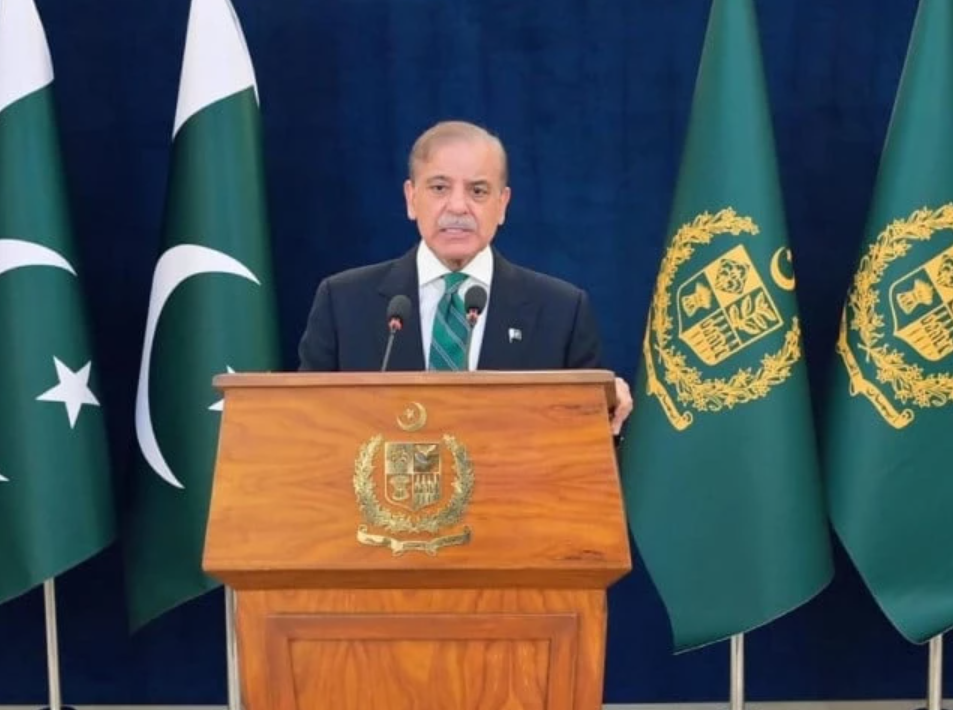
Acknowledges global diplomatic support; praises military for swift, decisive response
ISLAMABAD – In a national address on Saturday following the landmark ceasefire agreement with India, Prime Minister Shehbaz Sharif expressed strong confidence that critical issues between the two nations—such as the Indus Waters Treaty (IWT), terrorism, and the Kashmir dispute—can be resolved through peaceful dialogue.
The Prime Minister confirmed that Pakistan had responded positively to ceasefire proposals “in the interest of 230 million Pakistanis” after weeks of intensifying cross-border hostilities, triggered by the April 22 attack in Pahalgam, Indian-occupied Jammu and Kashmir, which left 26 people dead. Islamabad rejected Indian allegations of cross-border involvement and instead called for an impartial international investigation.
Tensions escalated further when India unilaterally suspended the Indus Waters Treaty and launched a series of 24 airstrikes on six locations within Pakistan on May 6–7, resulting in the deaths of at least 31 civilians and injuries to 71 others.
Addressing the nation, PM Shehbaz thanked the United States, particularly President Donald Trump, for playing a key role in facilitating the ceasefire. He also acknowledged diplomatic support from Saudi Arabia, the United Arab Emirates, Türkiye, Kuwait, the United Kingdom, the United Nations, and others.
“I am grateful to my brothers—Crown Prince Mohammed bin Salman, Sheikh Mohammed bin Zayed, Emir Sheikh Tamim bin Hamad, and President Recep Tayyip Erdoğan—for their unwavering support during this challenging time,” the Prime Minister said.
The ceasefire, brokered after extensive U.S.-led diplomatic efforts, was first announced by President Trump and later confirmed by Pakistani Deputy PM Ishaq Dar, Indian Foreign Minister S. Jaishankar, and U.S. Secretary of State Marco Rubio.
President Trump hailed the breakthrough, stating:
“After a long night of talks mediated by the United States, I am pleased to announce that India and Pakistan have agreed to a FULL AND IMMEDIATE CEASEFIRE. Congratulations to both countries on using common sense and great intelligence.”
PM Shehbaz also expressed deep appreciation for China’s unwavering support, thanking President Xi Jinping and the Chinese people for standing by Pakistan “as true friends for 78 years.”
He extended heartfelt gratitude to Pakistan’s military leadership for their defense of the nation, naming Chairman Joint Chiefs of Staff Committee Gen. Sahir Shamshad, Army Chief Gen. Asim Munir, and the heads of the Air Force and Navy.
“I salute our Shaheens and their leadership. Our Air Force responded with precision and pride, neutralizing the enemy’s Rafale jets and silencing their guns within hours,” he stated.
Highlighting Pakistan’s military response under Operation Bunyan-un-Marsoos, PM Shehbaz revealed that the Pakistan Air Force downed five Indian fighter jets—including Rafale, MiG-29, and SU-series aircraft—alongside an Israeli-made Heron drone. The targets were spread across Bathinda, Jammu, Akhnoor, Srinagar, and Avantipur.
Pakistan also launched Al-Fatah missiles at Indian airbases used in the attacks. Key targets reportedly included Akhnoor Aviation Base, Bathinda Airfield, and Sirsa Airfield. Pakistan further destroyed an Indian BrahMos missile stockpile near Beas and eliminated an S-400 defense system in Adampur using hypersonic missiles deployed from JF-17 Thunder jets.
The Prime Minister paid tribute to the nation’s martyrs, acknowledging the families of fallen soldiers and thanking all political stakeholders—particularly PML-N leader Nawaz Sharif and PPP President Asif Ali Zardari—for their solidarity.
He also lauded the efforts of Pakistani citizens, especially those active on social media, for combating disinformation and promoting unity.
“Every Pakistani became a digital soldier for the truth. I thank you all,” he said.
Looking ahead, PM Shehbaz called for unity and resilience, urging the nation to continue its collective efforts toward progress and international standing.
“We must work with such dedication that the world is once again astonished—just as they are now by the bravery of our armed forces.”