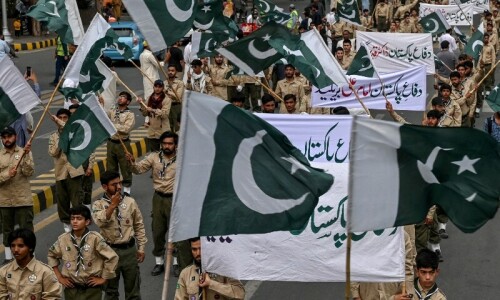
The Pakistan Army has officially declared the successful conclusion of Operation Bunyanum Marsoos, a decisive retaliatory campaign launched in response to Indian military aggression earlier this month. The announcement was made by Director General Inter-Services Public Relations (DG ISPR) Lt Gen Ahmed Sharif Chaudhry, who stated that the operation, executed on May 10 under the broader military campaign Marka-e-Haq, was Pakistan’s answer to unprovoked Indian attacks that resulted in civilian casualties, including women and children.
According to the ISPR, the operation was a textbook demonstration of joint warfare, integrating air, land, sea, and cyber capabilities. With real-time situational awareness and precision weaponry, Pakistan targeted 26 Indian military installations, including airbases, missile depots, and intelligence hubs, both in Indian Illegally Occupied Jammu & Kashmir (IIOJK) and across the Indian mainland.
Notable strikes included the destruction of Indian Air Force bases in Suratgarh, Adampur, Halwara, and Ambala; BrahMos missile storage at Beas and Nagrota; and S-400 air defence systems at Adampur and Bhuj. Command and logistical centers responsible for the attacks on Pakistani civilians were also targeted and reportedly destroyed.
The Pakistan Armed Forces deployed Al-Fatah F1 and F2 precision-guided long-range missiles, advanced loitering munitions, and high-accuracy artillery. The Pakistan Navy ensured maritime dominance while the Air Force carried out complex multi-domain operations. Cyber warfare units simultaneously degraded Indian military infrastructure.
The ISPR revealed that during the conflict, Pakistan Armed Forces also carried out drone surveillance missions over Indian territories, including New Delhi, to demonstrate their long-range capabilities. At the same time, Indian drone incursions were repelled. The statement claimed that Indian positions across the Line of Control (LoC) were heavily damaged until they raised white flags, seeking restraint.
In addition, Pakistan faced a surge in Indian-sponsored terrorist activity in Khyber Pakhtunkhwa and Balochistan during the operation. According to the ISPR, this coordinated proxy activity further demonstrated India’s role in destabilizing Pakistan internally while engaging in cross-border aggression.
Despite the complex threat landscape, the ISPR stressed that Operation Bunyanum Marsoos demonstrated the synergy of Pakistan’s tri-services and the resilience of its people. It expressed deep gratitude to the Armed Forces personnel, the Pakistani nation, media, diplomatic corps, scientists, engineers, and political leadership for their unwavering support.
National Day of Recognition Declared
In recognition of the operation’s success, Prime Minister Shehbaz Sharif announced that May 10 will be observed annually as Youm-e-Marka-e-Haq to honor the Armed Forces’ exemplary performance and the unity of the Pakistani nation. The day will be marked with patriotic fervor, tributes to the military, and prayers for national progress.
“May 16, 2025, will be observed as a day of thanksgiving and remembrance,” the Prime Minister stated. “Special prayers will be held to thank Allah Almighty and to recognize the bravery and professionalism of our armed forces.”
Prime Minister Sharif praised the Armed Forces for defending Pakistan’s sovereignty and dignity under the most testing circumstances and lauded the spirit of national unity displayed throughout the operation.
Diplomacy and Ceasefire
The escalation, triggered by deadly Indian strikes on May 6–7, culminated in a full ceasefire brokered by U.S. President Donald Trump. Following four days of military exchanges, diplomatic efforts involving senior U.S. officials and military leaders from both countries resulted in the suspension of hostilities.
Pakistan’s military leadership confirmed that the operation concluded with objectives achieved and warned that any future violations of its sovereignty would be met with equally swift and decisive responses.