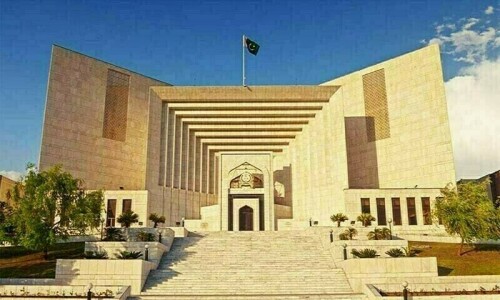
ISLAMABAD: Justice Shahid Bilal Hasan, a member of the Supreme Court’s five-judge constitutional bench, expressed concern on Thursday over the growing overlap between national politics and bar politics. The bench is currently hearing a case involving a seniority dispute among Islamabad High Court (IHC) judges.
Presided over by Justice Muhammad Ali Mazhar, the bench is reviewing petitions from five IHC judges relating to their seniority and the transfer of three judges to the court.
“It’s regrettable that bar politics is now being influenced by national political agendas,” said Justice Hasan. He pointed out that this trend appears to have started with a political party that is now in opposition. He added that such political interference in bar affairs was not the norm in the past.
Justice Hasan addressed senior lawyer Hamid Khan, who is representing the Lahore High Court Bar Association (LHCBA) and Lahore Bar Association (LBA), noting that both associations’ presidents were known members of a political party—and that Mr. Khan himself was a senator for that party.
He also questioned why the Islamabad High Court Bar Association had earlier withdrawn their petitions from the Supreme Court.
In response, Hamid Khan remarked, “If even judges cannot resist external pressure, how can the bar associations do so?” He referred to the IHC judges’ letters alleging interference by intelligence agencies in judicial affairs, and lamented that the suo motu notice taken by the Supreme Court on the matter still remains unresolved. “This delay reflects a weakness in the judiciary,” Khan asserted.
He argued that the Supreme Court should have resolved challenges to the 26th Constitutional Amendment, which has become a legal hurdle in multiple matters.
Khan also read out excerpts from the IHC judges’ letter and reports submitted by other high courts during the suo motu hearing. However, the constitutional bench repeatedly urged him to focus on the constitutional questions at hand, reminding him that the suo motu case was pending before a larger bench. Justice Mazhar advised Khan to file an application if he wanted that matter expedited.
Earlier, senior advocate Muneer A. Malik, representing the five petitioner judges, concluded his arguments, citing a joint statement from the judges. The bench noted the statement was not particularly relevant since the judges were already petitioners in the case.
In their statement, Justices Mohsin Akhtar Kayani, Tariq Mehmood Jahangiri, Babar Sattar, Sardar Ejaz Ishaq Khan, and Saman Riffat Imtiaz emphasized that they were acting in defense of constitutionalism, rule of law, and judicial independence—not for personal gain. They stressed that the contested actions were not just about seniority but about undermining the IHC’s independence and dignity.
They stated that their administrative actions were taken to counter the erosion of judicial independence and its impact on fundamental rights. They called their petition a “last resort.”
Malik also raised several questions for the bench’s consideration, such as whether there exists a proper constitutional mechanism for transferring judges between high courts, and how best to uphold judicial independence, referencing landmark cases like Sharaf Faridi, Malik Asad Ali, and Al-Jehad.
He argued that judicial independence cannot exist if judges are subjected to external pressure. For instance, transferring a judge ranked 16th in seniority to another high court where they would become the senior-most judge undermines the legitimate career expectations of others and threatens institutional integrity.
Lastly, Malik questioned whether judicial transfers could be guided by practices from civil services, to which Justice Mazhar replied that, unlike in civil services, judicial transfers do not require the judge’s consent.