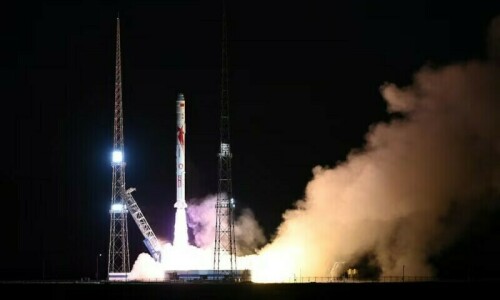

BEIJING – Chinese private space company LandSpace successfully launched an upgraded methane-powered rocket on Saturday, carrying six satellites into orbit and advancing its ambitions to develop reusable launch vehicles.
The Zhuque-2E Y2 rocket lifted off at 12:12pm local time from the Jiuquan Satellite Launch Centre in northwest China. This marks the fifth mission of the Zhuque-2 series, according to a company statement.
LandSpace made history in July 2023 by becoming the first company globally to successfully launch a rocket powered by liquid methane and liquid oxygen, ahead of U.S. competitors such as SpaceX and Blue Origin. Methane has gained traction in recent years due to its cleaner emissions, lower cost, and suitability for reusable rockets.
Saturday’s launch reflects growing demand in China’s commercial space sector, with intensified efforts to develop satellite constellations to rival Elon Musk’s Starlink network. This latest mission delivered six satellites into orbit—an improvement from the previous launch in December 2023, which placed three satellites into space. The inaugural Zhuque-2 mission in 2023 did not carry active payloads.
The updated Zhuque-2E model includes technical enhancements, such as the subcooled propulsion method, where both methane and liquid oxygen are chilled below their boiling points to increase thrust efficiency—a first for LandSpace.
LandSpace CEO Zhang Changwu confirmed the company is now developing reusable rockets, with a test launch expected in the second half of 2025. Reusability, pioneered by SpaceX, is seen as key to reducing costs in the space industry.
Founded in 2015, LandSpace was among the first private Chinese firms to enter the space race following government reforms in 2014 that opened the sector to private capital. It has since attracted significant investment, including backing from venture capital firm HongShan (formerly Sequoia Capital China), Country Garden’s investment arm, and the China SME Development Fund.
In December 2023, LandSpace raised 900 million yuan ($120 million) from a state-owned fund focused on advanced manufacturing. In 2020, it secured 1.2 billion yuan ($170 million) in another major funding round, according to Chinese corporate databases.