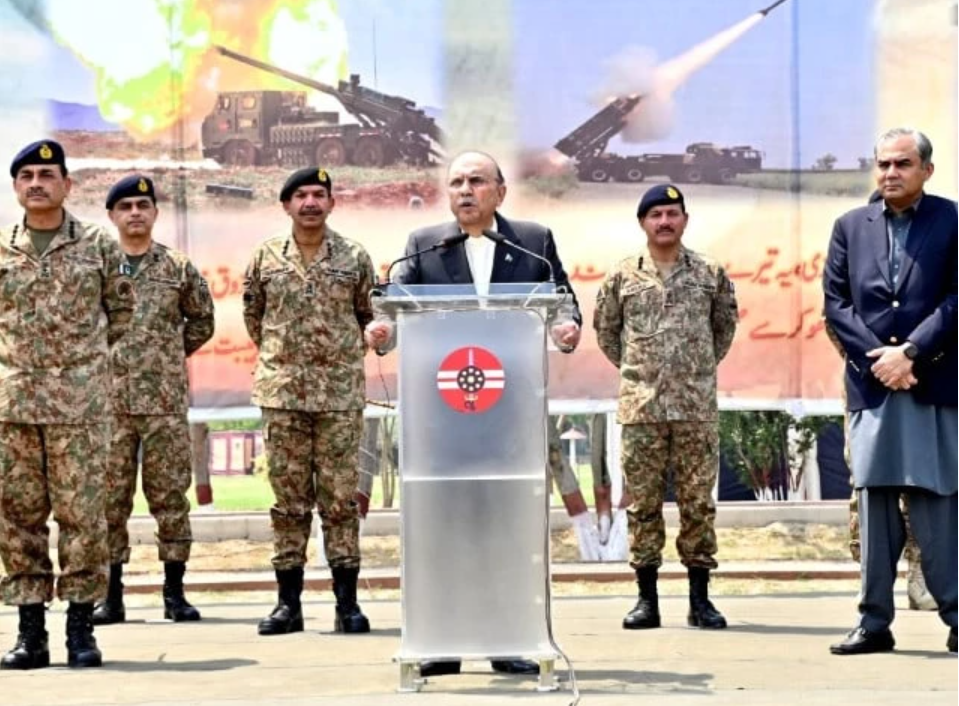
President Asif Ali Zardari commended the Pakistan Armed Forces for their bravery and professionalism in confronting recent hostilities with India. He stated that the “sons of the soil,” driven by patriotic spirit, successfully countered unprovoked Indian aggression with unwavering courage. He also paid homage to the military and civilian martyrs, calling their sacrifices a sacred trust and a symbol of national pride.
During a visit to Gujranwala Cantonment on Saturday, President Zardari praised the armed forces for their outstanding performance in the successful execution of Marka-e-Haq. In a statement issued by the Inter-Services Public Relations (ISPR), he highlighted the armed forces’ resilience and determination in defending the nation.
Zardari honored the sacrifices of those who laid down their lives in defense of Pakistan, reaffirming that their martyrdom holds eternal significance and continues to inspire national unity and pride.
He emphasized that history would record how Pakistan’s military swiftly and decisively repelled aggression, showcasing exceptional precision and resolve, and sending a clear message about the nation’s strength and cohesion.
During his interaction with officers and troops, the President applauded their high morale, combat preparedness, and dedication. He congratulated them on the successful conclusion of Operation Bunyanum Marsoos and expressed deep pride in their role as defenders of the homeland.
He asserted that the people of Pakistan deeply respect and admire their soldiers, whom they regard as the true guardians of national honor and sovereignty.
President Zardari was received at Gujranwala Cantonment by Chief of Army Staff General Asim Munir. He was accompanied by Interior Minister Mohsin Naqvi, with senior commanders from the Mangla and Gujranwala Corps also present.
The President’s visit, along with recent trips by Prime Minister Shehbaz Sharif to military installations, came in the wake of Pakistan’s robust military response to Indian aggression following the Pahalgam attack.
Earlier in the week, President Zardari visited wounded soldiers and civilians at the Combined Military Hospital (CMH) in Rawalpindi, offering words of support and inquiring about their recovery.
Prime Minister Sharif also visited the Pasrur Cantonment and the Pakistan Air Force base in Kamra, where he met with personnel, praised their combat capabilities, and reiterated Pakistan’s unwavering commitment to defending its sovereignty.
Rising Tensions and Ceasefire
The latest escalation between Pakistan and India began on April 22, following a deadly attack in Pahalgam that left 26 people dead. India immediately held Pakistan responsible, a claim Islamabad strongly denied.
On April 23, India responded with a series of aggressive measures: suspending the long-standing Indus Waters Treaty, cancelling visas for Pakistani nationals, closing the Wagah-Attari border, shutting down Pakistan’s High Commission in New Delhi, and reducing diplomatic staff.
Tensions peaked in the early hours of May 7, when missile strikes targeted six cities across Punjab and Azad Jammu and Kashmir, killing scores of civilians, including women and children, and destroying a mosque.
In retaliation, Pakistan’s military shot down several Indian aircraft, including three Rafale jets. The situation intensified further on May 10, when India launched missile strikes against multiple Pakistani airbases. Pakistan countered with Operation Bunyanum Marsoos, which inflicted significant damage on Indian military infrastructure, including missile depots and airbases.
A ceasefire was announced by U.S. President Donald Trump on Saturday evening after urgent diplomatic intervention. The agreement was later confirmed by Pakistan’s Foreign Minister Ishaq Dar and the Indian foreign secretary.