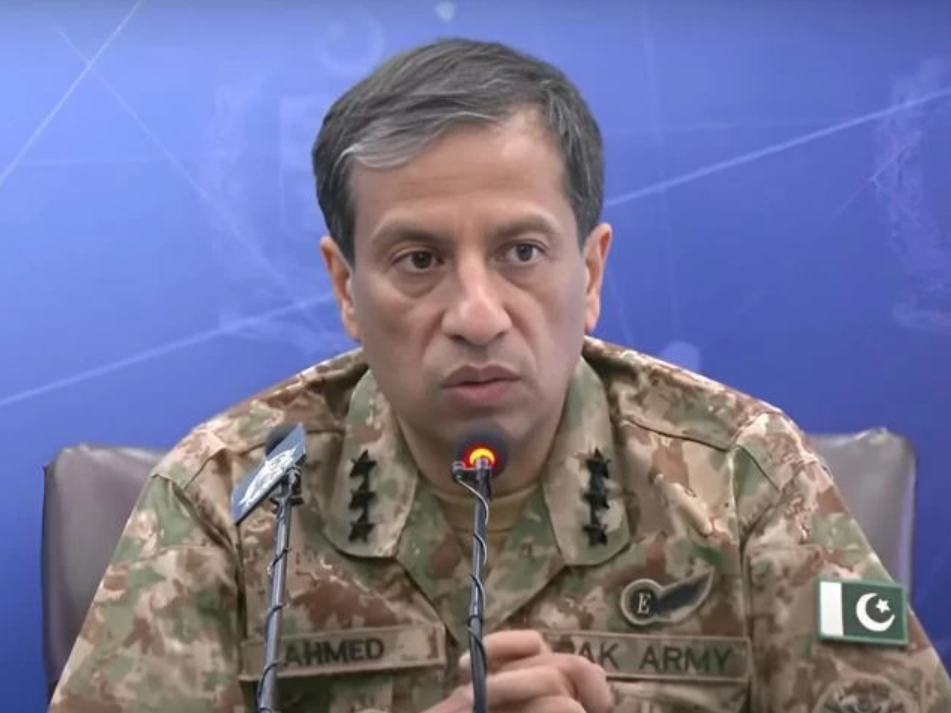
Director General of the Inter-Services Public Relations (ISPR), Lieutenant General Ahmed Sharif Chaudhry, has firmly stated that Pakistan will not accept Indian hegemony, vowing a swift and resolute response to any act of aggression.
In an interview with Anadolu Agency, the military spokesperson emphasized that while Pakistan is committed to peace, it will never be intimidated. “India is not the United States, and Pakistan is not Afghanistan. India is not Israel, and Pakistan is not Palestine,” he said, asserting Islamabad’s sovereignty and readiness to defend itself.
Lt Gen Chaudhry condemned India’s internal policies, particularly those targeting Muslims and Sikhs, which he said are fueling extremism and domestic unrest within India. He made these remarks amid escalating tensions, triggered by India’s unilateral suspension of the Indus Waters Treaty and cross-border strikes earlier this month.
Following an attack on tourists in Indian-occupied Jammu and Kashmir, which India blamed on Pakistan without evidence, India launched airstrikes across the Line of Control (LoC) and deeper into Pakistani territory. In retaliation, Pakistan struck 26 Indian military sites before a U.S.-mediated ceasefire took effect on May 10.
Despite the ceasefire, tensions remain high. Prime Minister Narendra Modi’s recent announcement that India could block Pakistan’s water supply from the Indus River system has been seen by Islamabad as a potential act of war.
In a separate interview with Arab News, Lt Gen Chaudhry warned against such a move, calling it a red line. “Only a madman would think they could cut off water to over 240 million people,” he said. “Should that happen, the world will witness its long-term consequences.”
The ISPR chief confirmed that during the recent conflict, Pakistan shot down six Indian aircraft, including Rafales, a Mirage 2000, and also destroyed a Russian-made S-400 air defense system—surpassing earlier reports of five aircraft losses. Prime Minister Shehbaz Sharif recently verified the sixth downed plane.
“We could have done more damage, but we exercised restraint,” Chaudhry noted.
Looking forward, he stressed that long-term peace cannot be achieved without addressing the core issue of Kashmir. “India’s policy on Kashmir is failing. Without dialogue on Kashmir, the risk of conflict will always be present,” he warned.
Pakistan’s Commitment to Peace
In an interview with RT Arabic, Chaudhry reiterated that Pakistan is not a warmongering nation. “We are a serious, peace-loving people. Peace is always our top priority,” he said.
He revealed that India initiated the ceasefire talks after Pakistan’s retaliatory Operation Bunyan-un-Marsoos, and it was a senior Indian defence official who personally requested the truce. “We welcomed it because we seek peace and stability,” he said, praising Pakistan’s diplomatic efforts during the crisis.
Referring to the events of May 9–10, Chaudhry recounted how India launched more missile strikes overnight to pressure Pakistan. “They misjudged us. Our military and people stood like an unbreakable wall,” he said, adding that Pakistan’s response was measured and strictly targeted military sites without harming civilians.
India’s Allegations and Pakistan’s Offer for a Probe
Commenting on the Pahalgam incident that sparked the recent crisis, Lt Gen Chaudhry accused India of pushing a false narrative. He criticized the immediate blame placed on Pakistan by Indian media, despite their own government admitting days later that investigations were still ongoing.
“Where is the logic in making accusations without evidence?” he asked, noting that Pakistan had offered to participate in a neutral investigation—an offer India rejected. “Instead, they launched missiles at our mosques, killing innocent children, women, and elders,” he said.
Standing Guard Against External Threats
Lt Gen Chaudhry reiterated that safeguarding Pakistan’s sovereignty is a sacred duty of the armed forces—a duty they have fulfilled and will continue to uphold at any cost.
He also reaffirmed Pakistan’s concerns about Indian involvement in supporting terrorism inside its borders. “India is the chief sponsor of terrorism in Pakistan, including groups like the banned Tehreek-e-Taliban Pakistan (TTP),” he said, directly accusing India of backing destabilizing elements, especially in Balochistan.