

By: Hira Ali Malik
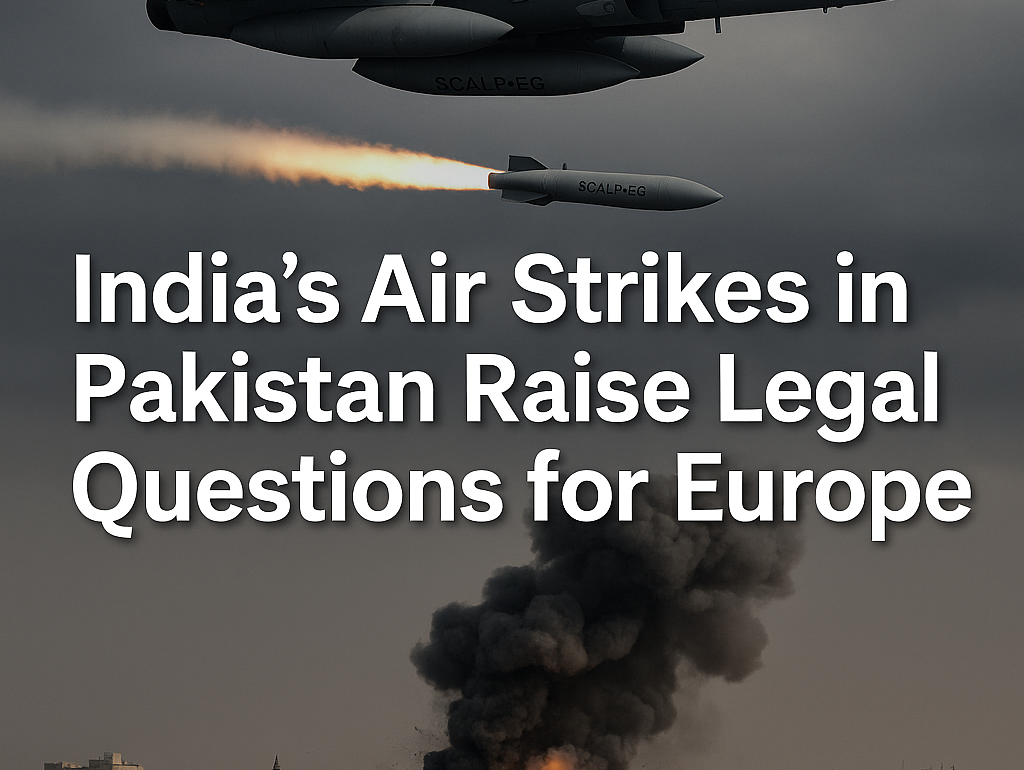
India’s May 7 air strikes in Pakistan’s Punjab and Azad Jammu and Kashmir (AJK) have sparked serious legal and ethical concerns. The attacks, claimed by India to be retaliation for an earlier attack on Indian tourists in Kashmir, targeted areas where civilians—including women and children—were killed or injured, with no evidence linking them to militant groups.
What’s particularly troubling is the reported use of European-made weapons—specifically French SCALP-EG missiles launched from Rafale fighter jets—during these strikes. Evidence in the form of missile fragments and downed aircraft suggests that these European weapons played a role in an operation that resulted in significant civilian casualties.
The European Union’s Common Position 2008/944/CFSP explicitly forbids arms exports where there is a clear risk of serious violations of international humanitarian law (IHL). This includes attacks that target or indiscriminately impact civilian areas. Moreover, the use of European weapons in a volatile region like South Asia raises red flags under EU criteria that consider the potential for regional instability and escalation.
France, as the primary supplier, bears special responsibility. As a party to the Arms Trade Treaty and a major player in EU arms policy, France must ensure that its exports do not fuel conflict or enable IHL violations. Yet, the system’s lack of enforcement mechanisms means that even in cases of civilian deaths, EU states face little pressure to suspend or review existing arms deals.
This situation mirrors broader challenges within EU arms export policy: national governments make final decisions, leaving enforcement fragmented and subject to political or economic interests. Civil society organisations and investigative journalists have often stepped in where EU institutions have remained passive, demanding greater transparency and accountability.
The civilian cost of these strikes—and the broader pattern of regional hostility—warrants an urgent and independent investigation. Beyond determining whether civilian casualties were intentional or proportionate, such an inquiry must also examine the responsibility of European exporters and their governments. It’s not enough to rely on licensing paperwork; actual end-use, especially in conflict-prone regions, must be scrutinised.
Moreover, if verified, the use of EU-origin weapons in these attacks could set a dangerous precedent—undermining the credibility of international arms control norms and eroding the EU’s position as a champion of human rights.
Europe must confront the uncomfortable reality that arms sales to unstable or conflict-prone regions come with serious ethical and legal obligations. National economic interests should never override these obligations, especially when civilian lives are at stake.
The world is watching. It is time for the EU to show that its commitment to human rights and international law extends beyond its borders—and beyond rhetoric.