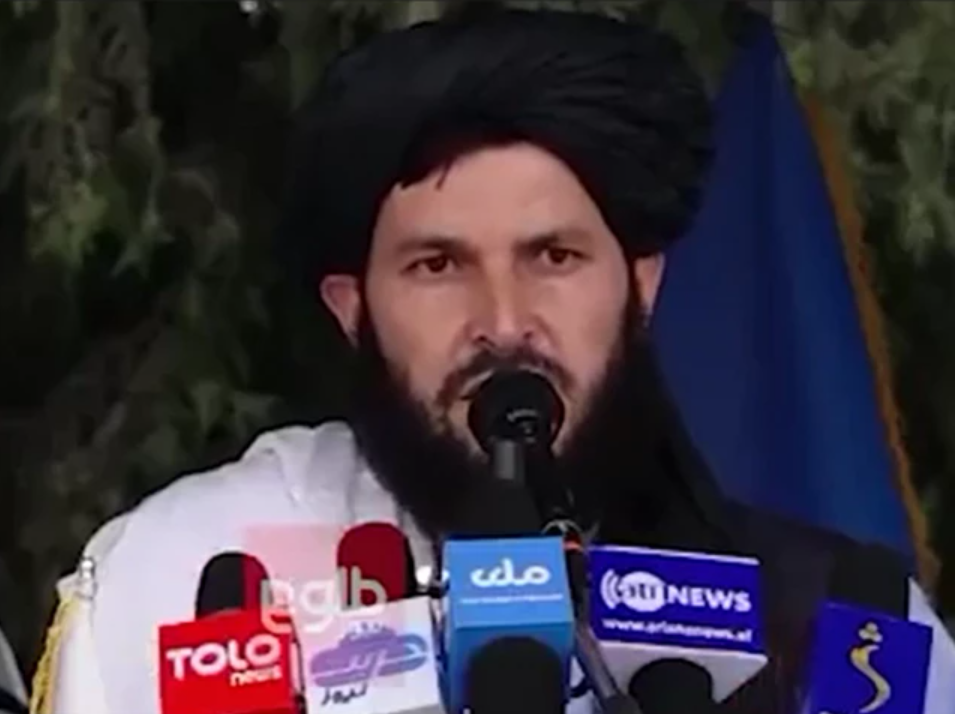
Senior Afghan Taliban commander Saeedullah Saeed has cautioned militant groups against carrying out unauthorized jihad, especially in Pakistan, stating that such actions violate both Shariah law and the directives of the Islamic Emirate leadership.
Speaking at a police graduation ceremony, Saeed stressed that engaging in armed conflict in any country—including Pakistan—without the explicit order of the Amir is forbidden.
“Joining various factions to wage jihad abroad does not make one a true mujahid,” he explained. “Only the state Amir has the authority to declare jihad—not individuals or factions.”
Saeed clarified that those conducting attacks independently or moving across regions to carry out operations cannot be deemed legitimate fighters under Islamic law. “Jihad driven by personal ego or loyalty to a group is considered fasad (corruption), not rightful resistance,” he added.
He also noted that the Afghan leadership has banned unauthorized crossings into Pakistan, warning that such acts are acts of disobedience. “Groups claiming to fight jihad without authorization violate both Shariah and the Afghan Emirate’s authority,” Saeed said.
Security analysts in Pakistan have welcomed this declaration, viewing it as supportive of the country’s counterterrorism efforts, domestic peace, and diplomatic stance.
Defense experts pointed out that India-backed proxy groups operating under the label of Khawarij are involved in terrorism rather than religious struggle, further destabilizing the region.
Meanwhile, while public attention largely focused on Pakistan-India tensions, Islamabad and Kabul quietly worked to improve their strained relationship during this period.
This led to closer cooperation between the two capitals, with the interim Afghan government taking unprecedented steps—such as cracking down on individuals encouraging Afghan nationals to conduct cross-border attacks.
The presence of banned groups like Tehreek-e-Taliban Pakistan (TTP) and others threatening Pakistan had long complicated bilateral ties. However, for the first time, Pakistan witnessed a shift in Kabul’s approach when a delegation led by Special Envoy on Afghanistan, Ambassador Muhammad Sadiq Khan, visited Kabul in March. The delegation was briefed on Kabul’s efforts to curb terrorism crossing the border.
Sources familiar with the closed-door talks said the Taliban showed genuine commitment this time. They confirmed that Afghan Taliban had begun detaining their nationals who had joined or planned to join the TTP. Those involved in recruitment were arrested and prosecuted.
The Taliban government gained Pakistan’s trust after apprehending Afghan nationals who facilitated over 70 militants, mostly Afghan, attempting to infiltrate Pakistan following the Pahalgam attack.
Thanks to Pakistan’s prompt response, all infiltrators were neutralized near North Waziristan in the largest single-day encounter with terrorists since Pakistan’s war on terror post-9/11.