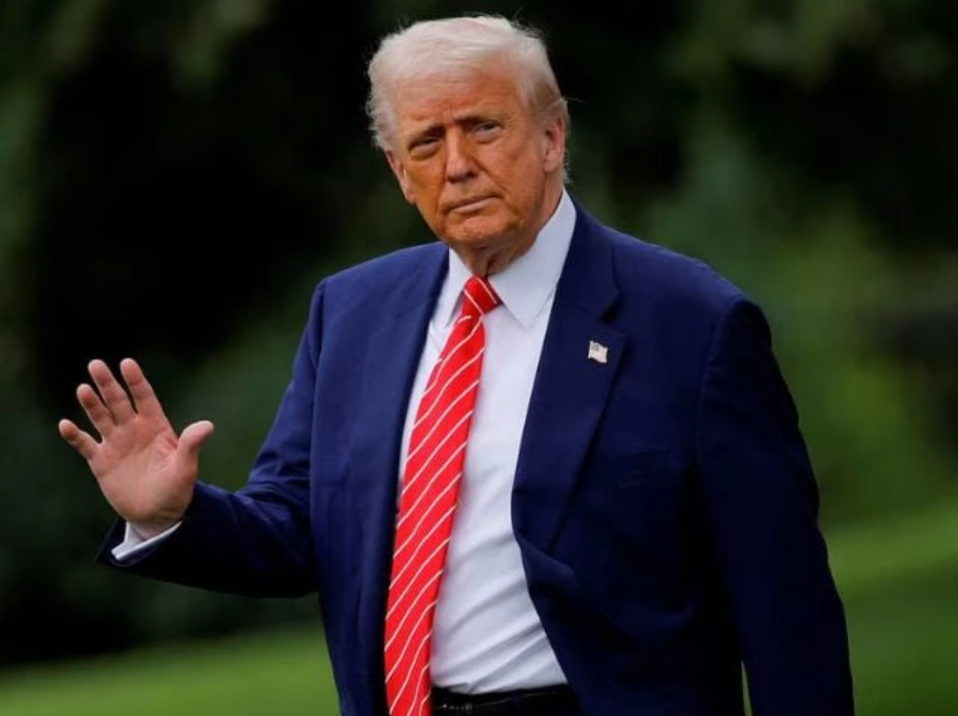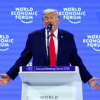
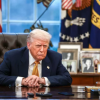
During a joint press conference with German Chancellor Friedrich Merz at the White House on Thursday, U.S. President Donald Trump praised Pakistan’s leadership, calling it “very strong”—a remark he acknowledged might not be popular with some.
The meeting, which marked their first bilateral engagement since Chancellor Merz’s election on May 6, touched on several international issues, including rising tensions between India and Pakistan following a deadly attack in Indian-occupied Jammu and Kashmir on April 22, which left 26 people dead. India blamed Pakistan for the incident without presenting evidence, while Islamabad firmly denied the allegations and called for an impartial investigation.
In the wake of the attack, India suspended the longstanding Indus Waters Treaty (IWT), closed border crossings, and halted trade with Pakistan. Pakistan responded in kind, implementing reciprocal measures such as airspace closures and trade suspensions.
The tit-for-tat escalations culminated in military strikes and air raids, resulting in numerous casualties on both sides. President Trump took credit for de-escalating the volatile situation, emphasizing his role in calming the crisis. “Pakistan has very strong leadership. Some people won’t like when I say that, but it is what it is,” Trump remarked.
He detailed his approach to diplomacy during the crisis, explaining that he spoke directly with key officials from both nations. “I told them, ‘We’re not going to talk trade if you’re shooting at each other or flashing nuclear weapons,’” he said, referencing the looming threat of a broader conflict between the nuclear-armed neighbors.
The situation reached its peak on May 7, when India launched strikes on multiple Pakistani cities and parts of Azad Jammu and Kashmir (AJK), killing civilians and damaging infrastructure. In retaliation, Pakistan’s military shot down several Indian aircraft, including Rafale fighter jets, and intercepted waves of Israeli-made drones.
On May 10, India escalated again by targeting Pakistani airbases. In response, Pakistan launched Operation Bunyanum Marsoos, striking Indian military sites. As tensions threatened to spiral into full-scale war, President Trump’s diplomatic intervention led to a ceasefire agreement, later confirmed by both countries’ foreign ministries.
While Pakistan acknowledged the critical role of Trump, along with support from China and Gulf nations, in brokering the ceasefire, Indian officials played down international involvement, attributing the resolution to direct talks.
Still, Trump remained firm in his narrative, expressing pride in his role. “I got that war stopped,” he said. “Now I hope we don’t go back and find out that they started it, but I don’t think they will.”
Trump commended both nations for their restraint, singling out Pakistan’s leadership once again. “They stopped that war. I was very proud of that,” he said, while also acknowledging Indian leadership. “The leader of India, who’s a great guy, was here a few weeks ago. We had some great talks. We’re doing a trade deal.”
The president’s comments reflect his continued engagement in South Asian diplomacy and underline his efforts to position the U.S. as a stabilizing force in one of the world’s most volatile regions.