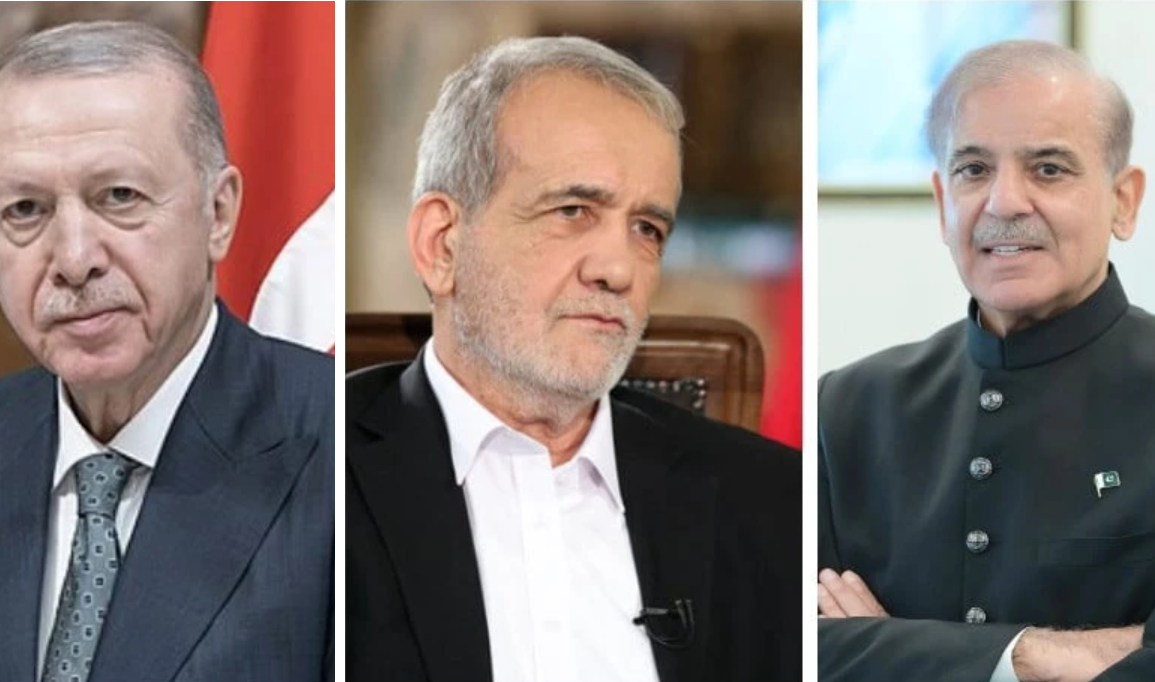
Islamabad – In a series of high-level diplomatic engagements and official statements, Pakistan has strongly condemned Israel’s recent strikes on Iran, labeling them as a blatant violation of international law and a serious threat to regional and global peace. Prime Minister Shehbaz Sharif reaffirmed Pakistan’s solidarity with Iran and called for urgent international intervention to halt Israeli aggression.
The Pakistani premier held separate telephone conversations with Iranian President Dr. Masoud Pezeshkian and Turkish President Recep Tayyip Erdogan, during which he expressed grave concern over Israel’s unprovoked attacks on Iranian territory. Sharif termed the Israeli actions an affront to Iran’s sovereignty and a clear contravention of the United Nations Charter.
“Pakistan stands in resolute solidarity with the brotherly people and government of Iran in the face of this unjustified aggression,” he stated. Sharif reiterated that Iran has the right to self-defense under Article 51 of the UN Charter and recalled Islamabad’s vocal support for Iran during the recent emergency meeting of the UN Security Council.
President Pezeshkian expressed gratitude to Pakistan for its timely support and denounced the U.S. for its alleged complicity in Israel’s actions. “The coordination between the Zionist regime and the United States during negotiations reflects Washington’s dishonesty,” Pezeshkian remarked, warning of a “more severe and powerful response” if attacks continue.
In his call with President Erdogan, PM Sharif stressed the need for collective international action. Both leaders agreed that Israel’s military strikes not only violated Iran’s territorial integrity but also endangered global stability. They denounced Israel’s continued campaign against Palestinians, calling it genocidal and carried out with impunity.
Sharif announced that Deputy Prime Minister and Foreign Minister Ishaq Dar would represent Pakistan at the upcoming OIC Council of Foreign Ministers meeting in Istanbul to formulate a unified Muslim response.
Defence Minister Khawaja Asif echoed similar concerns in Parliament, urging the Muslim world to urgently unite under the banner of the Organisation of Islamic Cooperation (OIC). “The way Israel has targeted Yemen, Iran, and Palestine reveals a broader agenda. If Muslim nations fail to act, each could become a target,” he warned.
He also highlighted the vigilance of Pakistan’s armed forces during recent tensions and praised the role of Pakistani youth in cyber defense efforts. “Our navy’s response during a recent alert forced the enemy to retreat. Meanwhile, our youth delivered a digital blow that surprised the world,” he said, citing disruptions to Indian infrastructure during recent cyber operations.
The crisis escalated when Israel launched a surprise military offensive against Iran, targeting nuclear facilities, ballistic missile factories, and senior Iranian military officials. The attack reportedly killed 78 Iranians, including six nuclear scientists and high-ranking IRGC generals. In retaliation, Iran fired ballistic missiles into central Israel, killing three people and injuring over 90 others.
The strikes devastated areas near Tel Aviv, destroying buildings and prompting the evacuation of hundreds of residents. Iranian and U.S. representatives clashed at the UN Security Council, with Iran accusing Washington of enabling Israeli aggression. The U.S. confirmed it had prior knowledge of the attack but claimed no involvement.
Former U.S. President Donald Trump also weighed in, urging Iran to return to negotiations or risk more severe consequences. “Make a deal before there is nothing left,” he said in an interview, while denying a direct role in the military action.
As tensions continue to rise, Pakistan has reaffirmed its commitment to peace and diplomacy, while calling on the international community — especially the United Nations and the Muslim world — to intervene decisively to halt Israel’s aggressive actions.