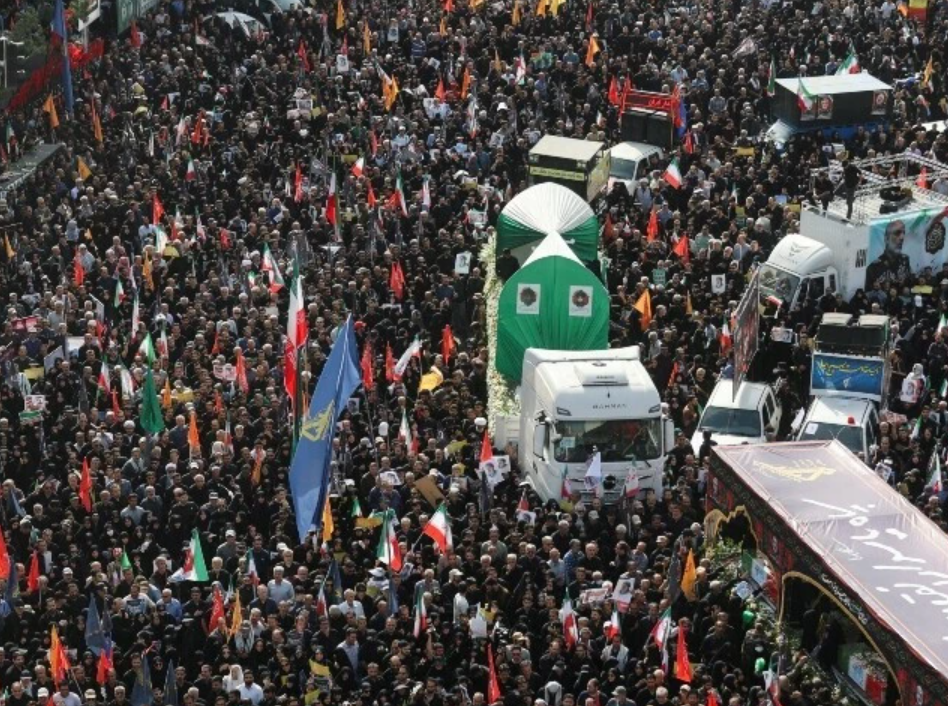

Tehran witnessed a solemn display of national mourning on June 28, 2025, as Iran held a mass funeral for dozens of senior military commanders and officials killed during Israeli airstrikes in a 12-day war that has reshaped the Middle East’s security landscape.
The funeral procession began in Tehran’s iconic Enghelab Square and moved toward Azadi Square—both symbolic locations often associated with major state events. State television broadcast sweeping images of thousands of mourners dressed in black, waving Iranian flags, and carrying portraits of the fallen and of Supreme Leader Ayatollah Ali Khamenei.
Among the 60 high-ranking individuals honoured were:
- Major General Mohammad Bagheri, Chief of Staff of the Iranian Armed Forces
- Major General Hossein Salami, Commander of the Islamic Revolutionary Guard Corps (IRGC)
- Brigadier General Amir-Ali Hajizadeh, head of the IRGC Aerospace Force
Footage showed coffins draped in Iran’s national flag, each marked with the name and rank of the deceased. The fallen were hailed as “martyrs in defence of the nation,” with Supreme Leader Khamenei vowing retaliation and affirming that their sacrifice would not be in vain.
Backdrop: The 12-Day War
The funeral marks the emotional climax of a brief but devastating conflict that erupted on June 13, when Israel launched a surprise offensive targeting Iranian military and nuclear installations. Israeli air forces conducted over 500 strikes, according to ACLED data, with some independent counts estimating 145 combined Israeli and US sorties.
Iran’s Ministry of Health reported 610 fatalities and 4,746 injuries, including women and children. Civilian infrastructure—including hospitals and emergency services—was severely damaged. A two-month-old infant was among the youngest confirmed casualties.
In response, Iran unleashed a wave of retaliatory attacks, firing an estimated 1,000 ballistic missiles and drones at Israeli territory. While the Israeli military claimed to intercept 90% of incoming projectiles, Iranian strikes did hit key targets, including:
- Soroka Medical Center
- Israeli Military Intelligence School
- Ministry of Interior in Haifa
- Energy infrastructure hubs
The US entered the fray on June 22, deploying bunker-buster munitions against Iran’s key nuclear facilities in Natanz, Fordow, and Isfahan. This marked the first time Washington had directly struck Iranian soil since the 2020 assassination of General Qassem Soleimani.
A ceasefire brokered by the US took effect on June 24—just hours after Iran launched missiles at the largest US airbase in the Middle East, located in Qatar.
Fallout and Future Risks
The war resulted in widespread displacement within Iran, with nearly nine million civilians fleeing major urban centers, according to Iranian officials. The north, particularly provinces along the Caspian Sea, became temporary refuges for the displaced.
While the ceasefire holds, tensions remain high. Both Iran and Israel have issued warnings of renewed retaliation in the event of further provocation. The scope and intensity of the conflict—and the high-profile casualties suffered by Iran—suggest that future escalations could be even more destabilising.
Final Thoughts
The funeral procession in Tehran served not only as a farewell to fallen military leaders but as a demonstration of Iran’s national resolve amid unprecedented military losses. The symbolism of the route, the turnout, and the government’s rhetoric all point toward a narrative of resilience and defiance.
At the same time, the sheer scale of destruction and displacement underscores the human and strategic costs of this brief yet brutal confrontation. With the Middle East now on a razor’s edge, the potential for further conflict looms large, even as the international community calls for restraint.