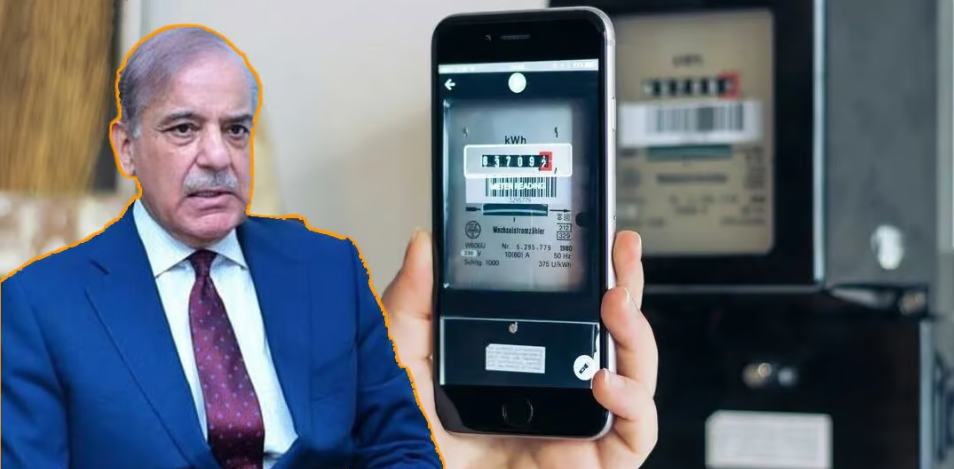
Prime Minister Shehbaz Sharif on Sunday formally launched the ‘Apna Meter, Apna Reading’ smart mobile application — a move designed to increase transparency and accuracy in electricity billing by enabling users to submit their own meter readings.
The initiative marks a shift away from the traditional reliance on meter readers across the country’s power distribution companies (Discos), aiming to address growing public frustration over inflated bills and faulty readings. Under the current system, pro rata estimations often push consumers out of subsidised slabs, leading to significantly higher charges.
At the launch ceremony, PM Shehbaz hailed the app as a “revolutionary step” within the broader framework of ongoing power sector reforms. “We have implemented major changes, but much more remains to be done,” he said. “We introduced merit-based appointments to Disco boards and cracked down on corrupt elements.”
He highlighted successful negotiations with independent power producers (IPPs), which led to a reduction in electricity prices by Rs7.5 per unit, and added that the government took advantage of falling global oil prices to further cut energy costs.
Despite economic pressures, the PM stated, the government made the difficult choice to rebase electricity prices without passing the burden onto consumers. In another key relief measure, he announced the abolition of the Rs35 monthly PTV license fee previously charged through electricity bills.
PM Shehbaz stressed that power theft — estimated at Rs500 billion annually — remains the sector’s most pressing challenge, and reaffirmed his government’s commitment to combating it. He also clarified that the government would continue to encourage solar energy, calling it the most affordable and sustainable electricity option.
“The real beneficiaries of this app are the people,” he said. “It’s a transformative technology that will empower every household.” He urged the Power Division to promote the app’s use nationwide, noting it is available in five languages for greater accessibility.
A Shift Toward Consumer Responsibility
Federal Minister for Energy Awais Leghari also addressed the gathering, stating that the app effectively shifts the responsibility of meter reading from utility staff to consumers. He pointed out that delayed or inaccurate readings often led to excessive bills for low-usage households, especially those consuming under 100 units — commonly classified as “protected consumers.”
Leghari added that the government had returned Rs10 billion in overbilled amounts last year and is working to institutionalise transparency in billing.
According to the Power Division, the app allows users to upload a photo of their meter on a designated date, which will then be used as the official reading for billing. Once a user submits a reading, any subsequent reading taken by a meter reader after the due date will be disregarded — putting billing power firmly in the hands of consumers.
This is particularly significant for households receiving government subsidies. For example, a consumer using 200 units pays around Rs2,330, but crossing into the next slab — even by just one unit — can push the bill up to Rs8,104. Timely submission via the app can help ensure eligible consumers retain their subsidy benefits.
The Power Division described the initiative not merely as a tech upgrade, but a governance reform that puts control back in the hands of citizens. “Consumers will no longer just receive bills — they will help generate them, monitor them, and verify their accuracy,” it said.
By reducing overbilling, human error, and bureaucratic interference, the new system aims to restore consumer trust and streamline power sector accountability.