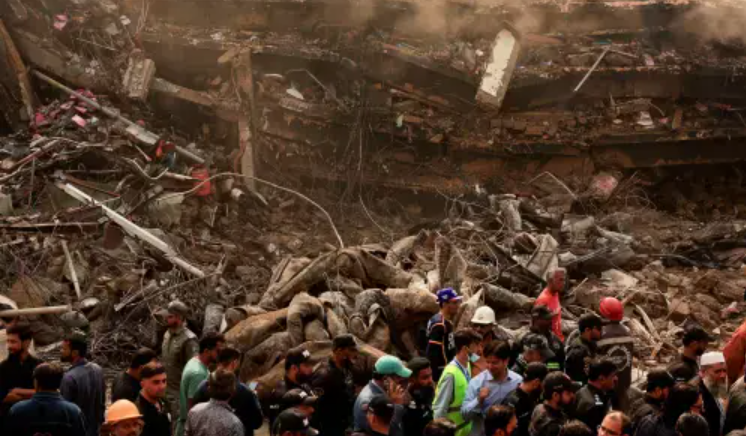

The fire at Gul Plaza, Karachi’s landmark shopping centre, was not an accident. It was a foreseeable tragedy rooted in governance failure. Buildings do not become death traps because rules are unclear; they become death traps because enforcement is deliberately neutralised.
Gul Plaza lacked emergency exits, fire-venting systems, and basic safety measures, despite heavy daily footfall. The question is not whether a short circuit triggered the blaze, but why a building with known safety deficiencies was allowed to operate for decades. The answer lies in institutional decay.
The Sindh Building Control Authority (SBCA) has been weakened by political interference and rapid leadership turnover. Directors-general are rotated frequently, often before they can enforce regulations. Officials who attempt to uphold safety standards are sidelined; those who accommodate violations are rewarded. Over time, neglect becomes normalised, and regulatory safeguards — meant to protect citizens — are rendered meaningless.
This problem is not limited to Karachi. In cities like Hyderabad, Sukkur, and Nawabshah, master plans are ignored, residential plots are converted into commercial hubs, and low-rise areas become high-rises with impunity. Conscientious officers face swift transfers, sending a clear message: rules exist only on paper.
Accountability must reach the top. Policymakers who allow leadership instability in regulatory bodies must be answerable. When governance failures lead to deaths, holding only lower-level officials or building owners responsible is insufficient. Countries that take public safety seriously launch inquiries reaching the highest echelons — why should Pakistan be different?
Trust in institutions is the lifeline of public safety. Entrusting regulatory systems to individuals chosen for obedience rather than competence guarantees substandard outcomes. Development projects, ribbon-cuttings, and high-profile announcements mean little if institutions fail to protect lives.
The Gul Plaza fire should be a wake-up call. Bad governance kills. Institutional decay erodes safety, dignity, and national resilience as surely as any external threat. If accountability and reform do not follow, this will not be the last tragedy. The next “accident” will again claim lives — until society recognises that the real fire lies in the failures of governance itself.