Deemak is arguably the most polarizing Pakistani film of the year. For those who’ve long championed the call to “support local cinema” regardless of a film’s quality, this might seem like a win. Yet, critiquing Rafay Rashdi’s horror-family drama feels almost too easy—if not for the current fragile state of Pakistani cinema.
With minimal competition at the box office—Love Guru being the only other notable Eidul Azha release—Deemak at least attempts something different. For viewers tired of seeing Humayun Saeed and Mahira Khan stuck in the same recycled roles, Deemak is a departure. Rashdi takes a risk by diving into psychological horror, a genre still underexplored in Pakistan, and assembles a star-studded cast including Faysal Quraishi, Sonya Hussyn, and Samina Peerzada—each capable of elevating even a flawed film.
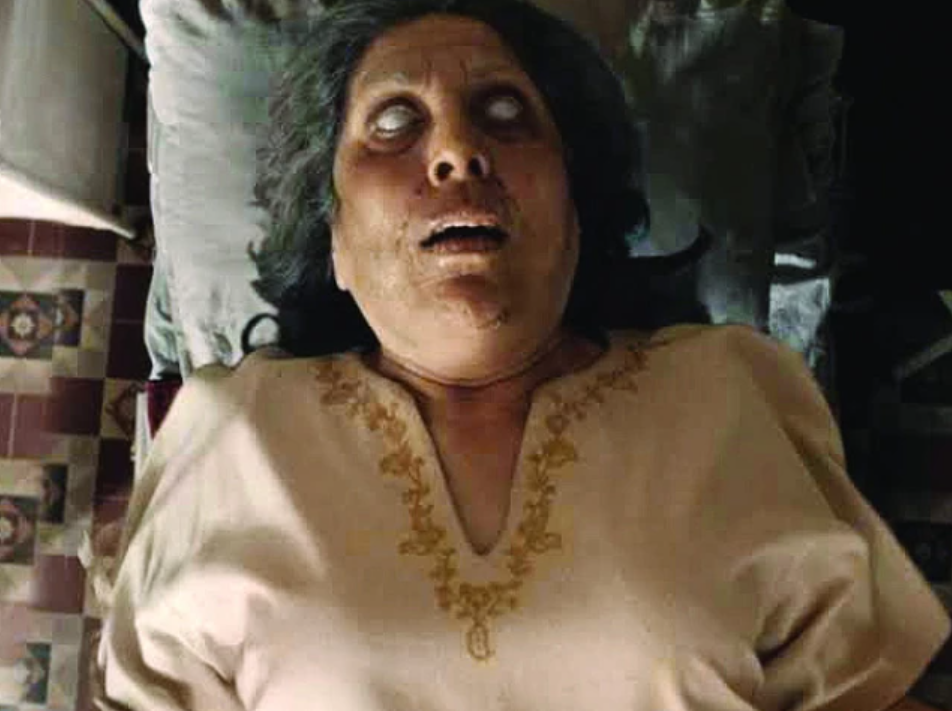
However, what starts as a bold genre experiment soon crumbles under the weight of generic horror tropes and unconvincing visual effects. There are fleeting moments of brilliance—especially in the intense familial dynamics—but they are constantly interrupted by poorly rendered CGI ghosts that feel more laughable than terrifying.
Horror or Hologram?
It’s difficult to tell whether Deemak underestimates its audience’s familiarity with horror or is simply banking on content-starved viewers to show up regardless. The film’s ghosts, rendered with video game-style CGI, are unlikely to convince anyone who has ever seen a basic horror sequence. Ironically, films like Stree 2 have proven that even outrageous special effects can work when paired with self-aware comedy. But Deemak isn’t trying to be funny—its tone is somber and serious, which only makes the hokey supernatural elements feel more out of place.
Stripped of its haunted trappings, Deemak is at its core a layered family drama. The story reimagines the classic saas-bahu conflict as a multi-generational psychological horror, rooted in trauma, control, and inherited pain rather than jump scares.
Samina Peerzada is, without question, the film’s strongest asset. Her portrayal of a tormented, toxic mother-in-law is riveting—at times dominating and cruel, at others frail and calculating. She embodies fear without needing ghosts to back her up.
A Battle of Beauty and Breakdown
Sonya Hussyn plays the suffering daughter-in-law with restrained elegance, but her polished appearance often undercuts the character’s emotional breakdowns. The pressure of stardom—always camera-ready, even in distress—conflicts with her deeper acting potential. But when she breaks free of the glamour, especially in a moment involving rice, curry, and a complete emotional collapse, she transcends. In that raw, grimy scene, she becomes both disturbed and strangely beautiful—a haunting image the film rarely matches elsewhere.
Faysal Quraishi, as Samina’s son and Sonya’s husband, gives a layered performance as a man torn between past trauma and present obligations. The mother-son dynamic taps into memories of The Ghost, the 2008 Pakistani TV adaptation of Danielle Steel’s novel, and showcases Faysal at his most volatile and vulnerable. His torment, shaped more by memory than the paranormal, gives Deemak its most compelling emotional thread.
Too Serious for Camp, Too Shallow for Horror
These deeply emotional performances make it clear: Deemak was never meant to be a comedy-horror. Yet, the film leans on campy horror conventions—floating bodies, melodramatic exorcisms, and overstated exposition—that sit awkwardly beside its serious tone. Instead of trusting its themes of grief and control to carry the narrative, the film clings to clichés, possibly out of fear of alienating viewers.
It’s not the lack of scares that’s disappointing—few horror films are truly frightening—but the way Deemak clings to the wrong tools. Rather than use subtlety, suggestion, or cultural nuance, it attempts to force horror into a shape it can’t quite fill. Pakistani audiences, well-versed in the spiritual and the unseen, don’t need ghosts rendered in pixels to feel disturbed.
By trying to make everything explicit, the film undercuts its most powerful asset: ambiguity. There’s only so much that can be explained in a two-hour runtime before the story begins to feel bloated and dull.
A Strong Cast in a Weak Shell
By the end of Deemak, the performances by Faysal, Samina, and Sonya are undeniably strong, supported by impressive work from child actors and notable appearances by Bushra Ansari, Javed Sheikh, and Saman Ansari. The film has a solid emotional foundation—but it’s buried under layers of ill-fitting visual horror.
In the end, Deemak doesn’t fail because it lacked potential—it fails because it couldn’t decide what to do with it. A ghost story, yes, but one ultimately haunted by its own unfulfilled promise.