“Premature blame served as a justification for unlawful military actions, including cross-border strikes.”
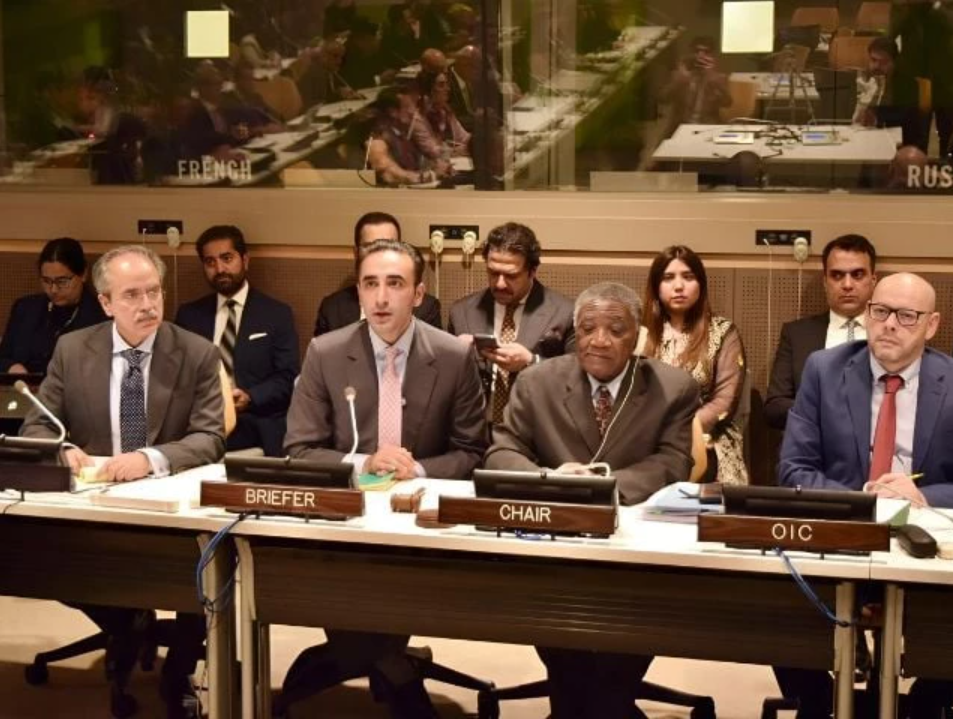
A high-level parliamentary delegation, led by Pakistan People’s Party Chairman Bilawal Bhutto Zardari, updated the Organization of Islamic Cooperation (OIC) member states at the United Nations about serious developments in South Asia following India’s military aggression and unfounded accusations against Pakistan after the Pahalgam attack.
Speaking to OIC Permanent Representatives, Bilawal Bhutto firmly rejected India’s attempt to implicate Pakistan in the Pahalgam incident without any credible investigation or evidence. He stressed that the rushed blame was exploited as a pretext for illegal military operations, including cross-border attacks targeting civilians and civilian infrastructure.
He expressed deep concern over India’s unilateral suspension of the Indus Waters Treaty, which Pakistan views as a deliberate weaponization of water resources and a breach of international and treaty obligations. Bilawal warned against normalizing such actions.
Highlighting India’s aggressive posture, he noted that it has made the world less secure, with significant repercussions for peace and stability in South Asia. Bilawal reaffirmed Pakistan’s commitment to peace, restraint, and diplomacy, urging the restoration of the Indus Waters Treaty, adherence to the ceasefire, and the resumption of comprehensive dialogue with India centered on resolving the Jammu and Kashmir dispute.
He praised the OIC as a vital moral authority during these challenging times and thanked member states for their steadfast support for the people of Jammu and Kashmir. Bilawal reiterated that the Kashmir issue remains central to achieving lasting peace in the region.
The OIC Permanent Representatives expressed appreciation for Pakistan’s transparent briefing and renewed their solidarity with Pakistan and Kashmiris. They voiced concern over the deteriorating security environment in South Asia and emphasized the need to uphold the UN Charter, international law, and treaty sanctity, including the Indus Waters Treaty.
The OIC members welcomed Pakistan’s dedication to dialogue and diplomacy in resolving disputes, including the Kashmir conflict, in line with UN Security Council resolutions.
As part of Pakistan’s diplomatic campaign against India’s recent military escalation, two multi-party delegations were dispatched to key world capitals starting June 2. Bilawal Bhutto Zardari’s delegation engaged with China and Russia’s UN ambassadors in New York.
Following directives from Prime Minister Shehbaz Sharif, these delegations are touring New York, Washington, London, Brussels, and Moscow to brief global leaders, officials, parliamentarians, think tanks, media, and diaspora communities on Pakistan’s position.
Bilawal, leading a nine-member delegation of parliamentarians and former diplomats, began his two-day New York visit with an interview on an international news channel, followed by meetings with China’s UN Permanent Representative Fu Cong and Russia’s Vassily Nebenzia.
China’s Support
Bilawal thanked China for backing Pakistan amid the conflict with India and updated the Chinese ambassador on Pakistan’s responsible conduct following the April 22 attack in the Indian Illegally Occupied Jammu and Kashmir (IIOJK) resort of Pahalgam.
He highlighted India’s refusal of Pakistan’s offer for a transparent and impartial investigation into the attack, underscoring that resolving the Kashmir dispute is essential for lasting peace in South Asia. The delegation called on China to play a constructive role in this process.
Expressing serious concerns over India’s targeting of Pakistani citizens during the four-day conflict, the delegation urged the international community to shift focus from managing conflicts to resolving disputes.
Both sides agreed on opposing unilateral actions and aggression, emphasizing respect for the UN Charter, international laws, and agreements, and condemning India’s weaponization of water.
The delegation included Dr. Musadik Malik, Sherry Rehman, Hina Rabbani Khar, Engr Khurram Dastgir Khan, Faisal Subzwari, Bushra Anjum Butt, Ambassador (retd) Jalil Abbas Jilani, and Ambassador (retd) Tehmina Janjua.
Briefing Russia
The delegation informed Russia’s UN ambassador about the situation post-Pahalgam attack, rejecting India’s baseless allegations against Pakistan and condemning India’s premature and unilateral suspension of the Indus Waters Treaty.
They highlighted Pakistan’s restrained and lawful response aimed at maintaining regional peace and preventing escalation. The delegation noted Pakistan’s suffering from terrorism, with over 80,000 civilian casualties, and detailed India’s sponsorship of terrorism within Pakistan.
They stressed that lasting peace depends on a just and peaceful resolution of the Jammu and Kashmir dispute in accordance with international law.
Humanitarian Concerns
Climate Change Minister Musadik Malik highlighted the humanitarian impact of India’s suspension of the Indus Waters Treaty. The delegation reiterated Pakistan’s mature approach and commitment to peace, dialogue, and regional stability.
In earlier remarks, Bilawal emphasized Pakistan’s pursuit of peace “with dignity, strength, and diplomacy,” condemning India’s actions after the Pahalgam attack as dangerous and violations of international law.
“No durable solution is possible without resolving the Jammu and Kashmir dispute,” he said, urging that the current ceasefire must pave the way to permanent peace through a resolution aligned with UN Security Council resolutions and the aspirations of Kashmiris.
He warned that India’s unilateral suspension of the Indus Waters Treaty sets a dangerous precedent threatening regional peace and security.
Bilawal called on the international community to facilitate dialogue between Pakistan and India, affirming Pakistan’s readiness to discuss Kashmir, the treaty, and terrorism.
He reiterated that Pakistan has been a victim of terrorism affecting all sectors of society, and while India committed blatant aggression by violating international borders, Pakistan’s response was one of self-defense.
Diplomatic Engagements in the US
On Tuesday, the Pakistani delegation held meetings with US lawmakers, think tanks, and media, with talks scheduled with US Secretary of State Marco Rubio.
These visits aim to present Pakistan’s perspective on recent Indian aggression. The Foreign Office stated the delegations would meet with leaders of international organizations, officials, parliamentarians, think tanks, media, and diaspora groups.
They will emphasize Pakistan’s responsible conduct and call for peace through dialogue rather than confrontation, urging the international community to actively promote lasting peace in South Asia. The restoration of the Indus Waters Treaty will be a key topic.
Response to Indian Statements
Addressing media queries about hostile remarks by Indian leaders and their foreign ministry spokesperson, the Foreign Office spokesperson said facts cannot be overshadowed by empty rhetoric.
The spokesperson described recent Indian statements as reflecting a mindset that favors hostility over peace. Attempts to portray Pakistan as the source of regional instability are detached from reality.
The international community is well aware of India’s record of aggression, including documented support for terrorism in Pakistan, and such facts cannot be hidden by hollow narratives or diversion tactics.
The spokesperson reaffirmed that the Kashmir dispute remains the central issue, and Pakistan will persist in advocating a just and lasting resolution consistent with UN Security Council resolutions and Kashmiri aspirations.
Avoiding this core issue risks ongoing mistrust and potential conflict. Recent weeks have underscored the futility of jingoism and coercion.
India will not achieve its objectives through threats or force, and Pakistan remains resolute in defending its sovereignty and territorial integrity.
Sustainable peace in South Asia requires maturity, restraint, and addressing root causes rather than pursuing narrow political goals at the expense of regional harmony, the spokesperson concluded.