ISLAMABAD:
Former Foreign Minister Bilawal Bhutto Zardari stated on Tuesday that if Pakistan’s and India’s leading intelligence agencies—ISI and RAW—collaborated closely, it could lead to a significant reduction in terrorist activities in the region.
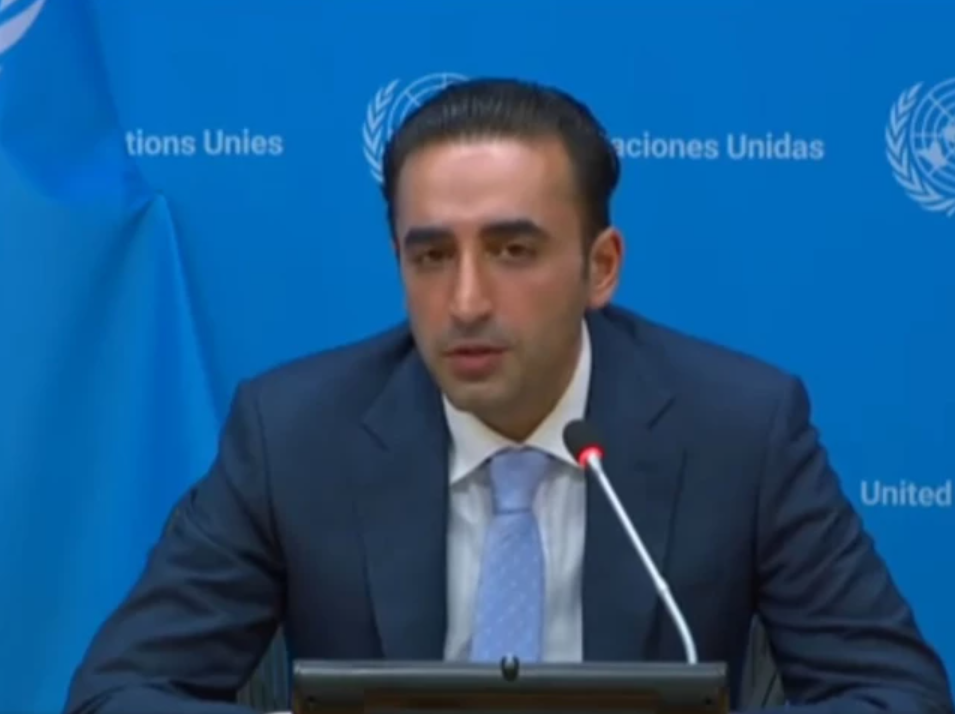
Speaking at a press conference in New York, where he is leading a multi-party delegation to present Pakistan’s perspective on the recent tensions with India, Bilawal described the ceasefire between the two nations as a “welcome first step,” though he emphasized it was only an initial move toward peace.
Bilawal’s remarks came just before his departure for Washington, where the delegation plans to meet with senior US officials and lawmakers. At the United Nations, he held discussions with ambassadors from Security Council member states including the US, France, and the current UNSC president, Guyana.
Instead of engaging in accusations and counteraccusations over terrorism, Bilawal advocated for cooperation between Pakistan and India to tackle the issue jointly. “I am confident that if ISI and RAW work together to fight terrorism, we would see a marked decline in attacks in both countries,” he said.
He highlighted that Pakistan has suffered more from terrorism than India, with a greater number of casualties. “When comparing victims, Pakistan has borne a heavier toll,” he noted.
Bilawal condemned India’s May 7 strikes inside Pakistan, calling them violations of the UN Charter and international law. He described the attacks as targeting civilian infrastructure, including places of worship, dams, and energy facilities, which caused civilian casualties, including women and children.
He rejected India’s so-called “new normal” doctrine as “new abnormal,” cautioning against allowing non-state actors and terrorists to dictate the fate of the region, especially between two nuclear-armed neighbors.
Bilawal accused India of using the April 22 Pahalgam attack in Indian Illegally Occupied Jammu and Kashmir (IIOJK) as a pretext for aggression. He said India refused Pakistan’s offer for a joint investigation and instead launched attacks on Pakistani territory.
In response, Pakistan acted in self-defense, shooting down six Indian aircraft, he stated. “Pakistan condemns terrorism in all forms and remains willing to cooperate with India to combat it.”
He credited the international community—especially US President Donald Trump and Secretary of State Marco Rubio—for helping secure the ceasefire but warned the risk of full-scale conflict remains high. Bilawal urged the global community to continue advocating for dialogue and diplomacy, calling these the only paths to lasting peace.
He stressed the unresolved Kashmir issue before the UN Security Council as the root cause of the conflict. “Ignoring this will leave the conflict between India and Pakistan unresolved,” he said.
Bilawal called for a mechanism allowing both countries to present complaints in a mutually agreed forum, cooperate in tracking terrorists, and ensure justice. He also warned that threats to cut Pakistan’s water supply would be seen as an act of war.
As part of Pakistan’s diplomatic efforts, two delegations are touring world capitals to explain Pakistan’s stance on India’s recent actions following the Pahalgam attack. Bilawal leads a nine-member team to the US, while another delegation, headed by Special Assistant to the Prime Minister Tariq Fatemi, is visiting Moscow and recently met Russian Foreign Minister Sergey Lavrov.
At the UN, the Pakistani delegation met with representatives from UNSC members—including close Indian allies—and briefed them on the heightened security tensions after India’s military actions and unilateral steps.
On Tuesday, meetings included the US, Guyana (the UNSC president for June), France, and the Organisation of Islamic Cooperation (OIC). The meeting with the French ambassador was particularly notable given the Pakistani Air Force’s recent downing of French-made Rafale jets during the May 6-7 clashes.
Ambassador Jerome Bonnafont met the Pakistani delegation, where Bilawal highlighted the consequences of India’s baseless blame on Pakistan for the Pahalgam attack, which was done without credible evidence or investigation.
The delegation briefed the French envoy on India’s military aggression violating international law and threatening regional stability. Bilawal condemned the strikes on civilians, damage to infrastructure, and India’s suspension of the Indus Waters Treaty (IWT). He warned that attempts to impose a “new normal” of arbitrary strikes could have severe consequences in a nuclear region.
Bilawal reiterated Pakistan’s commitment to eradicating terrorism, including that supported by India, and called for a peaceful resolution of the Kashmir dispute according to UNSC resolutions. He urged France to help ensure a sustained ceasefire, revive the IWT, and initiate comprehensive dialogue between Pakistan and India.
The French ambassador expressed support for regional peace and bilateral dialogue, stressing restraint, diplomacy, and adherence to international obligations.
Members of the parliamentary delegation, including Hina Rabbani Khar, Sherry Rehman, Dr. Musadik Malik, Khurram Dastgir Khan, Jalil Abbas Jilani, Tehmina Janjua, Bushra Anjum Butt, and Syed Faisal Subzwari, were also present.
The Pakistani delegation planned to arrive in Washington later on Tuesday to meet Secretary of State Marco Rubio, officials, lawmakers, and think tanks through June 6, before traveling to London and Brussels.
Meanwhile, in Moscow, SAPM Fatemi conveyed Prime Minister Shehbaz Sharif’s message to President Vladimir Putin during a meeting with Foreign Minister Lavrov. Fatemi reaffirmed Pakistan’s commitment to strengthening bilateral ties in energy, connectivity, and trade, and briefed Lavrov on the risks of escalating tensions in South Asia, especially regarding India’s suspension of the IWT.
Lavrov expressed satisfaction with growing cooperation and key projects like new steel mills and connectivity initiatives. He also highlighted Russia’s desire to deepen collaboration with Pakistan within the Shanghai Cooperation Organization (SCO), particularly on counter-terrorism.
Regarding Pakistan-India relations, Lavrov emphasized Russia’s support for normalizing ties between the two countries, recognizing the positive effects on regional stability.