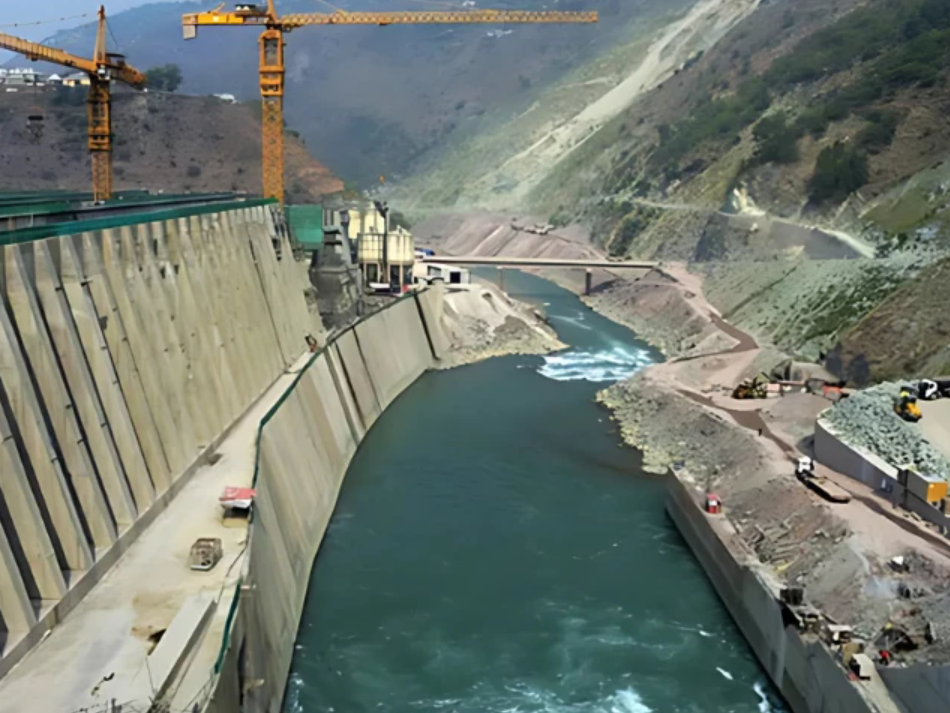
China is expediting work on Pakistan’s Mohmand Dam following India’s recent threat to halt water flows under the Indus Waters Treaty, according to a report from the South China Morning Post.
Located in Pakistan’s Khyber-Pakhtunkhwa province, the Mohmand Dam is a key initiative within the China-Pakistan Economic Corridor (CPEC), a central part of Beijing’s broader Belt and Road Initiative. Pakistani officials have labeled it a “flagship” project, underscoring its strategic importance.
Chinese state broadcaster CCTV reported that concrete filling at the site has reached a crucial milestone, marking a significant acceleration in the dam’s construction. Originally slated for completion by 2026, the project is being built by China Energy Engineering Corporation, a state-owned firm, and has been underway since 2019.
This construction push comes amid growing India-Pakistan tensions. In response to the recent Pahalgam incident, New Delhi has reportedly suspended the World Bank-mediated Indus Waters Treaty, which governs water sharing between the two countries. China’s decision to fast-track the dam project is widely seen as a strategic move to bolster Pakistan’s water infrastructure in light of these developments.
The Mohmand Dam is a multipurpose project designed to provide flood control, irrigation, hydropower, and drinking water. Once completed, it is expected to generate 800 megawatts of electricity and deliver 300 million gallons of potable water daily to Peshawar.
Beyond the Mohmand project, China and Pakistan are expanding cooperation in other sectors such as industrial development, agriculture, and public welfare. One of their other major infrastructure collaborations—the Diamer-Bhasha Dam, often referred to as Pakistan’s “Three Gorges Project”—remains another cornerstone of their strategic partnership.
China’s decision to accelerate work on the Mohmand Dam highlights the evolving geopolitical dynamics in South Asia, where water security is becoming a key element of regional influence and strategic alignment.