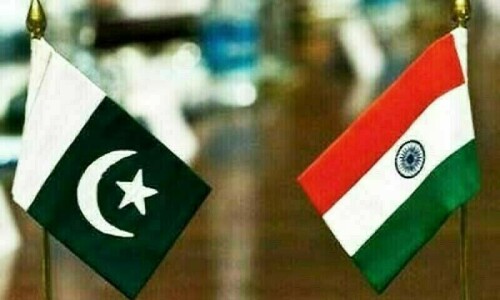

After clashing on the battlefield, Pakistan and India are now locked in a diplomatic contest, each sending high-level delegations to major world capitals to present their respective perspectives on the recent hostilities.
Prime Minister Shehbaz Sharif arrived in Turkiye on Sunday, kicking off a four-nation tour that will also take him to Iran, Azerbaijan, and Tajikistan. Meanwhile, current and former lawmakers and diplomats are preparing to visit the US and Europe.
There are reports that former foreign minister and PPP chairman Bilawal Bhutto-Zardari might lead one of these delegations. The group heading to the US is slated to meet with the UN secretary general, American lawmakers, and engage with think tanks and media outlets in Washington, DC. On the Indian side, a team led by lawmaker and former UN official Shashi Tharoor has already visited the US as part of New Delhi’s lobbying efforts.
Personal interactions are critical in diplomacy, which explains why the prime minister himself is heading delegations to friendly regional nations.
At the same time, experienced senior lawmakers are being sent to the US to present Pakistan’s viewpoint. In the current scenario, Pakistan has compelling arguments to make. Despite India’s efforts to shape the narrative, the reality is that New Delhi was quick to blame Pakistan for the Pahalgam attack—without providing any proof. India has yet to share any evidence of an alleged Pakistani role with either Islamabad or the international community.
Moreover, India initiated hostilities with Operation Sindoor, to which Pakistan responded defensively through Operation Bunyanum Marsoos. Such reckless actions in a nuclear-armed region highlight a deeply irresponsible approach by India.
Additionally, India’s threats to abrogate the Indus Waters Treaty unilaterally violate a binding bilateral agreement. By threatening to cut off Pakistan’s water supply, India is stoking a new source of tension in South Asia. Pakistan’s diplomatic teams abroad must highlight these critical issues.
While Pakistan must defend itself on the diplomatic front as resolutely as it does militarily, real peace in the region can only be achieved through dialogue between both countries.
Currently, India appears reluctant to engage in negotiations, as nationalist elements within its ruling party and media have stirred up war hysteria and anti-Pakistan sentiment. However, in the long term, without a formal peace process, the region risks sliding into deeper conflict.
New Delhi may reject foreign mediation in its disputes with Pakistan—as seen in its over-the-top reaction to Donald Trump’s mediation claims—but if tensions escalate to the point of talk about nuclear conflict, the global community is unlikely to stand by idly.