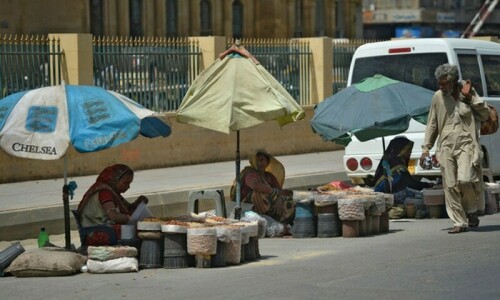
The revelation by the World Bank that nearly 45% of Pakistan’s population now lives below the poverty line should raise alarm — but not surprise. Even more sobering is the reported jump in extreme poverty, rising from 4.9% to 16.5%. These figures are based on the 2018–19 household income survey — the last of its kind conducted by Pakistan. They do not account for the profound economic and humanitarian damage caused by the 2022 floods or the punishing inflation of the last two years. One can only imagine how much worse the reality has become since.
While the World Bank clarifies that this statistical surge is primarily due to an update in global poverty thresholds — not necessarily a deterioration in Pakistan’s economic fundamentals — the context remains grim. According to the Bank, 82% of the increase can be attributed to these updated poverty benchmarks, while the rest reflects actual price increases in the economy between 2017 and 2021. But the poverty trend itself, it warns, remains unchanged.
In other words, the problem is real, enduring, and deepening.
Pakistan’s failure to conduct updated household surveys since 2019 reflects a worrying disinterest in confronting uncomfortable truths. An ongoing poverty and resilience assessment by the World Bank, expected in September, may provide the much-needed data to map the trajectory of poverty and inequality across various regions. But data alone cannot change outcomes. Without robust policy action, worsening conditions are inevitable.
The erosion of household incomes due to stagnant economic growth, surging inflation, climate-induced disasters, and shrinking development budgets is driving more and more families to the edge. The line between the “poor” and “non-poor” is becoming dangerously thin.
Yet, this trajectory is not irreversible. There is still time — and opportunity — to mitigate the damage through well-designed, targeted interventions. Conditional cash transfers, nutritional support, employment guarantees, and investments in health and education are all tools within the government’s reach. But they require more than bureaucratic procedures — they demand political courage, intergovernmental coordination, and a serious commitment to inclusive growth.
Pakistan would do well to study examples like China, which lifted hundreds of millions out of poverty through focused governance, rural development, and a long-term vision. Our challenge may differ in scale, but the principles of success remain the same: deliberate action, institutional accountability, and unwavering political will.
Ignoring this crisis is not an option. The human cost is too great, and the socioeconomic consequences will be lasting. Pakistan must act now — not just to count the poor, but to change their future.