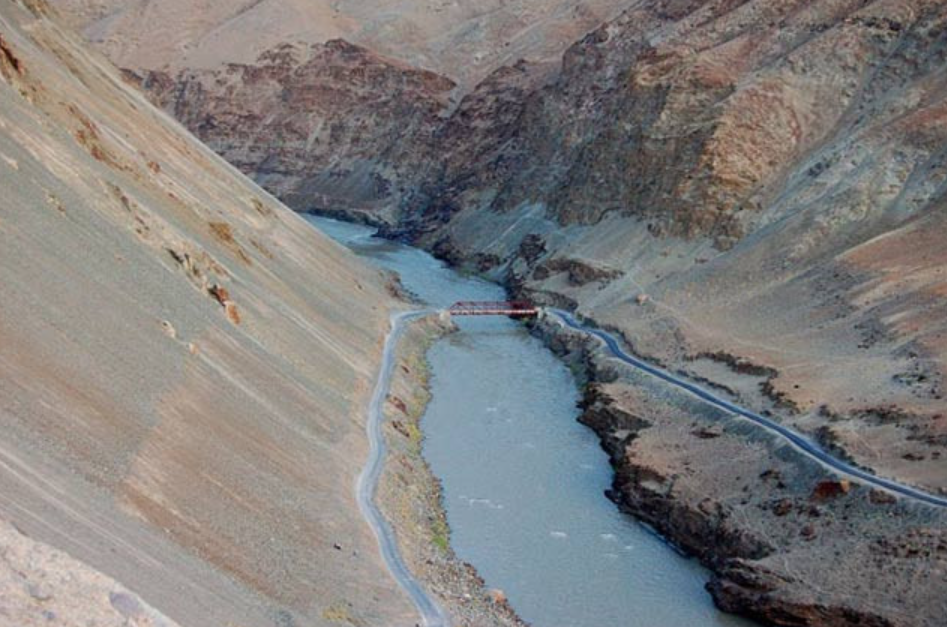
Modi government considers Chenab canal expansion and new storage sites, raising alarm in Pakistan
NEW DELHI/ISLAMABAD: India is weighing plans to significantly increase its use of water from the Indus River system—particularly from the Chenab River—by expanding an age-old canal and constructing new water storage facilities, according to sources familiar with the discussions.
These developments come after New Delhi unilaterally suspended participation in the 1960 Indus Waters Treaty (IWT), following a deadly attack in Indian Illegally Occupied Jammu and Kashmir (IIOJK) that killed 26 civilians. India, without presenting evidence, blamed Pakistan for the incident—an accusation Islamabad strongly denied.
Despite a ceasefire agreement last week between the nuclear-armed neighbours after their most intense fighting in decades, the treaty remains suspended, and India’s strategic water infrastructure planning appears to be accelerating.
Sources told Reuters that in April, Indian Prime Minister Narendra Modi instructed officials to fast-track projects on the Chenab, Jhelum, and Indus rivers—all of which are primarily designated for Pakistan’s use under the IWT.
A key project under review involves doubling the length of the Ranbir Canal on the Chenab River from 60 km to 120 km. Originally constructed in the 19th century, the expanded canal would enable India to divert 150 cubic meters of water per second—up from the current 40 cubic meters—according to official documentation. This move could take years but would mark a significant shift in regional water dynamics.
While India is allowed limited irrigation use from the Chenab under the treaty, such a dramatic expansion raises concerns over its long-term intentions. Discussions over the Ranbir project reportedly began last month and are ongoing despite the ceasefire.
Neither India’s water and foreign ministries nor the Prime Minister’s Office responded to Reuters’ queries. Pakistan’s Foreign Ministry has yet to issue an official statement, though Foreign Minister Ishaq Dar told parliament that Islamabad considers the treaty legally binding and has formally protested India’s suspension of it.
Water expert David Michel of the Washington-based Center for Strategic and International Studies noted that such large-scale water diversion or dam construction would take several years, even if initiated now.
With nearly 80% of Pakistan’s agriculture dependent on the Indus system and much of the country’s hydropower relying on its flow, Islamabad has warned that any attempt to block or redirect this water would be considered an “act of war.”
Despite enduring wars and deep-rooted hostilities, the Indus Waters Treaty has been regarded as a rare success in bilateral cooperation. It restricts India mainly to low-impact hydropower development on the rivers allocated to Pakistan.
However, internal Indian documents and interviews with officials suggest that Delhi is not only considering expanding the Ranbir Canal but also exploring ways to redirect flows from the Indus, Chenab, and Jhelum rivers into Indian territory, particularly to three northern states.
One government note, seen by Reuters, proposes distributing river water across Indian regions for irrigation. Meanwhile, a list created by India’s power ministry outlines plans to boost hydropower capacity in IIOJK from 3,360 megawatts to 12,000 MW. These prospective projects include India’s first large-scale dams capable of storing significant water volumes on Indus tributaries—particularly on the Chenab and Jhelum.
In response, Pakistan is preparing to initiate legal proceedings in multiple international forums, including the World Bank (which originally facilitated the IWT), the Permanent Court of Arbitration, and the International Court of Justice in The Hague.
Indian Objection to IMF Loan
Further escalating tensions, Indian Defence Minister Rajnath Singh urged the International Monetary Fund (IMF) to reconsider a $1 billion loan to Pakistan, claiming the country was “funding terror”—a charge Islamabad categorically rejected.
“Providing financial aid to Pakistan is tantamount to supporting terrorism,” Singh told personnel at an air force base in western India.
Pakistan’s Foreign Office responded sharply, calling the appeal a reflection of Indian “frustration and desperation.” Foreign Office spokesperson Shafqat Ali Khan said, “India was the only country to oppose the IMF programme, and it failed. Criticizing a global financial institution like the IMF only highlights India’s growing anxiety.”
Last week, the IMF approved Pakistan’s loan programme review, releasing the long-anticipated $1 billion payment despite Indian objections.