WASHINGTON:
PPP Chairman and former Foreign Minister Bilawal Bhutto-Zardari warned on Thursday that any attempt by India to unilaterally cut off Pakistan’s water supply would be considered an act of war, cautioning that such actions could lay the foundation for the world’s first nuclear conflict over water.
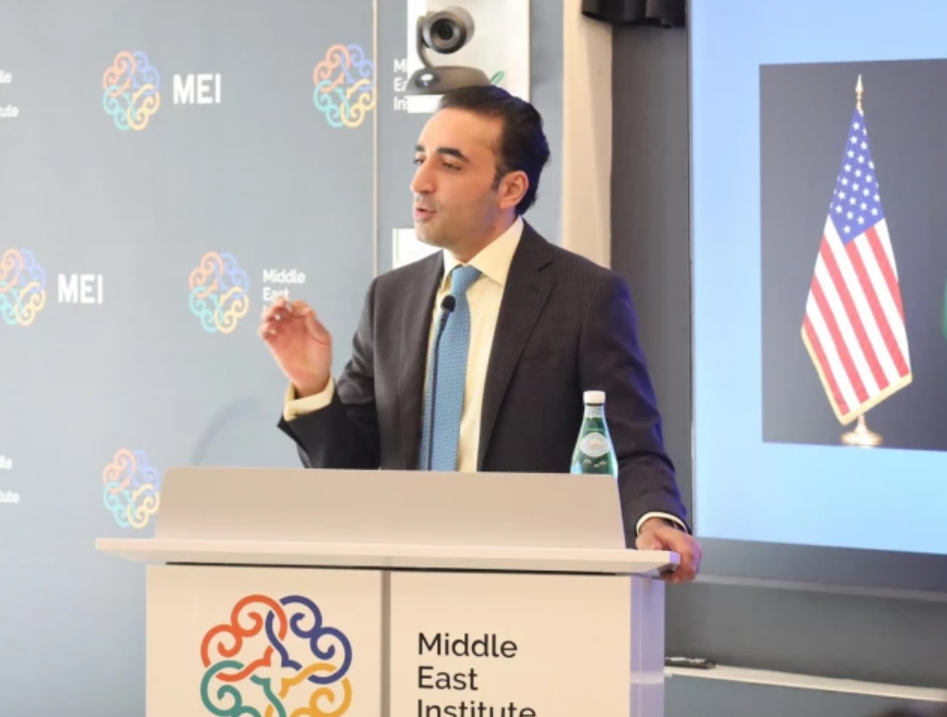
Speaking at the Middle East Institute in Washington, Bilawal said Prime Minister Shehbaz Sharif had mandated a diplomatic delegation to pursue peace with India through dialogue. “You may ask why we’re in Washington and not talking to our adversary — the reality is, they refuse to talk,” he said, citing New Delhi’s continued rejection of engagement.
Bilawal, who is currently leading a multi-party delegation to various global capitals, outlined Pakistan’s position amid rising tensions with India, which recently escalated to the brink of open conflict. Following cross-border strikes by India, Pakistan responded in kind, targeting Indian military installations before a ceasefire was reached on May 10.
While the violence has since subsided, Bilawal warned that India’s continued violations—particularly threats to Pakistan’s water rights—remain a flashpoint. He emphasized that Pakistan is open to forging new agreements, but insisted that India must first honor existing commitments, including the 1960 Indus Waters Treaty.
“For dialogue and diplomacy to succeed, India must reverse its recent decisions and demonstrate respect for international agreements,” he asserted.
The PPP chairman criticized India’s refusal to cooperate on counterterrorism efforts, highlighting its rejection of Pakistan’s offer for joint investigations and former US President Donald Trump’s proposal to mediate. “They’ve refused every overture — be it cooperation on terrorism, mediation, or dialogue,” he said.
Bilawal warned that dismissing diplomacy would only worsen regional instability. “If they continue down this path, it will only lead to more terrorism, more conflict, and no peace,” he said.
He made it clear that Pakistan would not mirror India’s combative posture. “I refuse to condemn the people of Pakistan or the people of India to endless conflict,” Bilawal stated.
Calling for international support, he said: “That’s why we are going from capital to capital with a simple message: we want peace, and we need your help.”
Bilawal pointed out that while India’s leadership reflects an older generation, their policies risk dragging future generations into persistent conflict. “Do they really want to condemn my generation to fight over Kashmir, terrorism, and now, water?” he asked.
He accused India of threatening to violate the UN Charter and the Indus Waters Treaty by cutting off water to 240 million Pakistanis. “This is not just about Kashmir or terrorism anymore,” he said. “They’re threatening future generations with conflict over a basic human necessity: water.”
Rejecting such a future, Bilawal said: “I will not allow the people of my country — or of India — to be condemned to water wars, Kashmir battles, or terrorism-fueled enmity.”
Addressing the longstanding Kashmir dispute, he stressed that resolving it is essential for lasting peace. “If India is serious about countering terrorism, it must begin by improving the situation in Kashmir,” he said, criticizing India’s heavy-handed tactics against civilians in the region and warning of broader consequences for regional peace.
Bilawal expressed deep concern over India’s threats regarding water, saying such actions represent a dangerous escalation. “No civilized nation can justify this. In an era already marked by climate stress, water scarcity, and looming environmental crises, weaponizing water access is nothing short of a provocation toward war.”
“India’s moves are setting the stage for the first nuclear water war. We’ve made it clear: cutting off our water is not a diplomatic gesture — it’s an existential threat,” he added. “We say this not with bravado, but with the gravity of a nation fighting for its survival.”
He urged the international community to intervene, stressing that India’s violations of the Indus Waters Treaty cannot go unchecked. “If this precedent is allowed to stand, it will open the door to global conflict over shared water resources,” Bilawal warned.
He concluded with a firm appeal: “Every country, regardless of size or power, would fight to protect its water. India must honor the Indus Waters Treaty — not just for peace in South Asia, but for the stability of the world.”