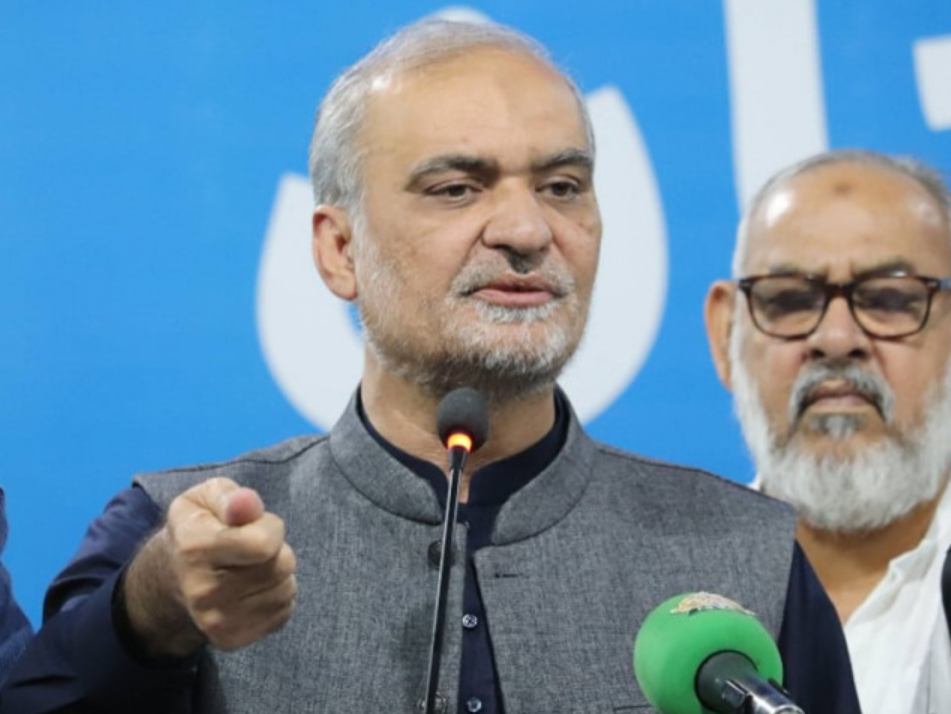
Hafiz Naeem slams government for neglecting public welfare, aiding the elite
Jamaat-e-Islami (JI) Ameer Hafiz Naeem ur Rehman has strongly opposed the federal budget, calling it a pro-elite policy document that deepens poverty, fuels inflation, and worsens inequality across the country.
Speaking at a press conference in Mansoora on Wednesday, he accused the government of failing to support ordinary citizens, saying the budget heavily favors the ruling elite while placing the financial burden on salaried and middle-income groups.
“This budget places crushing taxes on working people, offers no real relief, and lacks the structural reforms desperately needed,” he stated.
He dismissed government claims of reducing poverty as completely disconnected from reality, noting that more than 110 million people in Pakistan still live below the poverty line.
Hafiz Naeem also criticized the handling of the Benazir Income Support Programme (BISP), alleging widespread corruption and political misuse, especially in Sindh. “The Rs700 billion allocated for poverty reduction is being misused. This must be investigated, and those responsible held accountable,” he said.
He argued that if such funds were redirected towards information technology education, Pakistan’s IT sector could have seen revenues exceed Rs300 billion.
On education, he condemned the lack of progress, citing 29.2 million out-of-school children and the continued existence of “ghost schools” that siphon public funds through fraudulent means. He called the government’s talk of an “education emergency” hollow and unsupported by action.
Highlighting the tax burden on salaried citizens, Hafiz Naeem revealed that this group paid Rs499 billion in taxes this year but received no relief in return. He called for complete tax exemptions for the salaried class.
He further criticized the tax exemptions enjoyed by 111 departments, including military-run institutions and private organizations like Zia Hospital, while ordinary citizens face soaring utility bills.
Hafiz Naeem condemned the recent 600% pay hike for the National Assembly Speaker and Senate Chairman, questioning why such lavish raises go unchallenged by government officials.
He also decried the imposition of an 11% tax on solar energy systems, calling it a direct contradiction of environmental and energy sustainability goals.
“The government and opposition may act like rivals, but they unite when it comes to increasing their own benefits,” he remarked.
Discussing the broader economy, he said the country’s meager 0.45% growth rate reflects the failure of past and present governments. He criticized “anti-farmer policies” and labelled agriculture loan schemes as publicity stunts with little real impact. He pointed to a 30% drop in cotton cultivation as a sign of these neglectful practices.
He also highlighted outdated practices in agricultural governance, such as the continued use of Form 47, as a symbol of bureaucratic dysfunction.
Hafiz Naeem accused the government of extracting taxes without delivering essential services in return, whether in education, health, or public safety.
He criticized the government for failing to renegotiate Independent Power Producer (IPP) agreements, saying promised reductions in electricity rates remain unmet. Meanwhile, higher petroleum levies amount to “daylight robbery,” he claimed.
“The government admits it may miss its revenue target by Rs1,500 billion and plans to raise an additional Rs500 billion through taxes. What’s the logic of this budget?” he questioned.
Referring to Pakistan’s debt crisis, he noted that every citizen now owes Rs76,000, and nearly half of the country’s Rs11 trillion in debt servicing goes to interest payments. Reducing interest rates, he argued, would significantly lower electricity and gas costs.
He labelled the Federal Board of Revenue (FBR) as a “corruption hub,” calling for either sweeping reforms or its dissolution to ensure fair tax collection and end the cycle of debt dependency. He claimed the FBR uses the threat of anti-corruption measures as a cover to facilitate further misdeeds.
Hafiz Naeem called for a reduction in civil and military privileges, urging the government to focus national resources on genuine needs, particularly defense strategies based on necessity rather than excess.
Reiterating JI’s support for the farming community, he announced a nationwide campaign to protest against the injustices faced by farmers, citing past victories such as lowering power tariffs after public pressure against IPPs.
In his remarks on foreign policy, he alleged that India’s intelligence agency, RAW, was behind acts of terrorism in Balochistan. “There can be no dialogue with those who sponsor terrorism,” he declared.
He also urged Foreign Minister Bilawal Bhutto Zardari to adopt a more serious and proactive approach to the Kashmir issue and demanded a firm and clear stance from Pakistan against the policies of the United States and Israel.