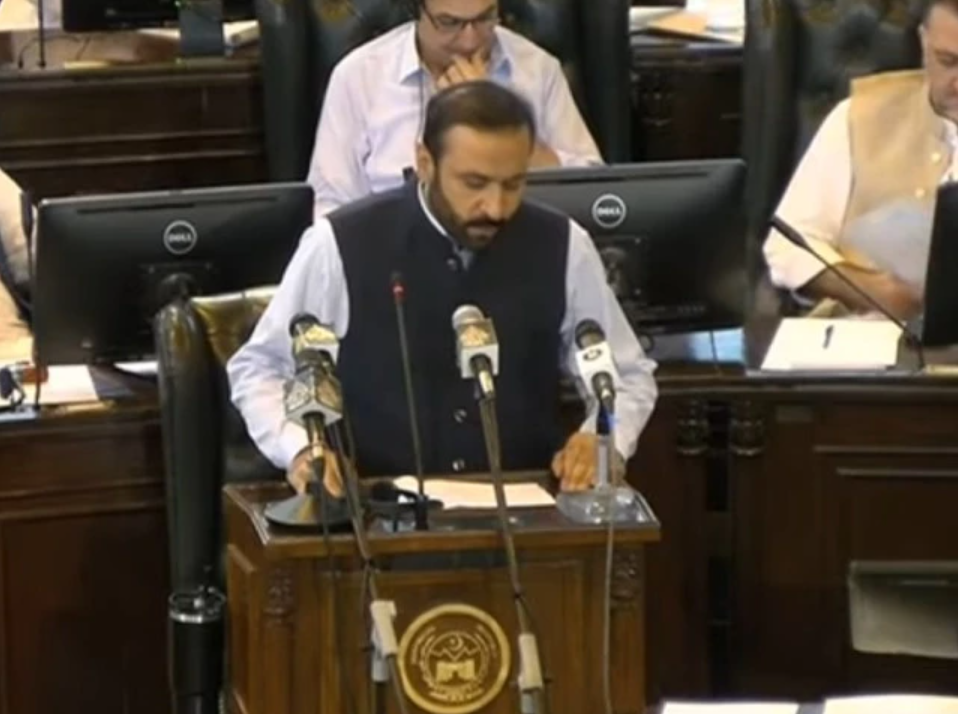
PESHAWAR – The Khyber-Pakhtunkhwa (K-P) government, led by Pakistan Tehreek-e-Insaf (PTI), presented a Rs2,119 billion budget for the fiscal year 2025–26 on Friday, projecting a Rs157 billion surplus without introducing any new taxes. The budget also includes a 10% increase in salaries and a 7% hike in pensions for government employees.
The budget session, chaired by Speaker Babar Salim Swati, commenced with Quranic recitation and was marked by noisy protests from opposition parties. Lawmakers from rival camps staged a demonstration in front of the speaker’s dais, holding placards and chanting slogans against what they called widespread corruption and nepotism in the provincial administration.
Chief Minister Ali Ameen Gandapur, opposition leader Dr Ebad Khan, PPP’s parliamentary head Ahmed Kundi, and other senior party representatives were present during the session.
The session followed a delay due to Governor Faisal Karim Kundi’s initial refusal to immediately summon the assembly, citing concerns over political pressure. Although bound by law to respond within 14 days to a session request, the governor chose not to act on the chief minister’s summary right away, causing friction over the budget’s timing.
Presenting the budget, Finance Minister Aftab Alam detailed estimated expenditures of Rs1,962 billion against projected revenues of Rs2,119 billion. A key portion of the budget—Rs292.34 billion—is expected from the federal government for the merged tribal districts, including Rs80 billion in current grants, Rs39.6 billion under the Annual Development Programme (ADP), Rs50 billion via the Accelerated Implementation Programme (AIP), and Rs42.74 billion as an inter-provincial share.
Further inflows include Rs17 billion earmarked for Temporarily Displaced Persons (TDPs), Rs3.293 billion from the Public Sector Development Programme (PSDP), and Rs1,506.92 billion in federal transfers. The province also expects Rs129 billion from its own revenue sources, Rs10.25 billion from other receipts, and Rs177.188 million in federal project aid.
Alam highlighted expected receipts of Rs137.912 billion from the divisible pool’s war-on-terror allocation, Rs57.115 billion from straight transfers related to oil and gas royalties, Rs58.151 billion from oil windfall levies, Rs34.580 billion in current net hydel profits, and Rs71.410 billion in hydel profit arrears.
Despite rising expenditures, the government opted not to impose new taxes. Instead, it aims to expand the tax base, targeting Rs83.5 billion in tax revenue and Rs45.5 billion in non-tax receipts.
The budget outlines Rs1,255 billion in current expenditure for settled areas, including:
- Rs288.514 billion for provincial salaries
- Rs288.609 billion for tehsil salaries
- Rs190.297 billion for pensions
- Rs334.028 billion for non-salary costs
- Rs65.657 billion for Medical Teaching Institutions (MTIs)
- Rs40.350 billion for capital expenditure
- Rs10 billion under other means
For the merged tribal districts, current expenditures are projected at Rs160 billion, covering:
- Rs56.842 billion in provincial salaries
- Rs46.865 billion in tehsil salaries
- Rs4.670 billion for pensions
- Rs24.285 billion in non-salary expenses
- Rs17 billion for TDPs
- Rs10.339 billion in tehsil non-salary spending
While the government hailed the budget as a pro-people and development-focused document, opposition members condemned it as disconnected from ground realities and rife with financial mismanagement.