

By Hira A. Malik
In the theatre of war, symbols matter. Words matter. And more often than not, gender becomes the unspoken grammar through which power is exercised, grief is shaped, and violence is justified. In the wake of the recent Indo-Pak conflict, a seemingly innocuous act — naming a military operation “Operation Sindoor” — lays bare how states conscript femininity into the machinery of nationalism.
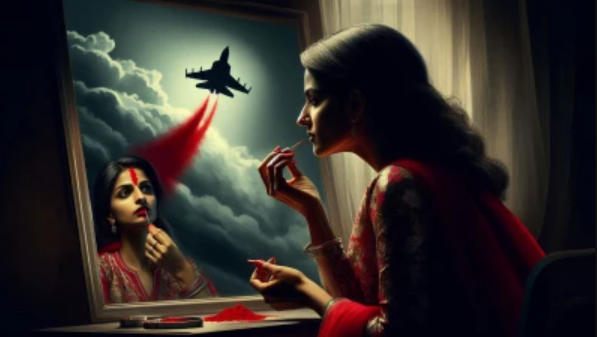
At first glance, Operation Sindoor may sound poetic, even benign. But dig deeper, and the layers are far from innocent. Sindoor — the red pigment worn by married Hindu women — is one of the most intimate cultural markers of femininity, tradition, and conjugal devotion. To use it as the label for a military retaliation is not just branding; it is narrative engineering. It feminizes the nation as a violated wife, romanticizes war as a husband’s dutiful vengeance, and embeds militarism within the language of marriage and sacrifice.
This is not new. Indian nationalism has long relied on the metaphor of Bharat Mata — the chaste, endangered motherland needing protection. In this schema, the soldier is not merely a defender of borders, but a son or husband avenging the honour of a feminine ideal. Blood becomes sindoor. Violence becomes devotion. War becomes a marriage ritual.
But what happens when the same symbol — sindoor — is reclaimed by a woman, not in service of nationalism but of selfhood?
Around the same time as Operation Sindoor, a short story by Mamata Kalia surfaced online: Chutki Bhar Sindoor (A Pinch of Sindoor). The story follows Rita, a celebrated stage actress who, after marrying an insecure admirer and enduring his tragic suicide, retreats into grief — only to return to the stage stronger, transformed. Her act of reclaiming the sindoor — not as a sign of wifely devotion, but as makeup, as performance, as rebirth — is quietly radical. It transforms a patriarchal relic into a personal emblem of resilience.
So we are left with two meanings of the same symbol. For the state, sindoor becomes sanctified violence. For the artist, it becomes survival. One version glorifies death. The other insists on life. One exalts sacrifice for the nation. The other insists on agency for the self.
This contrast becomes even more striking when read alongside Noor Jehan’s wartime elegy Ae Puttar Hattan Te Naiin Wikde. This iconic Pakistani song has endured for decades, its lamentation of lost sons rising anew with every fresh wave of conflict. But beneath its emotional resonance lies a quiet hierarchy: sons are sacred, irreplaceable, divine. The daughter — addressed tenderly as kurṛay — is there to listen, to grieve, to learn. She is never the hero. She is the witness.
And that is the throughline connecting these three texts — one fictional, one martial, one lyrical. In each, womanhood is rendered symbolic: the mourning mother, the metaphorical motherland, the muse. The feminine exists to validate male action — his sacrifice, his glory, his narrative. Her own story is either sidelined or only becomes legible when tethered to his.
Even Rita, the heroine of Kalia’s story, must re-enter the world of theatre through a conjugal symbol. Her resurrection, while autonomous, is still coded in the language of marriage. She performs her pain through symbols that were once assigned to her, even if now worn on her own terms.
What unites Operation Sindoor, Chutki Bhar Sindoor, and Ae Puttar Hattan Te Naiin Wikde is not simply their aesthetic power — it is the way they reveal a deeper cultural script: that the feminine exists to ornament the masculine. That a woman’s role is to mourn, beautify, or metaphorize — not to lead, command, or define the terms of war or peace.
This symbolic appropriation of femininity has consequences. It allows states to cloak violence in softness, to market bloodshed as romance, to justify war through metaphors of family. It silences women by assigning them symbolic roles while excluding them from the actual levers of power. It turns their grief into poetry, their rituals into propaganda, their bodies into battlegrounds.
And so the real tragedy lies not just in the loss of life, but in the loss of voice. In the quiet, generational script that continues to tell us who is sacred, and who is scenery.
War may be politics by other means. But it is also performance. And in that theatre, gender is both prop and player — unless, of course, we rewrite the script.
This piece reflects the author’s personal views and does not necessarily represent those of the publication.