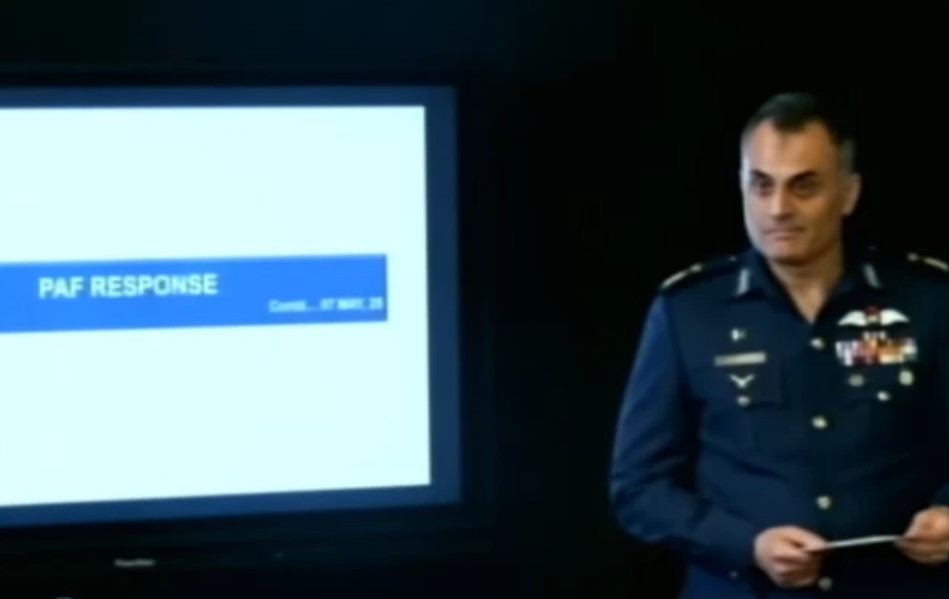
In what has been described as the most extensive Pakistan Air Force (PAF) operation since the 1971 war, Air Vice Marshal Aurangzeb Ahmed announced on Sunday that Pakistani fighter jets targeted the highest number of Indian Air Force (IAF) airfields in a single coordinated mission.
Speaking at a media briefing, AVM Aurangzeb stated that the airstrikes were conducted with high precision, intentionally avoiding civilian infrastructure. He characterized the operation as a swift, calculated response to recent Indian provocations, emphasizing that the mission was “executed on our terms under clear leadership directives.”
“India sought to establish a ‘new normal’ through escalatory aggression. Pakistan’s prompt and coordinated response thwarted that effort,” he added. Aurangzeb further noted that Pakistan’s military radar and jamming systems successfully intercepted multiple Indian drones allegedly targeting civilian areas.
Ceasefire Agreement Reached
The announcement came a day after Pakistan and India agreed to a full and immediate ceasefire, following days of escalating military engagements that raised fears of a broader regional conflict between the two nuclear-armed nations.
The ceasefire was first revealed by U.S. President Donald Trump and subsequently confirmed by Pakistani Prime Minister Shehbaz Sharif, Deputy Prime Minister Ishaq Dar, Indian External Affairs Minister S. Jaishankar, and U.S. Secretary of State Marco Rubio. The de-escalation followed a series of missile strikes, drone incursions, and retaliatory actions along the contested border.
Rising Tensions and Operation Bunyan-un-Marsoos
The latest round of hostilities was triggered by a deadly April 22 attack in Pahalgam, located in Indian Illegally Occupied Jammu and Kashmir (IIOJK), which killed 26 civilians. India blamed Pakistan-based actors for the incident but provided no supporting evidence. Islamabad rejected the accusation.
In response, India shut down the Wagah border crossing, revoked Pakistani visas, and unilaterally suspended the Indus Waters Treaty—moves Pakistan described as a serious provocation and “acts of war.”
Between May 6 and 7, Pakistan launched Operation Bunyan-un-Marsoos, during which it claimed to have shot down five Indian fighter jets, including Rafales, and intercepted 77 Israeli-manufactured Harop drones.
U.S.-Led Diplomatic Efforts
The United States played a key role in de-escalating the crisis. Secretary of State Marco Rubio and Vice President JD Vance held high-level discussions with both Pakistani and Indian leadership, including Prime Ministers Shehbaz Sharif and Narendra Modi, as well as top military and intelligence officials.
Following President Trump’s public announcement, both countries agreed to suspend all military operations across land, sea, and air. However, sporadic reports of ceasefire violations along the Line of Control (LoC) have since emerged.