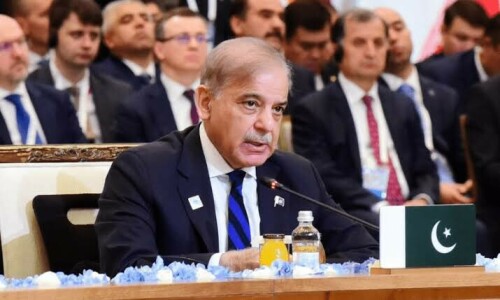

PM Shehbaz affirms readiness for both war and peace; shares concerns about India’s provocative rhetoric with UN chief; returns Indian border guard
ISLAMABAD — Prime Minister Shehbaz Sharif on Wednesday extended an invitation to India for a broad-ranging dialogue aimed at resolving all outstanding disputes, including the Kashmir conflict and water-sharing issues, between the two nuclear-armed neighbours.
Speaking during a visit to the frontline Pasrur Cantonment in Sialkot, PM Shehbaz praised the armed forces for their exemplary response under ‘Operation Bunyanum Marsoos,’ Pakistan’s retaliatory strikes against India following the Pahalgam incident. Pakistan targeted 26 Indian military installations, including airbases, using jets and missiles.
He asserted that Pakistan’s counterattack on May 6-7 inflicted significant losses on India, including the downing of multiple Indian Rafale jets. “We have avenged the 1971 war,” the prime minister declared, expressing national unity and support for the military.
Warning Indian Prime Minister Narendra Modi against further aggression, PM Shehbaz stated, “If you attack us again, you will lose everything. We are ready for both war and dialogue. The choice is yours.”
Addressing PM Modi’s recent national address, Shehbaz cautioned, “Do not dictate to us. Water is our red line; do not even think about diverting it. You have also damaged our Neelum-Jhelum water project. Had the damage been severe, we could have targeted your major dams, including Baglihar.”
The prime minister reiterated his call for dialogue to resolve differences, saying, “Let us extinguish this fire. Let us talk on Kashmir and water.”
Following the Pahalgam attack, India suspended the Indus Waters Treaty with Pakistan, prompting a strong Pakistani response. World Bank President Ajay Banga recently stated there is no provision for suspension in the treaty, which requires mutual consent for any changes.
PM Shehbaz condemned India’s “blatant aggression” against civilians, resulting in the deaths of children, women, and elders, and criticized Delhi’s labeling of them as terrorists as “shameful and against international law.”
He noted that Pakistan had offered a neutral probe into the incident, which India rejected, instead launching an offensive based on false pretexts fueled by arrogance — for which Pakistan responded forcefully.
During his visit, the prime minister received detailed briefings on military operations and troop readiness, meeting officers and soldiers engaged in current actions. He plans to visit Pakistan Air Force and Navy bases in the coming days to show continued support for all military branches.
PM Shehbaz emphasized Pakistan’s commitment to regional peace while defending its sovereignty, reaffirming the country’s acceptance of a ceasefire in the larger interest of peace in South Asia.
Concerns Shared with UN Chief
In a telephone call with UN Secretary-General Antonio Guterres, PM Shehbaz expressed appreciation for the UN’s diplomatic efforts to ease tensions in South Asia. He highlighted the importance of the UN’s preventive diplomacy in upholding the principles of the UN Charter and fostering peace.
This marked the third conversation between the two leaders in two weeks. The prime minister also raised concerns about India’s ongoing provocative rhetoric, warning that it threatens the fragile regional peace. He stressed the need for a just resolution of the Jammu and Kashmir dispute in line with UN Security Council resolutions to ensure lasting peace.
The UN chief welcomed the ceasefire and expressed condolences for civilian casualties, pledging continued engagement with both parties to promote stability.
Talks with UAE and Azerbaijan
PM Shehbaz also spoke with UAE President Sheikh Mohamed bin Zayed Al Nahyan, expressing gratitude for the UAE’s diplomatic support during the crisis and noting the close ties between the two nations.
In Islamabad, the prime minister met with Azerbaijan’s ambassador Khazar Farhadov and conveyed thanks to President Ilham Aliyev for Azerbaijan’s steadfast solidarity amid recent tensions with India.
Indian Border Guard Returned
In a goodwill gesture, Pakistan handed over an Indian border guard to India on Wednesday. The guard, Purnam Kumar Shaw, had been in Pakistan Rangers’ custody since April 23, a day after the Pahalgam attack that killed 26 people and triggered retaliatory missile and air strikes between the two countries.
India accused Pakistan of involvement in the attack, which Islamabad denies, calling instead for an independent investigation.