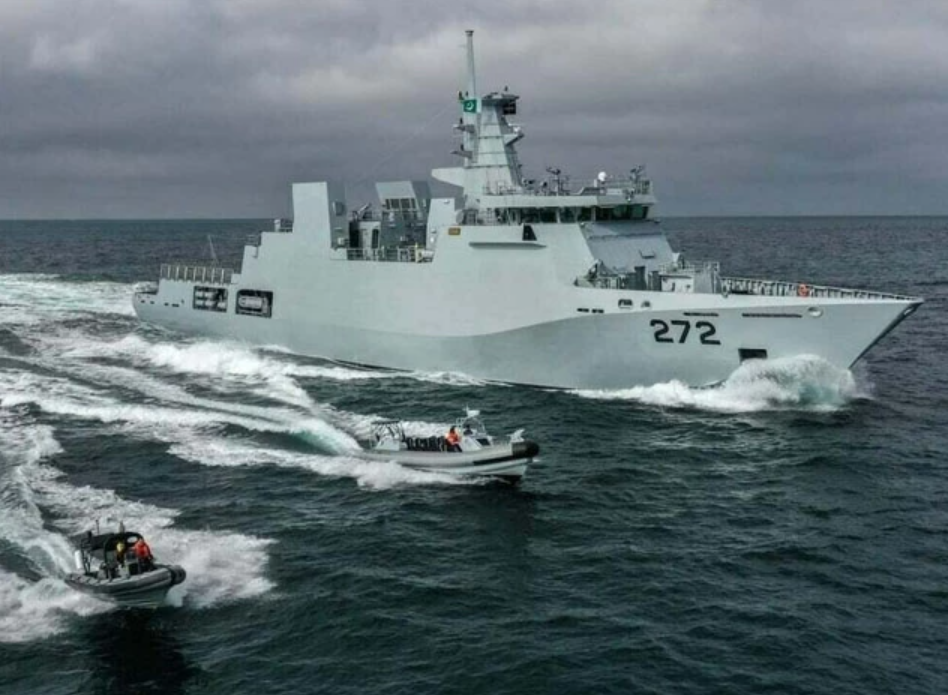
During the recent hostilities between Pakistan and India, the Pakistan Navy successfully prevented the Indian Navy, including its aircraft carrier INS Vikrant, from engaging in any offensive maneuvers in the North Arabian Sea, officials from the Pakistan Navy stated.
According to the officials, the Indian Navy was unable to move its warships or aircraft closer to Pakistan due to the Pakistan Navy’s strict surveillance and coordinated strategic operations. This naval vigilance kept INS Vikrant restricted to Indian territorial waters throughout the escalation.
The broader military response from Pakistan, code-named Operation Bunyanum Marsoos (“Formidable Wall”), targeted multiple Indian military installations, including airbases, weapons depots, and brigade headquarters. While the Pakistan Army and Air Force took the lead in the offensive, the Navy played a vital role in ensuring maritime security.
Officials emphasized that the Navy’s presence in southern waters not only blocked any Indian naval action but also ensured the security of Pakistan’s sea trade routes and critical coastal infrastructure. “Thanks to this robust posture, the Indian Navy was neutralized at sea and posed no threat,” one official noted.
The Indian Navy, for its part, admitted to not participating in “Operation Sindoor,” its military response during the crisis. India’s Director General of Naval Operations, Vice Admiral AN Pramod, stated that while Indian naval forces were ready, they awaited orders that never came.
In contrast, a senior Pakistani naval officer highlighted that all three of Pakistan’s key ports—Karachi, Port Qasim, and Gwadar—remained operational and secure throughout the tensions, showcasing the effectiveness of Pakistan’s maritime strategy.
“The Indian Navy suffered embarrassment by being confined to its own waters by a comparatively smaller force,” the official added. “The credit goes to the leadership, officers, and sailors of the Pakistan Navy who defended the nation’s maritime boundaries and denied the adversary any opportunity for engagement.”
Ceasefire Announced After Escalation
The crisis culminated in a full and immediate ceasefire announced on Saturday, following several days of intense military confrontation that brought both nuclear-armed nations to the brink of broader conflict.
The ceasefire announcement was first made by U.S. President Donald Trump and later confirmed by Pakistani Prime Minister Shehbaz Sharif, Deputy PM Ishaq Dar, Indian Foreign Minister S. Jaishankar, and U.S. Secretary of State Marco Rubio.
The escalation was triggered by a deadly April 22 attack in Pahalgam, in Indian Illegally Occupied Jammu and Kashmir (IIOJK), which resulted in 26 civilian deaths. India accused Pakistan-linked actors without offering proof, a charge Islamabad strongly denied.
In response, India closed the Wagah border, revoked Pakistani visas, and unilaterally suspended the Indus Waters Treaty—actions Pakistan condemned as provocations.
Pakistan launched Operation Bunyanum Marsoos on May 6–7, during which it downed five Indian fighter jets, including Rafales, and intercepted 77 Israeli-made Harop drones.
Behind-the-scenes diplomacy, led by U.S. officials including Secretary Rubio and Vice President JD Vance, facilitated direct communication between the leadership of both countries. Talks involved Prime Ministers Shehbaz Sharif and Narendra Modi, as well as top military and intelligence officials.
Following the ceasefire declaration, both nations agreed to halt all military actions across land, sea, and air. However, some reports of ceasefire violations from along the Line of Control (LoC) have since emerged.