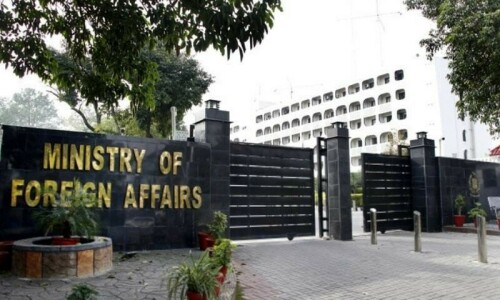
The Foreign Office (FO) on Friday firmly dismissed the “baseless, provocative, and irresponsible” accusations made by Indian Prime Minister Narendra Modi, who, in a recent fiery speech, accused Pakistan of orchestrating terrorist attacks in India.
The military tensions between New Delhi and Islamabad escalated following last month’s Pahalgam attack, which India blamed on Pakistan without providing evidence. On the night of May 6-7, India launched a series of airstrikes in Punjab and Azad Kashmir that resulted in civilian casualties. In retaliation, Pakistan shot down five Indian jets.
After mutual drone interceptions and retaliatory strikes on airbases, the conflict was de-escalated on May 10 through American mediation, leading to a ceasefire. Despite this, India has maintained aggressive rhetoric while Pakistan has cautioned against further military provocations and extended an offer for dialogue.
In a recent statement, Modi declared that Pakistan would not receive water from rivers over which India holds rights.
Responding on the social media platform X, Pakistan’s Foreign Office strongly condemned Modi’s remarks, calling them “baseless, provocative, and irresponsible.” The FO stated that the comments were filled with distortions, misrepresentations, and inflammatory language intended to stir regional tensions for narrow political gains.
The FO added that such statements not only aim to mislead the public but also violate norms of responsible statecraft. “Threatening military action against a sovereign nation breaches the United Nations Charter and international law,” the statement said.
Pakistan warned that this dangerous stance undermines peace and stability in the region.
The ministry emphasized that Pakistan has consistently been a “proactive partner” in the global fight against terrorism, and any attempt to link Pakistan with terrorism is “factually incorrect and misleading.”
It accused Modi of using these allegations to divert attention from India’s internal problems, particularly pointing to India’s documented human rights abuses in occupied Kashmir. The FO highlighted that the Kashmiri people’s struggle for self-determination cannot be overshadowed by aggressive rhetoric and political deflection.
Pakistan urged India’s leadership to show responsibility and restraint, warning that escalatory statements only worsen tensions. The FO urged India to move away from “fictitious narratives and warmongering for electoral gain” and instead pursue peaceful dialogue to resolve outstanding disputes.
Pakistan reaffirmed its commitment to peaceful coexistence, regional stability, and constructive engagement, but also stressed that this desire for peace should not be mistaken for weakness.
The FO affirmed that Pakistan’s people and armed forces are “fully prepared and capable” of defending the country’s sovereignty and territorial integrity. Any act of aggression would be met with a “resolute and proportionate response,” as Pakistan has demonstrated in the past and will do so again if necessary.
The statement called on the international community to recognize India’s aggressive posture and inflammatory rhetoric, which threaten regional peace. It emphasized the importance of discouraging such behavior to maintain stability in South Asia.
Concluding, the FO stated, “Glorification of conflict benefits no one. The path to lasting peace lies in dialogue, mutual respect, and adherence to international law.”