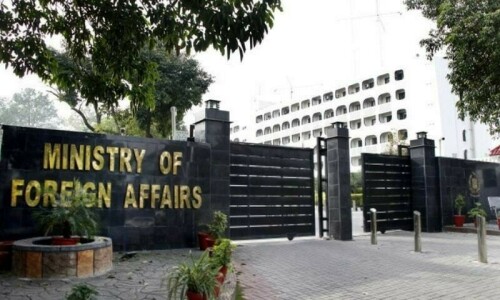
The Foreign Office (FO) on Tuesday strongly condemned recent remarks made by Indian Prime Minister Narendra Modi during a speech in Gujarat, denouncing them as a “reckless provocation.”
This statement comes in the wake of a recent military standoff between India and Pakistan, following New Delhi’s baseless allegations against Islamabad regarding a deadly attack in Pahalgam, occupied Kashmir.
On the night of May 6-7, India launched airstrikes in Pakistan, resulting in civilian casualties. Pakistan responded by downing five Indian fighter jets. After intercepting Indian drones and striking each other’s airbases, both countries finally agreed to a ceasefire on May 10, thanks to U.S. intervention.
In a video shared by Indian news outlet ANI, Modi urged the Pakistani people to rid their country of terrorism, stating: “Their youth must come forward… Live a life of peace, eat your bread or [choose my] bullet,” drawing applause from the crowd, many of whom were dressed in orange and white.
In an early Tuesday statement, the FO said it had noted Modi’s remarks “delivered in Gujarat with the theatrical flourish of a campaign rally rather than the sobriety expected of the leader of a nuclear-armed state.”
“The hate-driven invocation of violence in his remarks is deeply troubling, both for its substance and for the dangerous precedent it sets in an already volatile region,” the statement said.
“We regret the continued erosion of maturity and decorum in Indian statecraft,” the FO added.
It noted that such statements “blatantly violate” the core principles of the UN Charter, which requires member states to resolve disputes peacefully and to refrain from using or threatening force against the sovereignty or political independence of other states.
“Pakistan views these remarks as reckless provocation, aimed at distracting from ongoing human rights abuses and demographic manipulation in Indian Illegally Occupied Jammu & Kashmir,” the FO said.
It stressed that Pakistan’s track record as a leading UN peacekeeping contributor and its ongoing cooperation in global counter-terrorism efforts speak louder than any hostile statements.
“If extremism is a genuine concern for the Indian government, it would do well to address the alarming rise of majoritarianism, religious intolerance, and systematic disenfranchisement of minorities under the increasingly brutal Hindutva ideology,” the statement continued.
The FO reaffirmed Pakistan’s commitment to peace based on mutual respect and sovereign equality. “However, any threat to its security or territorial integrity will be met with firm and proportionate measures, as outlined in Article 51 of the UN Charter.”
The FO concluded by calling on the international community to take serious note of India’s escalating rhetoric, which threatens regional stability and undermines prospects for lasting peace.