A day after a landmark meeting between Chief of Army Staff Field Marshal Syed Asim Munir and US President Donald Trump at the White House, Pakistan reaffirmed its rejection of military solutions and urged diplomatic efforts to resolve the escalating conflict between Israel and Iran.
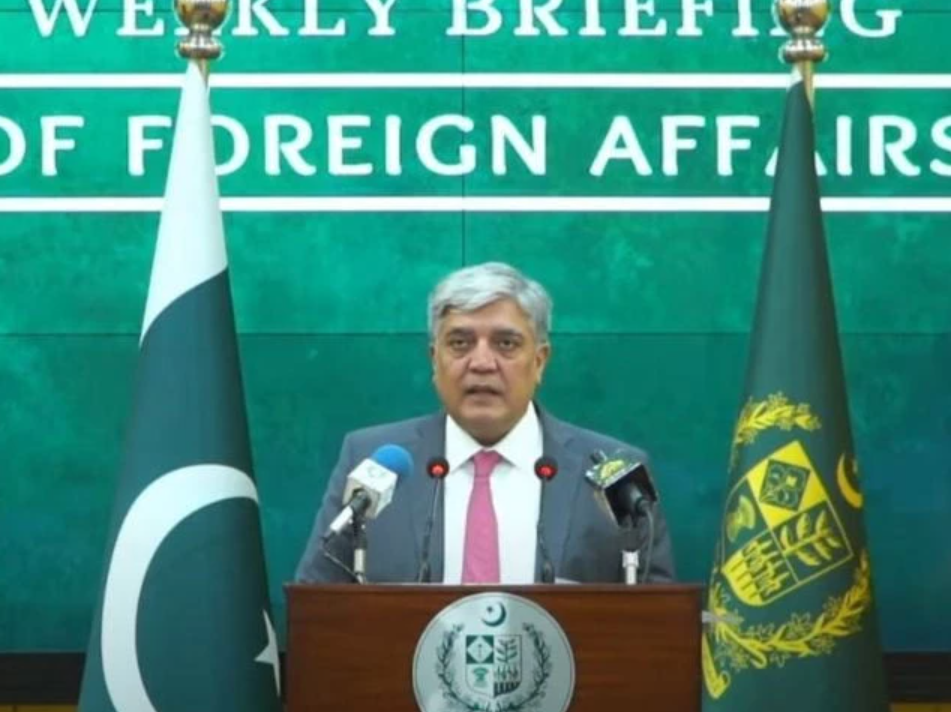
At a weekly media briefing on Thursday, Foreign Office Spokesperson Shafqat Ali Khan stated that Pakistan’s delegation, led by Field Marshal Munir, had likely conveyed Islamabad’s strong concerns regarding the Middle East crisis during the high-level talks.
The Inter-Services Public Relations (ISPR) also confirmed that the discussions included a comprehensive exchange on regional tensions, with both sides underscoring the need for peaceful resolution and dialogue.
Responding to a media question on President Trump’s earlier remark that “Pakistan is not happy with the situation”, the spokesperson noted that Pakistan’s position was made clear both during the meeting and in official statements from the Foreign Ministry and Deputy Prime Minister Ishaq Dar in the Senate.
“Pakistan’s stance is well-documented—we condemn Israel’s actions in Iran as violations of international law and norms of civilized interstate conduct,” said Khan. He added that Pakistan remains committed to supporting any diplomatic initiative that may lead to de-escalation and restoration of peace.
Sources familiar with the meeting revealed that the Pakistani side cautioned against non-diplomatic solutions, warning of far-reaching consequences. This context reportedly prompted President Trump to later acknowledge Pakistan’s deep understanding of Iran, stating that “Pakistan knows more about Iran than many others.”
Warmth and Strategic Dialogue at the White House
According to ISPR, the meeting—held in the White House Cabinet Room over luncheon and followed by a visit to the Oval Office—lasted over two hours, far exceeding the scheduled time, reflecting the depth of the discussion and mutual goodwill.
President Trump was joined by Secretary of State Marco Rubio and Special Representative for Middle Eastern Affairs Steve Witkoff, while Field Marshal Munir was accompanied by Pakistan’s National Security Adviser.
During the talks, Field Marshal Munir expressed Pakistan’s appreciation for President Trump’s constructive role in defusing tensions between Pakistan and India, referring to Trump’s involvement in recent regional peace efforts.
He commended the US President’s statesmanship and strategic vision, particularly in navigating global challenges, while President Trump praised Pakistan’s contributions to regional stability and the ongoing counter-terrorism cooperation between the two countries.
Expanding Bilateral Ties: Trade, Tech, and Strategic Convergence
In addition to security concerns, the meeting also explored avenues for deepening economic and strategic collaboration. Discussions covered a wide range of sectors, including:
- Trade and economic development
- Mining and minerals
- Energy cooperation
- Artificial intelligence and emerging technologies
- Cryptocurrency and digital innovation
President Trump expressed strong interest in building a long-term, mutually beneficial trade partnership with Pakistan, rooted in strategic alignment and shared goals.
He also lauded Field Marshal Munir’s leadership and decisiveness amid the region’s complex dynamics. In a gesture of goodwill, the Pakistani Army chief extended an official invitation to President Trump to visit Pakistan at a mutually agreeable time.
A Milestone in US-Pakistan Relations
The extended and substantive engagement marks a significant moment in efforts to reinvigorate the Pakistan-US partnership, which continues to evolve beyond traditional security ties into broader strategic cooperation.
In ISPR’s words, the meeting reflected a “shared commitment to peace, stability, and prosperity,” and underscored the enduring nature of bilateral ties based on mutual respect and strategic convergence.