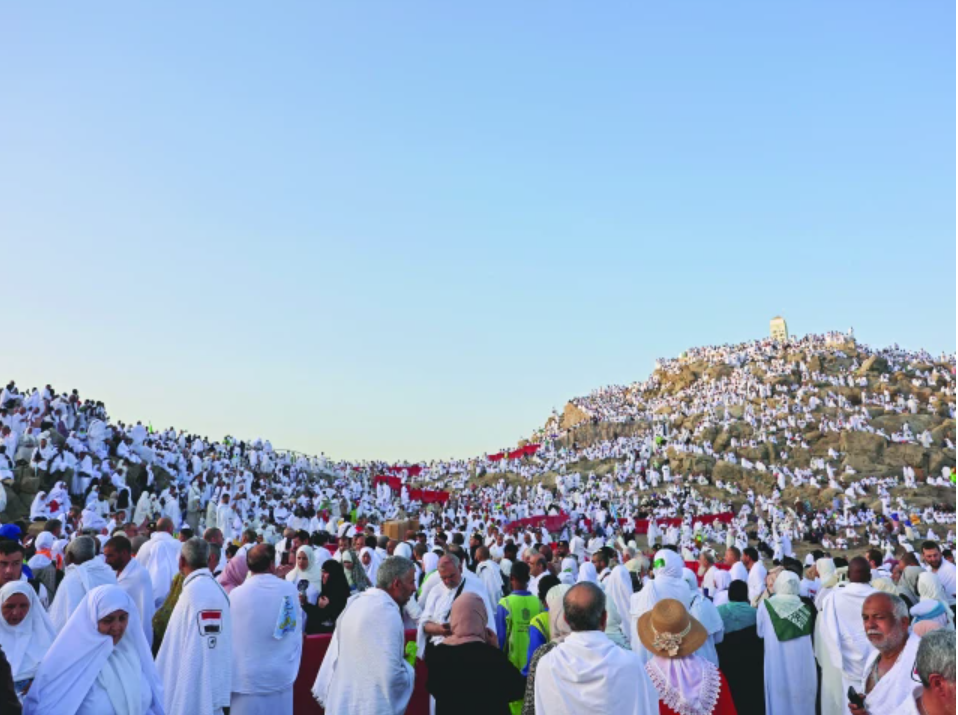

ARAFAT:
Muslim pilgrims gathered on Mount Arafat on Thursday, marking the spiritual peak of the annual Hajj pilgrimage. As worshippers recited verses from the Holy Quran at dawn on the 70-meter (230-foot) granite hill near Makkah—where Prophet Muhammad (Peace Be Upon Him) delivered his final sermon—authorities issued warnings to avoid peak midday heat following last year’s devastating fatalities.
The crowd began to thin by noon after officials advised pilgrims to remain indoors between 10:00am and 4:00pm. Last year, more than 1,300 pilgrims lost their lives due to extreme heat, with temperatures soaring to 51.8°C (125°F).
Delivering the Hajj sermon at Masjid-e-Nimrah, Sheikh Dr. Saleh bin Abdullah bin Humaid, Imam and Khateeb of the Grand Mosque, highlighted the Day of Arafah as a powerful symbol of unity and submission to Allah. He urged Muslims to embrace the true spirit of Islam through faith, humility, and devotion.
In his address, Sheikh Humaid emphasized Islam’s foundational values—monotheism, compassion, righteousness, and justice—and encouraged believers to engage in sincere worship and good deeds, especially on this sacred day when divine mercy is believed to be abundant and prayers are readily answered.
“The Day of Arafah unites the Ummah in worship and devotion. It is a time when Allah’s mercy descends, and supplications are accepted. Let our hearts overflow with gratitude and our tongues with His praise,” he said.
Pilgrims took personal precautions as well. “I came early to avoid the sun, and later I’ll return to my tent to pray,” said 54-year-old Syrian pilgrim Adel Ismail.
Saudi authorities have implemented extensive heat mitigation measures for this year’s Hajj, which has attracted over 1.6 million pilgrims. Shaded areas have been increased by 50,000 square meters (12 acres), over 400 cooling units have been installed, and thousands of medical personnel are on standby.
In a bid to prevent overcrowding and ensure safety, officials have also cracked down on unregistered pilgrims—who accounted for over 80% of last year’s fatalities and often lack access to proper facilities.
Icepacks were distributed to pilgrims walking toward Mount Arafat, with many placing them on their heads for relief. Fans blowing mist were set up around the hill, and officials guided people away if they remained in the sun too long. Temperatures reached 42°C (107.6°F) during the day.
As the sun began to set, pilgrims moved on to Muzdalifah, where they will collect pebbles for the symbolic “stoning of the devil” ritual in Mina on Friday.
Despite the intense heat, pilgrims expressed joy and gratitude. “I don’t think about the sun or the temperature,” said Ahmed, a 44-year-old from Egypt. “Standing in Arafat is a great and beautiful experience. Just look around—everyone is doing it.”
Ali, 33, from Pakistan, shared his excitement: “I used to watch this on TV every year and always dreamed of being here. Now it’s real.”
Iman Abdel Khaleq, an Egyptian woman in her 50s, broke into tears as she reached Arafat after a decade-long wait. “I almost gave up hope. This is a dream come true,” she told AFP.
Saudi health officials reported that this year’s heat-related incidents have been minimal. “We’re seeing a limited number of cases, which shows the effectiveness of our organisational and preventive measures,” said Dr. Mohammed Al-Abd Al-Aali, Assistant Minister of Health.
In addition to medical and infrastructural upgrades, the Kingdom is using advanced technology to manage crowds. More than 15,000 AI-powered surveillance cameras are monitoring holy sites and pathways, helping avert the kind of stampedes that have marred previous pilgrimages.
Authorities have also intensified efforts to stop unauthorized pilgrims using drones, raids, and SMS alerts to enforce entry regulations into Makkah.
With improved logistics, stricter controls, and greater awareness, this year’s Hajj has so far avoided the tragedies of the past—offering pilgrims a safer and spiritually uplifting experience.