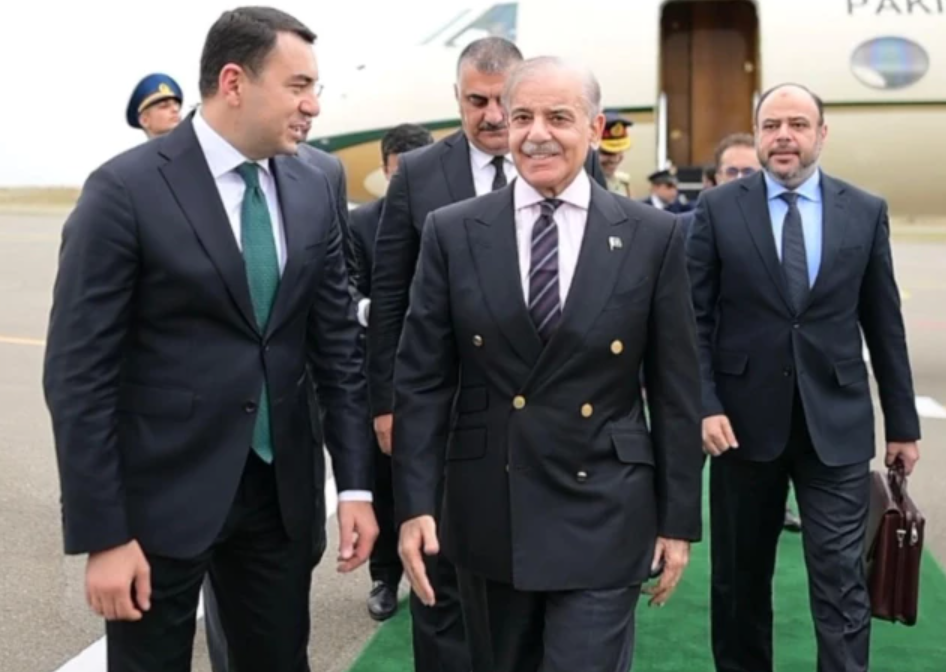
Prime Minister Shehbaz Sharif arrived in Azerbaijan on Thursday for a two-day official visit to attend the 17th Economic Cooperation Organization (ECO) Summit, being held in Khankendi from July 3 to 4.
The summit, themed “New ECO Vision for a Sustainable and Climate Resilient Future”, brings together leaders from ECO member states to deliberate on key regional challenges, including trade, connectivity, and climate resilience.
Leading Pakistan’s delegation, PM Shehbaz is accompanied by Deputy Prime Minister and Foreign Minister Ishaq Dar, Federal Information Minister Attaullah Tarar, and Special Assistant to the Prime Minister Tariq Fatemi.
Upon arrival at Fuzuli International Airport, the prime minister was welcomed by Azerbaijan’s Minister of Culture Adil Karimli, Azerbaijani Ambassador to Pakistan Khazar Farhadov, Pakistan’s Ambassador to Azerbaijan Qasim Moinuddin, and other senior officials.
According to the Foreign Office, Prime Minister Shehbaz will address the summit, presenting Pakistan’s stance on regional and global developments. He is expected to reaffirm Pakistan’s commitment to the ECO Vision 2025, while advocating for stronger regional trade ties, improved transport and energy connectivity, and sustainable growth.
On the sidelines of the summit, the prime minister is also scheduled to hold bilateral meetings with leaders of ECO member countries, focusing on enhanced economic cooperation, regional peace, and climate resilience.
The ECO, which evolved from the Regional Cooperation for Development (RCD) established in 1964, was formally founded in 1985 and now includes ten member states from South and Central Asia and the Middle East.
Pakistan has been an active voice on global climate issues, often highlighting its vulnerability despite its minimal contribution—less than 1%—to global carbon emissions.
In his address, PM Shehbaz is expected to spotlight the country’s climate challenges, especially the devastating 2022 floods that displaced over 33 million people, caused more than 1,700 deaths, and inflicted over $30 billion in losses. He is likely to call for enhanced regional collaboration and stronger international support for climate adaptation and mitigation in vulnerable countries.