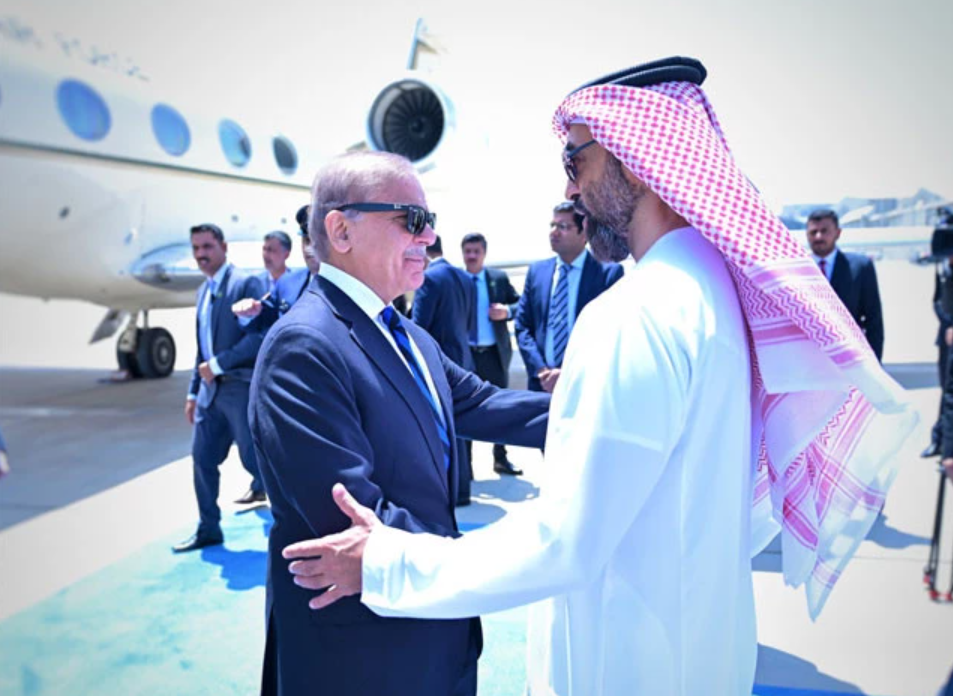
Welcomed by UAE’s National Security Advisor Sheikh Tahnoun bin Zayed at Al Bateen Airport
Prime Minister Shehbaz Sharif arrived in Abu Dhabi on Thursday for a one-day official visit to the United Arab Emirates (UAE) at the invitation of UAE President and Ruler of Abu Dhabi, His Highness Sheikh Mohamed bin Zayed Al Nahyan.
Upon his arrival at Al Bateen Airport, the Prime Minister was warmly received by Sheikh Tahnoun bin Zayed Al Nahyan, the UAE’s National Security Advisor.
During his brief stay, PM Shehbaz is expected to engage in high-level talks with the Emirati leadership, including a key meeting with Sheikh Mohamed bin Zayed. Discussions will span a range of bilateral, regional, and global matters of mutual concern.
Accompanying the Prime Minister is a high-level delegation comprising Deputy Prime Minister and Foreign Minister Ishaq Dar, Chief of Army Staff Field Marshal Asim Munir, Interior Minister Mohsin Naqvi, and Information Minister Attaullah Tarar.
The visit underscores Pakistan’s ongoing efforts to deepen ties with the UAE, with particular focus on boosting cooperation in areas such as trade, investment, security, and regional peace.
This trip follows Prime Minister Sharif’s recent two-day visit to Saudi Arabia, where he met with Crown Prince Mohammed bin Salman. Both leaders agreed to further elevate their countries’ strategic partnership, reflecting the shared vision of their leadership and the aspirations of their people.
Earlier in May, PM Shehbaz concluded a six-day diplomatic tour of Turkiye, Iran, Azerbaijan, and Tajikistan. The purpose of the tour was to reinforce regional cooperation and personally thank allied nations for their support during heightened tensions with India.
The Prime Minister’s visit ended in Dushanbe, Tajikistan, where he took part in the International Conference on Glaciers and reaffirmed Pakistan’s commitment to regional collaboration on climate change.
According to the Foreign Office, these diplomatic efforts form part of a broader initiative to enhance strategic alliances, strengthen economic partnerships, and foster solidarity across the region.