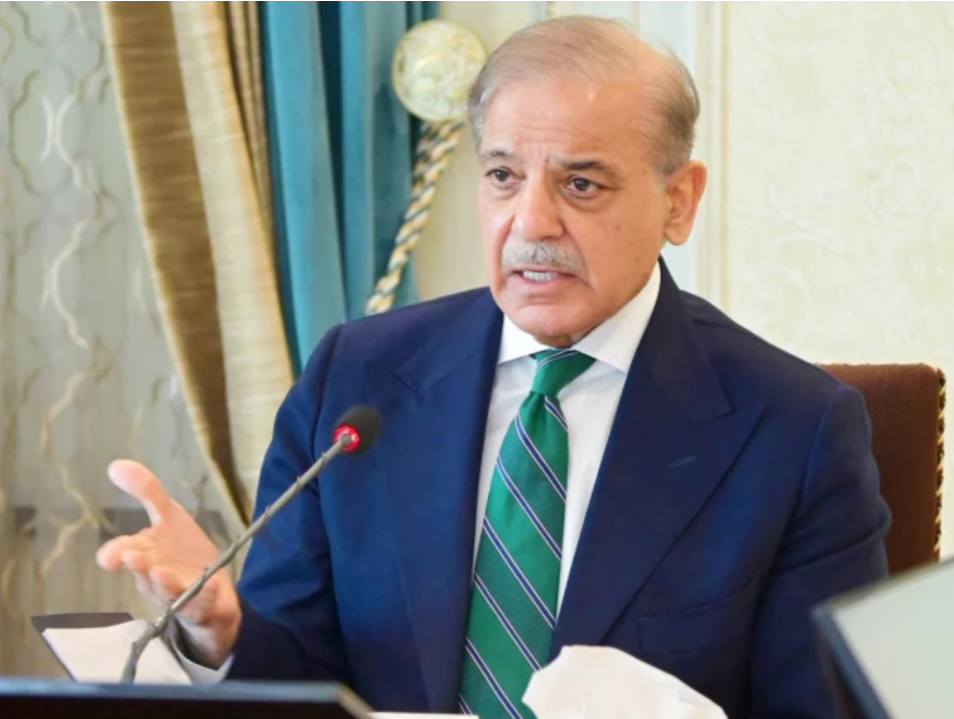
Prime Minister Shehbaz Sharif on Thursday reaffirmed his government’s commitment to fast-tracking institutional reforms and strengthening macroeconomic stability, declaring that Pakistan is now transitioning from recovery toward sustained economic growth.
“By the grace of Allah, Pakistan is progressing from economic stabilisation to long-term, sustainable growth,” the prime minister stated during a high-level meeting with an International Monetary Fund (IMF) delegation led by Jihad Azour at the Prime Minister’s Office.
Shehbaz Sharif stressed that while maintaining macroeconomic gains remains a key priority, accelerating comprehensive institutional reform is critical for ensuring long-term economic resilience.
The meeting focused on the ongoing implementation of Pakistan’s current IMF programme, with both sides expressing satisfaction over the progress made and the positive outcomes of recent policy measures.
The IMF delegation acknowledged Pakistan’s reform efforts and reaffirmed its support for the country’s economic stabilisation and inclusive growth initiatives.
Federal Ministers Ahsan Iqbal, Cheema, Muhammad Aurangzeb, Finance Secretary Imdadullah Bosal, FBR Chairman Rashid Mehmood Langrial, and other senior officials also attended the meeting.
Budget Talks and IMF Engagement
Jihad Azour, IMF’s Director for the Middle East and Central Asia, is currently visiting Pakistan amid ongoing discussions surrounding the upcoming federal budget for fiscal year 2025–26. His visit comes just 10 days after Pakistan received the second tranche of a $7 billion loan programme — a disbursement reportedly opposed by India. Nonetheless, the visit is seen as a sign of strong working relations between Pakistan and the IMF despite external criticism.
While the IMF and Pakistan’s Ministry of Finance have not publicly disclosed the specific purpose of Azour’s visit, officials confirmed it is focused on resolving budget-related matters, particularly key spending areas.
According to government sources, the IMF has introduced a new requirement: parliamentary approval of the 2025–26 budget must align with the staff-level agreement to meet programme benchmarks. This stipulation has limited the government’s flexibility to implement its own fiscal priorities, even as PM Sharif aims to provide relief to salaried citizens.
Key Budget Points Under Review
Discussions with the IMF are centred on taxation targets, defence expenditure, and grant allocations. The federal government is planning to allocate approximately Rs2.504 trillion for defence in the next fiscal year — an 18% increase from the current year. However, the IMF’s latest staff-level report projects defence spending at Rs2.414 trillion, reflecting a more conservative 12% rise.
Some grants and subsidies have yet to be finalised.
On the revenue side, the Federal Board of Revenue (FBR) presented its proposed tax plan for FY2025–26 to the prime minister. Officials revealed that the FBR’s projected revenue may be around Rs14.07 trillion — roughly Rs240 billion short of the target previously agreed upon with the IMF.
In a bid to bridge the gap, the government is reportedly considering a significant hike in the petroleum levy. The IMF anticipates revenue from the petroleum levy to exceed Rs1.3 trillion in the coming fiscal year, potentially making it the largest source of non-tax revenue. This would require increasing the levy to Rs100 per litre on petrol and diesel, up from the current rate of Rs78 per litre.