DG ISPR: India’s ‘Fitna al-Hindustan’ has Sponsored Terrorism in Pakistan for Over 20 Years
ISLAMABAD:
Following the devastating suicide attack on a school bus in Khuzdar on Wednesday, Interior Secretary Captain (retd) Khurram Agha asserted that Pakistan stands fully prepared to carry out a military operation similar to Zarb-e-Azb, should the need arise.
The tragic assault claimed the lives of at least eight people, six of whom were children. Sharing details from preliminary investigations, Agha said the attack was orchestrated by ‘Fitna al-Hindustan’ — a group seen as a proxy for Indian interests — marking a shift in targeting strategy from hard to soft targets. He condemned the “cowardly attack on innocent lives,” vowing that Pakistan’s response would be decisive.
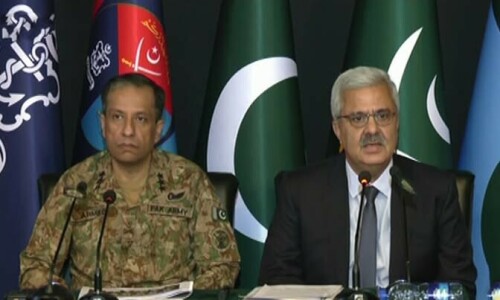
Speaking alongside DG ISPR Lt Gen Ahmed Sharif Chaudhry during a joint press conference in Rawalpindi on Friday, Agha recalled how Operation Zarb-e-Azb, launched in the aftermath of the 2016 Army Public School tragedy, had significantly curbed terrorism in the country.
He said, “If the situation demands, the government may decide to launch an operation similar to Zarb-e-Azb, but for now, we are already engaged in continuous counterterrorism operations.” He added, “This attack was not merely on a school bus; it was an attack on our values, our education, and the very fabric of our society. Our response will be decisive. They will not succeed.”
India’s Involvement and State-sponsored Terrorism
Lt Gen Chaudhry emphasised that the attackers sponsored by India had no sense of humanity or identity — Pakistani or Baloch — and that India has been orchestrating terrorism in the region for over two decades. He reminded that in 2009, Pakistan had submitted a dossier to the UN detailing India’s involvement in terrorism in Balochistan. Similar evidence was shared in 2016, including confessions by arrested terrorists who admitted to receiving Indian funding.
Chaudhry linked the Khuzdar attack to India’s wider agenda of using proxies to destabilise the region. He also outlined other recent attacks tied to India’s influence, including:
- The killing of 12 labourers in Nushki on April 12
- The deaths of two civilians in Tump Kech on April 28
- An IED attack in Harnai on February 14 that killed 10
- The targeting of off-duty security personnel and attacks in Lasbela on May 9
He noted that the Khuzdar incident marked a new low, with terrorists specifically targeting women and children. During the briefing, graphic images and footage of the attack’s aftermath were shown.
The DG ISPR confirmed that these attacks were carried out by Fitna al-Hindustan, with direct Indian support. He stressed that terrorism in Balochistan was not rooted in any ethnic or religious conflict, but in India’s longstanding proxy war.
He even played an audio clip of an Indian army officer, Major Sandeep, allegedly discussing how funds were transferred to support terrorism in Balochistan, exposing India’s deep involvement in destabilising Pakistan.
India’s Role and Pakistan’s Evidence
Chaudhry also questioned the credibility of India’s claims about Pakistan’s alleged support for terrorism, noting that India had never provided credible evidence to support such accusations, while Pakistan had consistently presented hard evidence to the international community.
The press conference also showcased images of advanced foreign weapons — including sniper rifles and night-vision gear — seized from terrorists in Balochistan. Lt Gen Chaudhry suggested that India was the primary source of these sophisticated arms.
He pointed out that India’s media was complicit in the narrative against Pakistan, celebrating attacks on Pakistani women and children and misrepresenting facts to paint Pakistan as the aggressor.
Counterterrorism Success and Development Initiatives
Lt Gen Chaudhry shared that in Balochistan alone, over 200 terrorists have been killed by Pakistani security forces so far this year, with nearly 250 killed last year. He said that Pakistan is shutting down illegal trade routes that fund terrorism, with local communities supporting these counterterrorism efforts.
He linked India’s aggressive tactics to Pakistan’s growing economic footprint in Balochistan, highlighting development projects such as the Gwadar International Airport, the construction of roads and hospitals, and investment in the blue economy. Over 73,000 Baloch students are currently benefiting from scholarships, he noted, signalling the region’s progress and prosperity as a challenge to India’s destabilisation agenda.
Pakistan’s Firm Stance on Sovereignty
Lt Gen Chaudhry reiterated that Pakistan’s strategy focuses on intelligence-based operations to eliminate terrorism while minimising civilian harm. He emphasised that India’s use of proxy groups to create instability would not deter Pakistan’s resolve to defend its sovereignty.
In conclusion, the DG ISPR also touched upon the broader regional dynamics, stating that India must acknowledge Pakistan’s determination to protect its territory and rights, including those enshrined in the Indus Waters Treaty. He also reaffirmed that resolving the Kashmir dispute was essential for peace in the region.
Military Commanders’ Resolve
Separately, a day earlier, military commanders gathered at the 270th corps commanders’ conference, chaired by Army Chief Field Marshal Syed Asim Munir in Rawalpindi. They declared that “no one can coerce Pakistan through the use or threat of force” and vowed to decimate hostile elements trained and financed to foment chaos in the country.
According to the ISPR, the forum reaffirmed Pakistan’s unwavering resolve to defend its sovereignty and strategic interests, highlighting that any act of aggression or misadventure would be met with a decisive response.