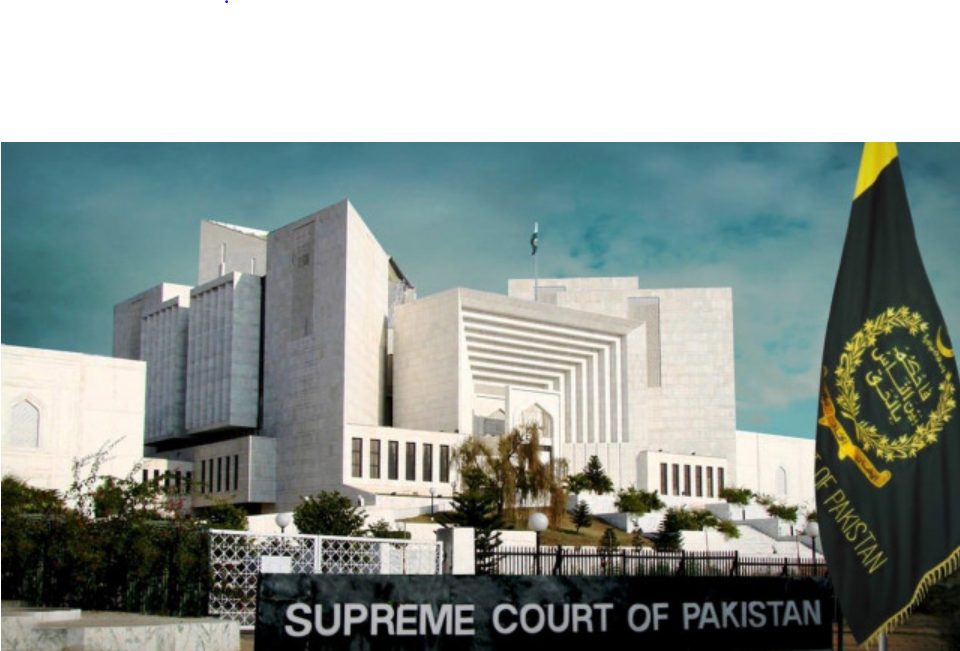
For the first time since the 26th Constitutional Amendment was passed, the Supreme Court of Pakistan livestreamed its proceedings as it resumed hearing a set of review petitions challenging the apex court’s July 12, 2024 ruling that declared the Pakistan Tehreek-e-Insaf (PTI) eligible for reserved seats.
An 11-member bench led by Justice Aminuddin Khan is hearing the review petitions against the ruling, which has not yet been implemented. In that short order, eight of the 13 judges had determined that 39 out of 80 MNAs in the National Assembly were returned candidates of the PTI.
During the hearing, Justice Jamal Khan Mandokhail observed that presiding and returning officers had not fulfilled their legal and constitutional duties in the February 2024 general elections. He questioned senior counsel Makhdoom Ali Khan, who is representing some women petitioners, whether the court should ignore these failings.
Justices Ayesha A Malik and Aqeel Ahmed Abbasi had dismissed the review petitions on the first day of proceedings. The remaining bench includes Justices Jamal Khan Mandokhail, Muhammad Ali Mazhar, Syed Hasan Azhar Rizvi, Musarrat Hilali, Naeem Akhter Afghan, Shahid Bilal Hassan, Muhammad Hashim Khan Kakar, Salahuddin Panhwar, Aamer Farooq, and Ali Baqar Najafi.
Interestingly, six judges, including the author of the majority decision, are not part of this larger bench.
Justice Shahid Bilal and Justice Mussarat Hilali questioned how PTI was allocated reserved seats when it was not a party to the original proceedings at the Election Commission of Pakistan (ECP) or the Peshawar High Court.
Justice Aminuddin Khan remarked that it was an undisputed fact that all PTI-backed candidates had joined the Sunni Ittehad Council (SIC), which had not contested the general elections.
Makhdoom Ali Khan, representing PML-N and PPP women candidates impacted by the July ruling, argued that the SIC could not be awarded reserved seats as it did not participate in the elections. Justice Malik also raised this point, questioning how independent lawmakers could join a party that was not in parliament.
The PPP lawyer clarified that the SIC did not contest the elections and that its chairman, Sahibzada Hamid Raza, had run as an independent candidate.
Justice Mandokhail concluded, “The SIC is not eligible for reserved seats. While it could form a parliamentary party, it cannot claim these reserved seats.”
Makhdoom argued that once the ECP allocates reserved seats, they cannot be questioned through quo warranto jurisdiction. He noted that election disputes fall under Article 225 of the Constitution, and he questioned the court’s decision to invoke Article 187 to allocate seats to PTI, arguing that the Supreme Court has limited jurisdiction under Article 185.
His arguments were completed, and interestingly, the counsels for the PML-N and the ECP also adopted his stance.
The hearing was adjourned until tomorrow, when SIC counsel Faisal Siddiqi will present his arguments.
In its detailed verdict on the reserved seats matter, authored by Justice Mansoor Ali Shah, the Supreme Court criticised the ECP for its “unlawful acts and omissions,” saying they had prejudiced PTI and its voters. The court also rebuked the ECP for not acting impartially during the elections.
On September 14, 2024, when the government failed to introduce the 26th Amendment in Parliament, the Supreme Court issued a clarification, criticising the ECP for not implementing the July 12 ruling on the reserved seats case.
Then on October 18, Justice Shah again clarified that the amendment to the Elections Act 2017, made in August, could not overturn the verdict on reserved seats.
The “Elections (Second Amendment) Act, 2024” was seen as a way to bypass the SC ruling by preventing independent lawmakers from joining a political party after a certain period.
A six-judge bench is set to hear PTI’s petition challenging these amendments in December 2024, while PTI’s separate challenge to the January 13, 2024 ruling on its election symbol remains pending.