ISLAMABAD: Senators on Friday asserted that Pakistan would not tolerate any attempt by India to suspend or amend the Indus Waters Treaty (IWT), warning that such unilateral action would be seen as an act of war.
They emphasized that the treaty is a settled matter, and international law would back Pakistan’s military response if India blocks the water flow.
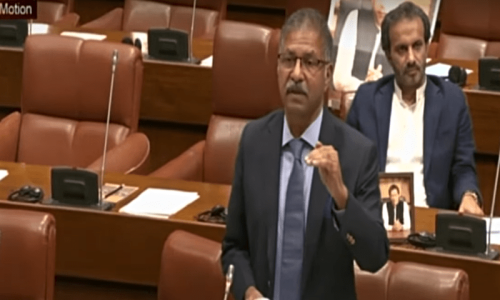
During the debate on India’s unilateral suspension of the IWT, PTI parliamentary leader Ali Zafar described the looming water crisis as an existential threat, likening it to terrorism. “This is a war imposed on us. The ticking water bomb must be defused before it detonates,” he warned.
Mr Zafar said that according to international law and UN resolutions, water is a fundamental human right for lower riparian countries. Accusing India of violating international norms by holding the treaty in abeyance, he noted that the UN Charter and various conventions give Pakistan the right to take any necessary measures—including military action—if India disrupts Pakistan’s share of water.
“If India stops even a drop of our water, international law and UN resolutions authorize Pakistan to destroy the infrastructure using missiles, planes, or soldiers,” he declared.
He urged the government to be cautious in discussing the issue to avoid damaging Pakistan’s case internationally.
Mr Zafar also pointed out that Pakistan is moving rapidly toward water scarcity due to climate change and population growth, adding that the Indus basin is a lifeline for 90% of Pakistan’s people and agriculture.
He called for unity across party lines to address the issue.
Opposition Leader Shibli Faraz echoed these views, saying the IWT is a settled treaty that cannot be changed without the consent of both parties. “No Pakistani government even has the mandate to amend the treaty unilaterally,” he said. He warned against knee-jerk reactions and called for a carefully prepared response.
Faraz stressed the need for a comprehensive plan to address the water crisis technically and internationally.
PTI Senator Humayun Mohmand said there was no need to hold talks with India on the matter, while JUI-F Senator Kamran Murtaza took a more measured stance, saying that military action against a country with a $700 billion economy would be challenging.
Murtaza noted that Pakistan had already lost several water-related cases internationally. He proposed forming a parliamentary committee of legal experts to review all agreements with India, including the Shimla Agreement and the IWT.
‘Tyranny of Majority’
Earlier in the session, Mr Faraz lamented how the Senate had been run in the past year, saying democracy does not mean “tyranny of the majority.” He argued that the upper house had been reduced to a mere post office and called for a return to a democratic approach in its proceedings.
He criticized the frequent bypassing of rules and rushed legislation, saying the upper house’s role must not be undermined. Faraz highlighted the disappearance of a healthy debate culture and stressed that the opposition’s duty is to hold the government accountable.
He also accused the ruling coalition of monopolizing key committees like the Finance Committee to weaken the system of checks and balances.
Faraz urged all members to work together to restore the Senate’s dignity and ensure it regains respect.
In response, PML-N parliamentary leader Irfan Siddiqui, who chaired the session, agreed with most of Faraz’s concerns. However, he noted that similar issues existed when PTI was in power, with only one minister answering questions for all ministries.
Siddiqui supported holding the question hour and proposed that decisions on this be made in consultation with both the government and the opposition.
He emphasized that members should be given advance notice and complete details about upcoming legislation to strengthen the upper house’s role.
Former deputy chairman and PPP lawmaker Saleem Mandviwala also agreed, stressing that the question hour should be held regularly.