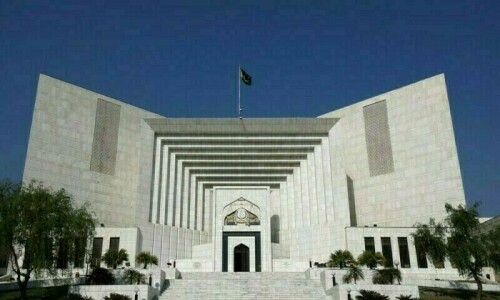
ISLAMABAD: The Supreme Court’s Constitutional Bench on Thursday deliberated over how to properly determine the seniority of judges, as it heard a case involving a seniority dispute among Islamabad High Court (IHC) judges.
Presiding over the five-member bench, Justice Muhammad Ali Mazhar raised the key question: should the authority to determine superior court judges’ seniority rest with the President or the Chief Justice of Pakistan (CJP)?
Justice Mazhar also drew parallels to civil service practices, noting that when officers are transferred to a new department, their seniority often resets to the bottom. He questioned whether any similar rules or traditions apply for judges, or whether such comparisons are even valid.
Case Background
The bench was reviewing a joint petition filed by five IHC judges — Justices Mohsin Akhtar Kayani, Tariq Mehmood Jahangiri, Babar Sattar, Sardar Ejaz Ishaq Khan, and Saman Rafat Imtiaz — who argued that three judges transferred to the IHC should not be considered IHC judges unless they take a fresh oath under Article 194, as required by the Constitution.
Representing the petitioners, senior lawyer Muneer A. Malik argued that the transfer process lacked meaningful consultation, especially between the CJP and the chief justices of the affected high courts. Therefore, he asserted, the transfers should be nullified.
Key Points Raised in Court
Justice Shahid Bilal Hassan pointed out that in the past, transferred judges had even gone on to become chief justice of the IHC. He asked whether those judges had been required to take a fresh oath upon transfer. Malik responded that those transfers had happened after the IHC was re-established under the 18th Amendment and the Islamabad High Court Act, 2010, following its earlier dissolution.
Malik further claimed that the consultation process lacked transparency — for instance, no explanation was provided for why Justice Sardar Muhammad Sarfraz Dogar was selected from among 33 Lahore High Court judges, despite being ranked only 16th in seniority.
Justice Salahuddin Panhwar commented, “You’re suggesting no option was offered to other LHC judges for transfer to the IHC,” while observing that the petitioners appeared particularly concerned with Justice Dogar’s transfer.
When Justice Mazhar noted that one of the official summaries had stated the transferred judges would keep their seniority, Malik clarified that the communication was directed to the prime minister, not the CJP.
Seniority & Future Appointments
Malik stressed that under the Judicial Commission of Pakistan (JCP) rules, the top five judges of a high court now reasonably expect to be considered for the position of chief justice. If a lower-ranked judge is suddenly elevated, it opens the door for a quo warranto petition to challenge the appointment.
He argued that key issues — such as selection criteria and salary details — were not even discussed during consultations. He cited a past case from the Balochistan High Court, where consent for a transfer was obtained only from the acting chief justice (ACJ), which raises legal concerns.
Malik referred to the Al-Jihad Trust case, which held that an ACJ can only handle routine tasks and cannot recommend judicial appointments. Justice Mazhar, however, noted that the context was different at the time because decisions were made between the CJP and the President, whereas today, the JCP has a collective vote.
Malik concluded by emphasizing that the seniority issue is not just about personal ranking — it affects the entire system, and currently, there is no clear legal framework to establish judges’ seniority.