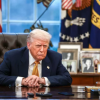
WASHINGTON — President Donald Trump’s decision to launch airstrikes on Iran’s nuclear facilities — joining Israel’s offensive against Tehran — represents his most perilous foreign policy move to date, analysts warn. The operation, which targeted Iran’s heavily fortified underground nuclear site at Fordow, is being described as a high-stakes gamble that could trigger dangerous escalation across the region.
For a president who long vowed to avoid getting entangled in new foreign wars, the strikes mark a dramatic shift. Trump, addressing the nation on Saturday, framed the attack as a necessary step to force Iran to the negotiating table. He warned Tehran to choose peace or face further military action.
However, experts caution that the strikes may backfire, prompting Iran to retaliate in ways that could spiral into a wider, prolonged conflict. Potential scenarios include closure of the vital Strait of Hormuz, attacks on U.S. military bases and allies in the region, missile strikes against Israel, and activation of proxy groups targeting U.S. and Israeli interests globally.
“The Iranians are seriously weakened and degraded in their military capabilities,” said Aaron David Miller, a former U.S. Middle East negotiator. “But they have all sorts of asymmetric ways to respond. This is not going to end quick.”
Trump reportedly approved the strikes after determining Iran was not interested in a nuclear deal and after receiving assurances of a high probability of success following Israel’s sustained air campaign on Iran’s military and nuclear sites.
Nuclear Threat Persists Despite Strikes
Trump hailed the strikes as a “great success,” highlighting the use of powerful bunker-buster bombs. While U.S. officials claim Iran’s nuclear program has been set back by years, experts argue that the strikes could strengthen Tehran’s resolve to pursue nuclear weapons as a deterrent.
The Arms Control Association, a nonpartisan group advocating arms control, said in a statement: “Military action alone cannot eliminate Iran’s nuclear knowledge. The strikes will delay the program, but at the cost of reinforcing Tehran’s determination to rebuild.”
Iran, which maintains that its nuclear program is for peaceful purposes, vowed to resist further aggression. Its Atomic Energy Organization stated it would not allow development of its “national industry” to be halted, and state media warned that U.S. personnel across the region are now legitimate targets.
“Iran considers it its right to resist with all its might against U.S. military aggression,” the foreign ministry said in a statement.
Karim Sadjadpour, an analyst at the Carnegie Endowment for International Peace, wrote on social media: “Trump says this is the time for peace. It’s unlikely the Iranians will see it that way. This is more likely to open a new chapter in the long-running U.S.-Iran confrontation than conclude it.”
Fears of Mission Creep and Broader War
Some analysts fear the strikes could pull the U.S. deeper into a quest for regime change if Iran escalates or accelerates its nuclear program. Laura Blumenfeld of Johns Hopkins University warned of the risks of “mission creep” and failed attempts at forced democratization.
Jonathan Panikoff, former U.S. deputy intelligence officer for the Middle East, said Iran’s leadership could resort to disproportionate responses if it believes its survival is at stake. Still, Tehran would also weigh the costs of moves like closing the Strait of Hormuz, which could harm China — one of its few powerful allies — as well as the U.S.
Trump now faces backlash from Democrats in Congress and skepticism from anti-interventionist voices within his own Republican Party. Six months into his second term, he finds himself at the center of a major international crisis — despite promises to avoid foreign entanglements and end wars in Ukraine and Gaza.
“Trump is back in the war business,” said Richard Gowan, UN director at the International Crisis Group. “Few in Moscow, Tehran, or Beijing ever believed his peacemaker rhetoric. It always looked more like a campaign slogan than a genuine strategy.”