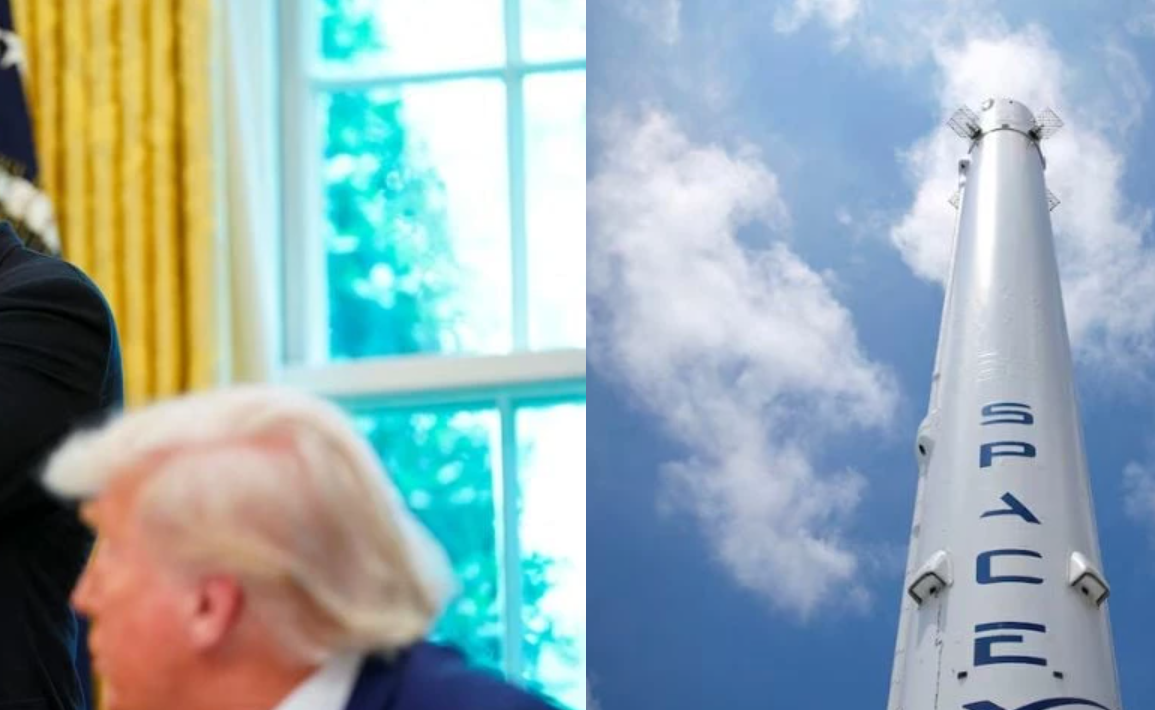
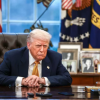
A dramatic fallout between former allies—President Donald Trump and billionaire entrepreneur Elon Musk—has escalated into a public and political firestorm, putting more than $22 billion in government contracts and the future of the U.S. space program in jeopardy.
What began as a policy disagreement over Trump’s sweeping tax-and-spending bill quickly spiraled into a full-blown feud, amplified across social media and fueled by personal barbs. Musk denounced Trump’s legislation as a “disgusting abomination” that would balloon the federal deficit. Trump retaliated by threatening to sever federal contracts and subsidies to Musk’s companies, including Tesla and the aerospace giant SpaceX.
The impact was swift and severe. Tesla’s stock plummeted 14.3%—its steepest single-day decline in history—wiping out around $150 billion in market value. Meanwhile, Musk threatened to decommission SpaceX’s Dragon spacecraft, the only active U.S. vehicle capable of ferrying astronauts to the International Space Station. Though he reversed that threat hours later, the mere suggestion sent shockwaves through NASA and the broader space community.
The stakes are enormous. SpaceX holds around $22 billion in government contracts, including a $5 billion deal with NASA for the Dragon capsule, a crucial component of U.S. space operations. It also dominates the commercial launch industry and holds contracts to deploy national security satellites for the Pentagon and intelligence agencies.
This high-profile rupture marks a stunning reversal for a relationship that once seemed unshakable. Musk had been one of Trump’s most visible allies, serving as head of the Department of Government Efficiency and contributing nearly $300 million to Republican campaigns. Just a week before their public fallout, the two appeared together in the Oval Office, vowing continued collaboration.
But behind the scenes, tensions had been simmering. Musk clashed with cabinet officials over his aggressive budget-cutting agenda, and his criticism of Trump’s bill—particularly its elimination of EV tax credits and inclusion of what he called “mountains of pork”—pushed the relationship over the edge.
Trump, never one to back down from a challenge, responded by not only threatening SpaceX’s contracts but also torpedoing Musk’s preferred pick to head NASA, billionaire astronaut Jared Isaacman. The White House abruptly removed Isaacman from consideration, with Trump dismissing him as “totally Democrat”—a claim partially supported by Isaacman’s mixed political donations.
The feud has created uncertainty around key U.S. space initiatives. NASA, already facing layoffs and program cuts under Trump’s budget plan, could now be forced to rely more heavily on Russia’s Soyuz spacecraft for astronaut transport if relations with SpaceX deteriorate further. Planned missions to the Moon and Mars, as well as ambitious military space projects, could stall or be redirected to more expensive alternatives like the Space Launch System (SLS), whose funding was partially restored by the Senate in defiance of Trump’s proposal.
The consequences also extend beyond space. Musk’s flirtation with launching a new political party and his public musings about impeachment have widened divisions within the Republican Party, where he had previously served as a bridge to Silicon Valley and a key donor network. His pivot away from political funding and growing list of critics within the GOP threaten to destabilize the party ahead of the 2026 midterms.
Both Trump and Musk are no strangers to political pugilism. But this clash between the most powerful man in politics and the richest man in the world has transcended personal grievance and veered into territory with serious national and global implications.
Former NASA Deputy Administrator Lori Garver summed it up best: “A rogue CEO threatening to decommission spacecraft, putting astronauts’ lives at risk, is untenable.” Yet so, too, is a president using federal contracts as political weapons.
The path forward is uncertain, but the damage is already done. A once-powerful alliance has imploded, and what remains is a cautionary tale about the perils of mixing personal vendettas with public policy.