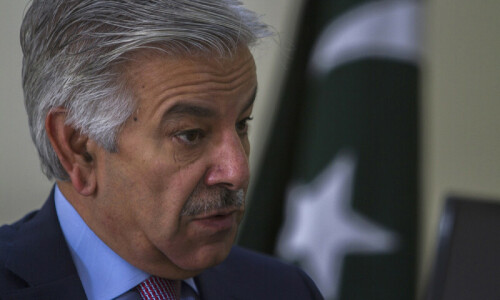
Federal Defence Minister Khawaja Asif has outlined that, should talks take place between Pakistan and India, three critical issues would be on the agenda: Kashmir, terrorism, and water-related concerns.
In an interview with Geo News, Asif explained that these issues have been longstanding, with terrorism having plagued the region for the past 20 to 30 years. He emphasized that this represents a golden opportunity for both nations to address the Kashmir dispute.
Asif remarked, “There are three key issues: Kashmir, terrorism, and water. These are historical problems that have persisted for 76 years and need to be addressed. Pakistan has been the biggest victim of terrorism, and this is a significant chance for both countries to resolve the issue. Regarding Kashmir, this is a historic moment. Even Trump has raised the Kashmir issue, which is another breakthrough—he has called for Kashmir to be part of the discussions.”
The defence minister noted that nearly all conflicts between India and Pakistan have been driven by the Kashmir issue. “The recent conflict was also about Kashmir. Modi attempted to turn the region into a living hell, but by God’s grace, we were saved. Our armed forces stood firm like an iron wall. These issues need to be resolved now,” he added.
Asif also pointed out the irony that Pakistan, the country most affected by terrorism, is often blamed and attacked for it.
Regarding the water dispute, Asif reaffirmed that the issue had already been addressed under the 1960 Indus Waters Treaty, which remains binding and cannot be suspended.
He continued, “Our response demonstrates our preparedness. The strong reaction we gave has left them wounded. Modi is facing criticism in the Indian Parliament, and their media and military briefings reflect their discomfort. This is also a diplomatic win for us. Apart from Israel, no one stands with India. If India tries again, the entire world will support Pakistan. Pakistan has shown both restraint and military strength. In our 76-year history, our forces have not achieved a victory as significant as this.”
Pakistan-India Ceasefire
On Saturday, Pakistan and India agreed to a full and immediate ceasefire, following several days of intense military exchanges that had raised fears of a large-scale war between the two nuclear-armed neighbors.
The ceasefire was first announced by US President Donald Trump and later confirmed by Pakistan’s Prime Minister Shehbaz Sharif, Deputy Prime Minister Ishaq Dar, Indian External Affairs Minister S. Jaishankar, and US Secretary of State Marco Rubio. This truce came after missile strikes, drone incursions, and retaliatory operations across the border.
The tensions had escalated after a deadly attack on April 22 in Pahalgam, in Indian Illegally Occupied Jammu and Kashmir (IIOJK), which resulted in 26 civilian deaths. India blamed elements based in Pakistan without providing evidence, a claim Pakistan rejected.
India responded by closing the Wagah border, revoking Pakistani visas, and suspending the Indus Waters Treaty—actions Pakistan labeled as “acts of war.”
By May 6–7, Pakistan launched Operation Bunyan-un-Marsoos, claiming to have shot down five Indian jets, including Rafales, and intercepted 77 Israeli-origin Harop drones.
The United States played a pivotal role in facilitating backchannel diplomacy. Secretary Rubio and Vice President JD Vance held discussions with senior leaders from both countries, including PMs Shehbaz Sharif and Narendra Modi, as well as top defense and intelligence officials.
After Trump’s announcement, both nations suspended military activities across land, air, and sea, although reports of ceasefire violations were also reported from both sides of the Line of Control (LoC).