- Interior secretary says NAP is being revitalized
- Foreign Office condemns Modi’s accusations
- UNSC denounces school bus attack
ISLAMABAD: Pakistani authorities announced on Friday that they will continue to rely on intelligence-based operations (IBOs) in Balochistan to counter terrorism, rather than launching a large-scale military offensive at this time.
“Intelligence-based operations will continue,” stated Lt Gen Ahmed Sharif Chaudhry, Director General of Inter-Services Public Relations (ISPR), during a joint press conference alongside Federal Interior Secretary Khurram Agha in Rawalpindi.
The joint briefing highlighted a unified civil-military stance on counterterrorism, especially amid growing tensions with India and the worsening security situation in Balochistan.
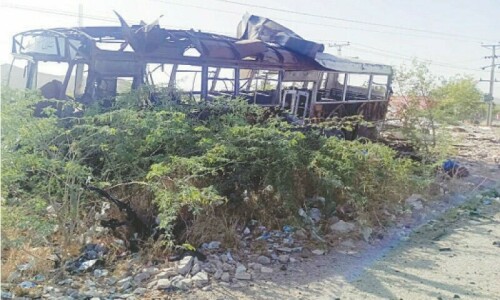
These remarks came in the wake of a suicide bombing in Khuzdar that targeted a school bus transporting children of military personnel. The attack claimed eight lives—including six children—and injured dozens more. Two additional children, Haider (13) and Malika (12), died from their injuries, raising the death toll to eight.
Pakistan’s military has accused India of masterminding the attack through proxy groups in the troubled province.
Condemning the attack, Interior Secretary Agha said, “This assault on the school bus in Khuzdar was an attack on our values, our education system, and the very fabric of our society.” He noted that initial investigations suggest it was carried out by India-backed terrorists operating as “Fitna al Hindustan” (Indian mischief).
The phrase ‘Fitna al Hindustan’ is a new term introduced by the military, framing India’s alleged role in terrorism as a deliberate strategy to destabilize Pakistan and rally domestic support.
Lt Gen Chaudhry stressed that terrorism in Balochistan is being addressed through “rational” means, citing Pakistan’s decades of experience in developing advanced counterterrorism methods.
“Intelligence-based operations are a highly effective way to neutralize terrorists. We are tracking them down and eliminating them,” he said. “The number of terrorists killed through these operations far exceeds those targeted in large-scale campaigns.”
This focus on targeted, intelligence-driven strikes suggests an effort to minimize civilian casualties—addressing criticism of past heavy-handed military operations.
Soft Targets
The military spokesperson revealed that the armed forces are currently conducting nearly 150 IBOs daily without disrupting civilian life. “The terrorists, having suffered significant losses, are now attacking soft targets. This highlights the success of our operations,” he added.
Interior Secretary Agha reiterated that a broader military campaign, like Operation Zarb-i-Azb, could be launched if necessary, but only after all preparations are complete. “If required, a major operation similar to Zarb-i-Azb will be initiated later. At the moment, all operations are ongoing,” Agha said.
Referencing Operation Zarb-i-Azb (2014-2017), which significantly weakened militant groups, he signaled that a large-scale military offensive remains an option but with a cautious approach to avoid further destabilizing Balochistan.
He also mentioned that the National Action Plan (NAP) is being “revitalized” to bolster future counterterrorism efforts. “All aspects of the NAP are being strengthened to ensure that social, economic, legal, counterterrorism, information, and political domains are fully operational,” he said. “When we launch a major operation… everything will be in place.”
The NAP, initiated after the 2014 Peshawar Army Public School attack, aims to address not only security threats but also socio-economic factors fueling unrest in Balochistan.
Proxies Activated
Lt Gen Chaudhry pointed to the coordinated attacks on May 9 and 10, which involved 33 incidents across Balochistan, as evidence of collaboration between India and proxy groups.
“While India was firing missiles into Pakistan, it was also activating these proxies,” he said. “This synchronized campaign proved the link between Fitna al Hindustan and India.”
He argued that India’s alleged targeting of Balochistan was driven by Pakistan’s recent economic strides in the province. “Balochistan has reached a critical phase of socio-economic development, with the Gwadar airport inauguration and road network expansions,” he said.
He emphasized that resolving the Balochistan conflict requires a comprehensive approach that combines military, political, and economic tools.
Agha underscored the government’s determination to confront terrorism: “The state has the capacity and the will to dismantle these networks and bring their handlers to justice. Such actions will have consequences… Our resolve is firm and our response will be decisive.”
Addressing rising tensions with India, the DG ISPR warned of serious repercussions if provocations continue. “India is using terrorism as a weapon against Pakistan through Fitna al Hindustan and Fitna al Khawarij,” he said. “Pakistan, meanwhile, is acting as a rational state, committed to peace through the resolve of its people and the strength of its armed forces.”
He also condemned India’s “arrogant political mindset,” linking it to New Delhi’s refusal to address the Kashmir issue and the oppression of minorities—factors he said fuel instability in the region.
FO Rejects Allegations
Earlier on Friday, Pakistan’s Foreign Office (FO) rejected what it described as the “baseless, provocative, and irresponsible” accusations made by Indian Prime Minister Narendra Modi in a speech in Rajasthan.
“These remarks, full of distortions and inflammatory rhetoric, aim to stir up regional tensions for domestic political gain,” said Foreign Office spokesperson Shafqat Ali Khan. “Such statements mislead the public and violate the norms of responsible statecraft.”
He stressed that threats and boasts of military action against a sovereign nation contravene the UN Charter and international law, undermining regional peace.
The spokesperson reaffirmed Pakistan’s commitment to global counterterrorism efforts and dismissed any allegations linking Pakistan to terrorism as false and politically motivated. He said such accusations are often used to distract from India’s internal challenges and its repressive policies in Indian-occupied Kashmir.
“India’s attempts to cover up its serious human rights violations are well documented and recognized by the international community,” he added. “The legitimate struggle of the Kashmiri people cannot be erased through aggressive rhetoric.”
He urged India to show restraint and responsibility, warning that escalatory rhetoric only deepens tensions.
UNSC Condemns Khuzdar Attack
Meanwhile, the United Nations Security Council (UNSC) strongly condemned the attack on the school bus in Khuzdar, describing it as a “heinous and cowardly” act that killed at least six people, including four children, and injured more than 50 others.
In an official statement, the UNSC expressed profound sorrow and offered condolences to the victims’ families and the Pakistani government. “We express our deepest sympathy and condolences to the families of the victims and to the government and people of Pakistan. We wish a speedy and full recovery to those injured,” the statement read.