
Mahmud Abbas accuses Netanyahu of prolonging war for personal motives; Italy decries worsening humanitarian crisis
GAZA CITY: At least 80 Palestinians were killed on Wednesday in intensified Israeli airstrikes across the Gaza Strip, according to local rescue officials, as the Israeli military ramped up its large-scale assault on the embattled territory.
Mohammed al-Mughayyir, a senior official with Gaza’s civil defence, confirmed the death toll since dawn, reporting that 59 of the fatalities occurred in the northern part of the enclave.
Scenes from Jabalia in northern Gaza depicted utter devastation—piles of rubble, twisted rebar, and collapsed buildings. Displaced Palestinians, including children, were seen combing through the ruins in search of any salvageable belongings.
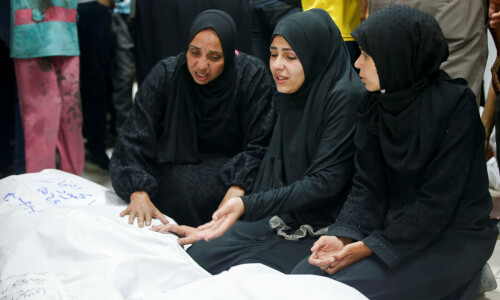
In other footage, grieving women knelt beside bloodied shrouds of the deceased. One mourner cried out, “It’s a nine-month-old baby. What did he do?”
Hasan Moqbel, a local resident, described dire conditions: “There are no livable homes left. I have no shelter, no food, no water. If you’re not killed by airstrikes, you die from hunger or the lack of medicine.”
The Israeli military issued new evacuation warnings to residents of a Gaza City neighbourhood, stating it planned to “strike the area with overwhelming force.”
Prisoners and Negotiations
Israeli Prime Minister Benjamin Netanyahu met with U.S. envoy Steve Witkoff on Wednesday to discuss efforts to free hostages held in Gaza. Talks on the issue are ongoing in Doha, where U.S. President Donald Trump was also visiting.
Netanyahu’s office said the discussion focused on the fate of captives and missing persons. Witkoff later noted that Trump had a “very productive conversation” with Qatar’s emir regarding a Gaza ceasefire plan and that both sides were aligned on a “solid path forward.”
Calls for Ceasefire
From the occupied West Bank, Palestinian President Mahmud Abbas reiterated his call for an immediate ceasefire “at any cost,” accusing Netanyahu of dragging the war on “for his own political reasons.”
In northern Gaza’s Indonesian Hospital, emergency physician Mohammad Awad painted a grim picture: “We’re overwhelmed. There are no beds, no medicine, and no surgical tools. People are dying simply because we can’t treat them.”
He added that the morgue is at full capacity and that bodies now lie in hospital corridors. “This is a complete humanitarian disaster,” he said.
Israel enforced a full blockade on humanitarian aid entering Gaza on March 2, following the collapse of talks to extend the January 19 ceasefire.
Global Response
United Nations Secretary-General António Guterres renewed his calls for an immediate ceasefire, the unconditional release of hostages, and unrestricted humanitarian access into Gaza.
Italian Prime Minister Giorgia Meloni described the humanitarian situation in Gaza as “increasingly dire and indefensible.” A U.S.-backed aid plan, which proposes delivery of supplies under Israeli military oversight, drew backlash from international groups for bypassing the UN and other established aid networks.
Médecins Sans Frontières (Doctors Without Borders) condemned the proposal, arguing that it effectively ties aid to forced displacement and population screening. The organization warned that Israel was “creating conditions for the extermination of Palestinian life in Gaza.”