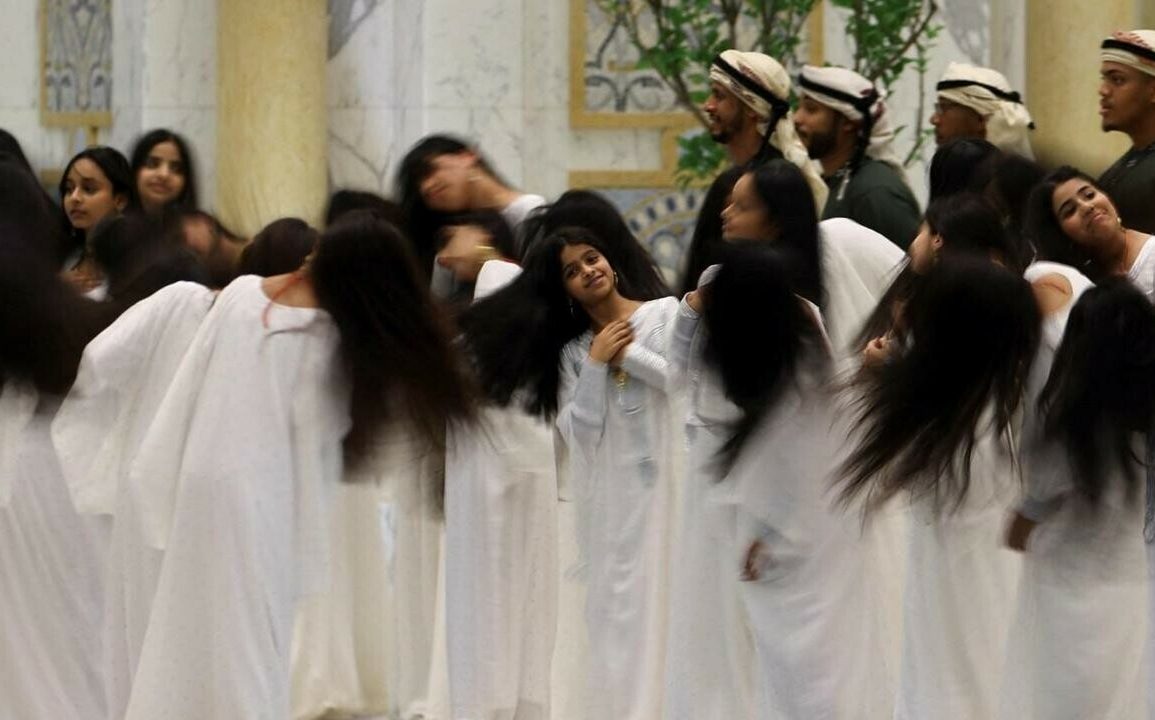

When US President Donald Trump concluded his Gulf visit in Abu Dhabi, he was met with the traditional fanfare of the region — an official welcome by President Sheikh Mohamed bin Zayed, children waving UAE and US flags, and a group of young Emirati girls performing a traditional hair-tossing dance. What followed online, however, was a wave of confusion, criticism, and cultural insensitivity, largely from viewers unfamiliar with the region’s traditions.
The girls, dressed in white, rhythmically swung their hair from side to side — a performance that caught global attention, not always for the right reasons. Some viewers expressed confusion or even discomfort. Others, more alarmingly, labeled the display “disturbing,” “shameless,” or “pagan,” without bothering to understand the tradition they were witnessing.
What these critics failed to recognize is that the dance is a deeply rooted cultural expression known as Al Ayyala. Far from a random display, Al Ayyala is a traditional performance with centuries of history, recognized by UNESCO as an Intangible Cultural Heritage of Humanity. Often referred to as the “hair dance,” it’s especially common during national celebrations, weddings, and significant public occasions in the UAE and Oman.
The origins of Al Ayyala lie in Bedouin life and martial traditions. Historically, it began as a re-enactment of battle scenes with rows of men wielding bamboo sticks, moving in unison to the rhythm of drums and chanting poetry. The female performers, typically young girls in traditional dress, add grace and symbolism by rhythmically tossing their hair, signifying beauty, pride, and collective identity.
This performance isn’t mere entertainment; it embodies valour, community solidarity, and cultural dignity. Dismissing it as primitive or inappropriate betrays a deep misunderstanding — or worse, a refusal — to see the dance through its cultural lens.
To label this centuries-old performance as “pagan” is not only inaccurate but also disrespectful. As noted by cultural experts and Emiratis alike, heritage and faith are not mutually exclusive. Celebrating a cultural identity, especially one steeped in poetry, symbolism, and history, doesn’t contradict religious values — it enriches them.
Moreover, the criticism of the dance reveals a troubling gender bias. The notion that women flipping their hair is somehow controversial while male displays of traditional swordplay or poetry might be more readily accepted points to a double standard. It suggests that cultural expression by women, even in its most traditional form, is scrutinized more harshly than that of men.
In an age where global cultures intermingle online with increasing frequency, the impulse to critique before understanding is a dangerous one. A few seconds of research — or a willingness to pause judgment — could turn ridicule into respect.
In essence, Al Ayyala is not just a dance. It is a living archive of heritage, a visual poem of the Arabian Peninsula’s past, and a powerful reminder that tradition deserves recognition, not ridicule. Those quick to condemn it should reconsider: what you’re watching is not just choreography — it’s culture.