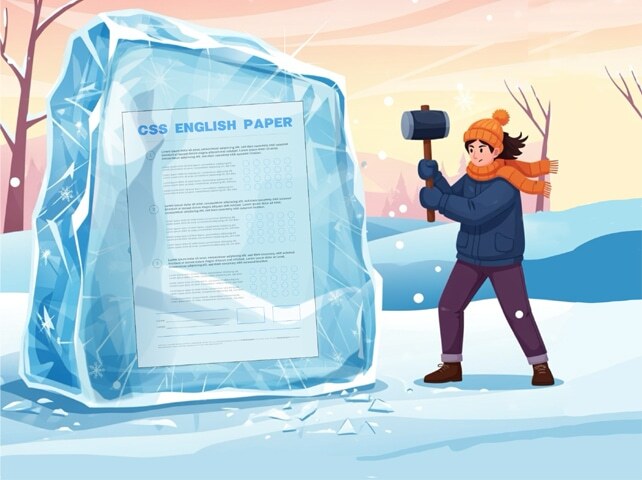

Nearly three decades ago, a critique of the Central Superior Services (CSS) English (Précis and Composition) paper highlighted a simple truth: the paper did not assess authentic language proficiency or the communicative skills essential for a modern civil servant. Instead, it relied on archaic formats, ritualised exercises, and decontextualised language fragments, distorting both teaching and learning.
Fast-forward to 2025, and the sobering conclusion is unavoidable: little has changed. This is no longer merely a matter of academic debate. When a well-founded critique is ignored for nearly thirty years, the question shifts from “Is the criticism valid?” to “What does such sustained inaction reveal about the institution itself?”
English as Symbolic Capital
The CSS English paper occupies a unique and powerful position. Unlike university examinations, it is untethered from a formal syllabus or curriculum. That autonomy, in theory, could have fostered innovation. In practice, it has entrenched rigidity. Where reform could have flourished, repetition has become the default.
Contemporary papers continue to prioritise synonym–antonym exercises built on obscure or low-utility vocabulary. These items do not measure how candidates read, write, summarise, argue, or communicate effectively. Instead, they reward rote memorisation — often facilitated by coaching centres specialising in exam-focused “ritual” preparation. The result is a form of English proficiency that functions less as a skill and more as symbolic capital.
Meaningful language proficiency is contextual. Effective communication depends on purpose, audience, and register. The CSS paper strips away context, presenting words and sentences as isolated tokens to be decoded. Objectivity and ease of marking are purchased at the cost of relevance, producing an illusion of rigor while sacrificing functional competence.
Institutional Inertia and the Price of Continuity
The paper’s long-standing centerpiece, the précis exercise, illustrates this disconnect. Condensing a few hundred words into a prescribed length bears little resemblance to the real summarising tasks civil servants perform: identifying key points, understanding implications, and organising information for decision-makers. Decades of applied linguistics research have questioned the pedagogical value of such exercises, yet the format endures — a testament to institutional inertia rather than merit.
The imbalance of accountability is equally troubling. Candidates are penalised for minor lapses, while the examination itself exhibits ambiguities, careless proofreading, and conceptual inconsistencies. When errors in a high-stakes exam provoke no explanation or redress, the implicit message is clear: the institution is beyond scrutiny and refuses to learn.
Over the past thirty years, English education and communicative teaching methods have evolved. The demands on public administration have become more complex, not less. Yet the CSS English paper remains anchored in a model that prizes lexical obscurity over practical skill. Continuity in the face of mounting evidence now reads as deliberate resistance.
Gatekeeping and Systemic Consequences
The CSS English paper functions as a gatekeeping mechanism — filtering candidates not by their ability to think, communicate, or perform administrative tasks, but by their mastery of a ritualised testing tradition. Gatekeeping need not be malicious; it requires only that tradition be mistaken for standards and difficulty for merit.
The wider consequences are systemic. Millions of students shape their English learning around the demands of this high-status exam. When assessment rewards memorisation over reasoning, entire educational systems reorganise themselves accordingly. Reading, writing, and critical thinking wither, replaced by rote learning and exam-centric preparation.
A Way Forward
Reform is no longer a favour to candidates — it is a responsibility to the state. Key steps include:
- Define competencies clearly: The Federal Public Service Commission (FPSC) must articulate a precise competency framework, identifying the reading, writing, and reasoning skills genuinely required of civil servants.
- Contextual assessment: Language should be tested in real-world administrative contexts — summarising policy passages, revising flawed official prose, and constructing concise, reasoned arguments.
- Maintain rigor without ritual: Objectivity and efficient marking can be achieved through robust rubrics and examiner training, not by resorting to obscure lexical trivia.
- Invite critique and continuous improvement: Assessment should be treated as a living practice, open to informed review, rather than a sacred inheritance immune to challenge.
After nearly thirty years of silence, meaningful reform is overdue. Modernising the CSS English paper is not merely a pedagogical exercise; it is essential to ensuring that Pakistan’s civil service selects and cultivates officers capable of meeting the complex demands of governance in the 21st century.