Former US president says trade helped prevent war, urges greater economic ties with Pakistan
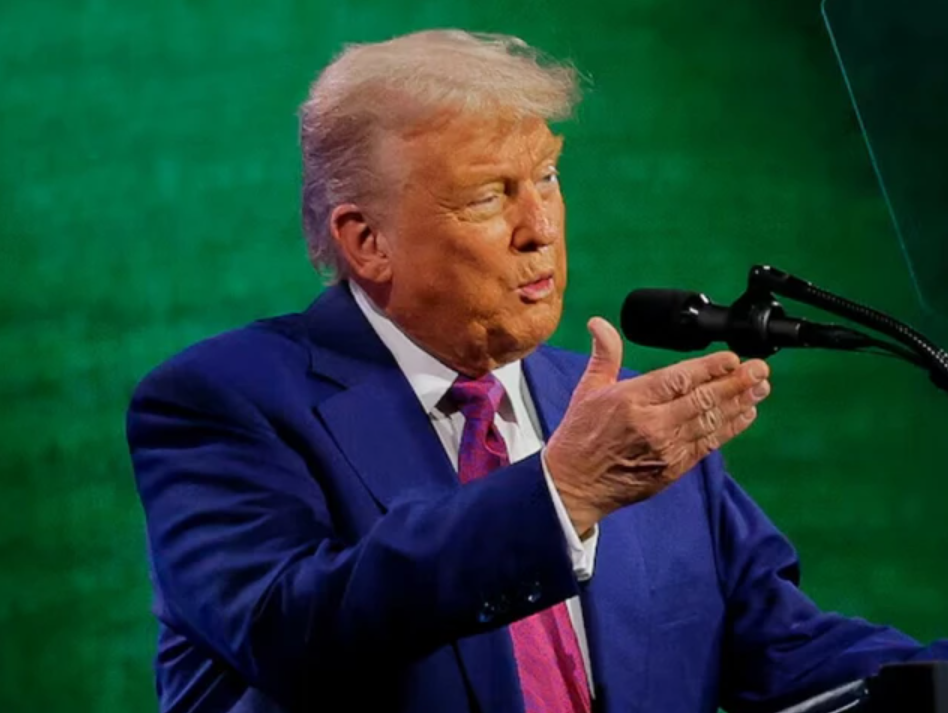
Former US President Donald Trump has praised the Pakistani people as “brilliant” and emphasized the importance of trade as a tool for peace, while taking credit for de-escalating what he described as a near-nuclear standoff between India and Pakistan.
In an interview with Fox News, Trump claimed that his diplomatic efforts helped pull the two nuclear-armed nations back from the edge of war during a period of intense military escalation. “It was heading toward a nuclear war, I believe — or very close,” he said. “Missiles were flying, there was retaliation, and tensions were rising fast.”
According to Trump, his administration’s discreet intervention played a key role in halting the crisis. He said he instructed his team to initiate immediate contact with both countries and to use trade as a means to calm tensions. “I told my people, call them up — let’s start trading right away,” Trump said.
He also spoke positively about his conversations with Pakistan’s leadership, describing them as productive and forward-looking. “They’re brilliant people. They make amazing products. We don’t trade nearly enough with them,” he said, calling for expanded US-Pakistan economic ties.
Although trade between the two nations remains limited, Trump said there is significant potential. He added, albeit awkwardly, “It takes two rectangle,” seemingly meaning to stress that cooperation requires effort from both sides.
Trump also used the interview to criticise India’s economic policies, labeling it “the country with the highest tariffs in the world.” However, he acknowledged that India had shown a willingness to reduce trade barriers for the United States.
“India makes it incredibly difficult to do business,” he said. “But they offered to cut 100% of their tariffs just for us.”
He went on to describe his role in de-escalating the South Asian conflict as one of the most underappreciated achievements of his presidency. “This was bigger than I’ll ever get credit for,” Trump said. “These are not minor players. These are major nuclear powers. And they were angry.”
Reflecting on how close the situation came to catastrophe, Trump said, “It was tit for tat, more missiles, more escalation. The next step could’ve been the ‘N word’—nuclear. That’s the worst possible outcome. And I think they were very, very close.”
He underscored his belief in trade as a diplomatic tool. “Trade is how you settle disputes and avoid wars,” he said. “Let’s not trade missiles. Let’s trade the incredible products you make.”
Background on the Conflict
The most recent escalation between India and Pakistan began on April 22, when a deadly attack in the Indian Illegally Occupied Jammu and Kashmir (IIOJK) town of Pahalgam killed 26 people. India immediately blamed Pakistan, despite providing no public evidence.
In retaliation, India suspended the decades-old Indus Waters Treaty, canceled Pakistani visas, closed the Wagah-Attari border, shut down the Pakistan High Commission in Delhi, and scaled down diplomatic representation.
Pakistan denied involvement and responded with reciprocal measures, including halting bilateral trade, closing its airspace to Indian aircraft, and activating countermeasures via its National Security Committee.
Tensions escalated dramatically on May 7, when Indian missile strikes targeted multiple cities in Punjab and Azad Jammu and Kashmir (AJK), destroying a mosque and killing dozens, including women and children.
Pakistan’s military responded by shooting down several Indian aircraft, including three Rafale jets. Over the next 48 hours, India launched drone attacks using Israeli-made UAVs, which were also neutralized by Pakistani defenses.
The situation intensified again on May 10, when India launched missile strikes on Pakistani airbases. Pakistan retaliated with Operation Bunyan-un-Marsoos, targeting Indian military infrastructure, including airbases and missile storage sites.
On the evening of May 11, Trump announced that a ceasefire had been reached, following overnight diplomatic efforts. The ceasefire was later confirmed by both Pakistan’s Foreign Minister Ishaq Dar and India’s Foreign Secretary.
Despite the halt in military hostilities, the diplomatic narrative has remained contested. Pakistan publicly credited the US, along with China and Gulf nations, for their role in defusing tensions. India, however, downplayed any foreign role, asserting that the ceasefire resulted from bilateral efforts. Indian officials also insisted that trade was not discussed with the US.
Trump, speaking later at the US-Saudi Investment Forum, reiterated his belief that trade played a central role in brokering peace. “Let’s not trade nuclear missiles,” he said. “Let’s trade the incredible things you make.”
The remarks signal Trump’s continued emphasis on using economic engagement as a pathway to global stability—and his desire to be remembered as a dealmaker who averted disaster.