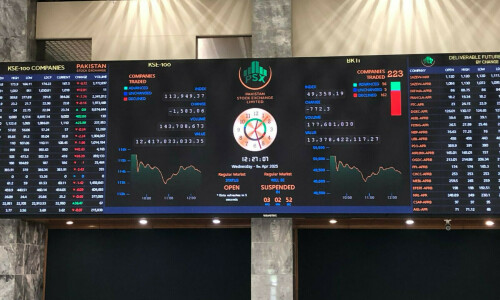

The Pakistan Stock Exchange (PSX) surged past the 120,000-point milestone during intraday trading on Monday, reaching a historic high before retreating slightly by the end of the session.
The benchmark KSE-100 index jumped 636.4 points, or 0.53%, to hit 120,285.54 points at 9:33 AM, compared to its previous close of 119,649.14 points. However, the index later experienced volatility, dipping to 119,426.44 points by 11:44 AM—down 222.70 points from the last close.
By the end of the trading day, the index settled at 119,689.63 points, marking a modest gain of 40.49 points, or 0.03%.
This upward momentum follows a strong performance last week, when the market surged after news of a ceasefire between Pakistan and India eased investor concerns. The KSE-100 gained 12,474 points during the week, closing at 119,649 on Friday.
Recent bullish sentiment has also been supported by the IMF’s approval of the first review of Pakistan’s loan programme, a green light for climate funding, and the release of a $1 billion tranche.
Yousuf M. Farooq, Director of Research at Chase Securities, noted that the market is “consolidating ahead of the budget as participants assess the IMF review.” Pakistan’s federal budget is expected to be unveiled on June 2.
Farooq advised retail investors to avoid reacting to short-term market swings and instead maintain disciplined investing habits—focusing on consistent, small investments aligned with personal risk tolerance and long-term objectives.
Awais Ashraf, Research Director at AKD Securities, highlighted that the IMF’s acknowledgment of Pakistan’s success in meeting key performance benchmarks has been well-received by the market. However, he cautioned that investors remain wary of the IMF’s call for higher revenue targets in the upcoming budget—a challenge the Federal Board of Revenue believes it can meet.
Ashraf also pointed out that a stronger external position, a current account surplus, and declining inflation could help stimulate economic activity and open the door for further monetary easing—potentially making equities more attractive than fixed-income assets.
Looking ahead, analysts anticipate the KSE-100 index could climb to 165,215 points by December 2025. The projection is backed by strong corporate earnings, solid returns in the banking sector, and improved financial performance in the energy and oil marketing industries.
Falling interest rates and increasing macroeconomic stability are also expected to act as key drivers of future market growth.