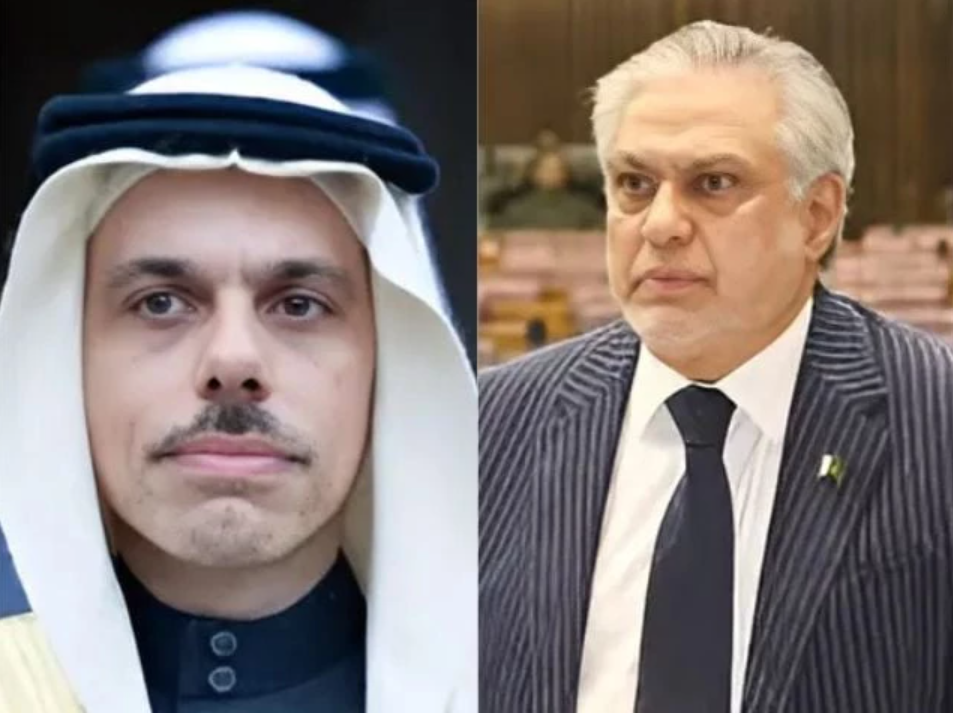
FM Ishaq Dar and Saudi counterpart discuss regional developments and deepen bilateral cooperation
ISLAMABAD – Pakistan’s Deputy Prime Minister and Foreign Minister Ishaq Dar met with Saudi Foreign Minister Prince Faisal bin Farhan in Islamabad, reaffirming the strong and historic ties between the two nations. The leaders discussed strengthening cooperation across a wide range of sectors and exchanged views on key regional developments.
The high-level dialogue underscored both countries’ commitment to expanding their partnership, particularly in economic, political, and strategic domains.
The meeting took place against the backdrop of major regional realignments. On Thursday, Dar announced that Pakistan would consider upgrading its diplomatic engagement with the Afghan Taliban government, following a comprehensive internal consultation process.
“We will carry out thorough due diligence and assess all potential implications,” Dar told reporters when asked about this potential shift in policy.
This development followed a China-brokered trilateral meeting in Beijing, bringing together Foreign Ministers from Pakistan, Afghanistan, and China. The three nations agreed to collaborate on counter-terrorism efforts, specifically targeting groups like Tehreek-e-Taliban Pakistan (TTP) and the Baloch Liberation Army (BLA).
Dar emphasized that Pakistan would not tolerate cross-border attacks originating from Afghan territory. He acknowledged that while non-state actors may act independently of the Afghan government, any state-sanctioned aggression would cross a red line.
Addressing the issue of Afghan refugees, Dar introduced a new visa policy under which Afghan nationals could enter Pakistan on a one-year, multiple-entry visa for a fee of $100. He stressed that the Afghan government must ensure its territory is not used as a launchpad for terrorist activities against Pakistan.
During his recent visit to China, Dar also discussed regional security, trade cooperation, and refugee management. A key outcome was the agreement to expand the China-Pakistan Economic Corridor (CPEC) into Afghanistan. Proposed infrastructure projects include a highway linking Peshawar to Kabul and a trans-Afghan railway connecting Central and South Asia — initiatives aimed at bolstering regional connectivity and economic integration.
The latest meeting with the Saudi foreign minister also builds on growing momentum in Pakistan-Saudi relations. Last month, a high-level Saudi delegation led by Prince Faisal visited Pakistan to explore investment opportunities, following a meeting between Prime Minister Shehbaz Sharif and Saudi Crown Prince Mohammed bin Salman in Riyadh.
During the current visit, the Saudi delegation is expected to engage with Pakistan’s top leadership — including the president, prime minister, and military officials — to discuss major investment projects.
Pakistan is particularly keen on attracting Saudi investment in critical sectors such as mining and agriculture, with a focus on the Reko Diq gold and copper project, under the umbrella of the Special Investment Facilitation Council (SIFC).
The ongoing diplomatic engagements signal a broader strategic recalibration as Pakistan seeks to enhance ties with regional allies and build resilience through economic and security cooperation.