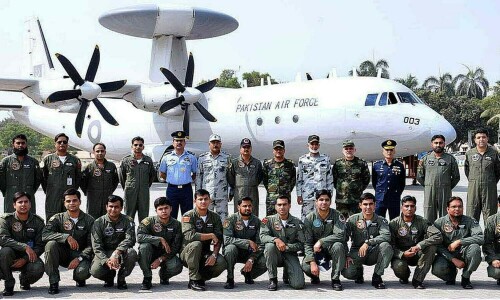
ISLAMABAD: Shortly after midnight on May 7, tension filled the Pakistan Air Force (PAF) Combat Operations Centre in Islamabad as radar screens revealed a large cluster of Indian Air Force (IAF) fighters assembling in the north with clear intent.
Within moments, Pakistan scrambled its fighter jets, including the newly inducted J-10C aircraft, piloted by one of its most renowned units—No. 15 Squadron, known as the “Cobras.”
Nearly a month later, the PAF officially confirmed what had been widely speculated: that the Kamra-based 15 Squadron led the operation that resulted in the downing of six Indian jets during one of the largest air-to-air battles in South Asia in over 50 years.
Eighteen of the squadron’s 20 J-10C jets participated in this high-stakes interception of a large Indian formation, executing Pakistan’s defensive response.
In a statement from the PAF’s media wing, the Cobras were praised for their legacy and professionalism: “From heroic air battles in the 1965 war—where Flight Lieutenant Imtiaz Bhatti shot down two Indian Vampires—to vigilant patrols during the Soviet-Afghan War, this squadron has always remained combat-ready. Now equipped with advanced J-10C fighters, the Cobras continue to exemplify precision, bravery, and air superiority.”
The May 7 clash, triggered by India’s Operation Sindoor following a deadly attack in Pahalgam, involved more than 120 aircraft from both nations.
According to Pakistani military sources, the six Indian aircraft destroyed included three Rafales, one MiG-29, a Mirage-2000, and a Su-30MKI—all taken down by PL-15 beyond-visual-range missiles launched from PAF J-10Cs. All missile launches were conducted by pilots from the 15 Squadron, who are expected to be publicly recognized and honored at an upcoming ceremony.
A senior PAF official, speaking on condition of anonymity, confirmed: “The pilots involved will be decorated soon. They are among our finest aviators, and their actions speak volumes.”
Insiders say the engagement was a calculated bait-and-counter tactic. Armed with intelligence of a pending Indian attack, the PAF deployed four defensive air formations and tracked over 60 Indian aircraft using sophisticated electromagnetic spectrum management.
“We fought the battle on our terms,” said the official. “Our kill chain was fully active. When the command shifted from ‘Deter’ to ‘Assure Kill, Deny Own Loss,’ the Cobras executed their mission with precision and control.”
Among the prioritized targets were the Rafale jets—the pride of the IAF since 2019. “The Indians expected Rafales to be game changers,” the official added. “So we made them our first priority.”
Initially, the Indian side downplayed the losses. On May 11, IAF Director General of Air Operations Air Marshal A.K. Bharti remarked, “Losses are part of combat,” assuring all pilots returned safely.
However, during the Shangri-La Dialogue in Singapore on May 31, India’s Chief of Defence Staff, Gen Anil Chauhan, acknowledged the losses, attributing them to “tactical errors.” His comments sparked domestic criticism and attempts to minimize the embarrassment with confusing cricket metaphors.
Cobras’ History of Valor
No. 15 Squadron, established in 1956, has a storied history. It recorded Pakistan’s first confirmed aerial kill in 1959 and played key roles in the 1965 and 1971 wars. Later, it conducted patrol and interdiction missions along the Durand Line during the Soviet-Afghan conflict.
Before the recent air battle, the squadron participated in the 2019 Operation Swift Retort—Pakistan’s measured response to India’s Balakot airstrike—conducting precision strikes with H-4 SOW glide bombs near the Narian Army Base in Indian-occupied Kashmir.
In 2022, the Cobras transitioned from aging Mirage jets to the advanced Chinese-built Chengdu J-10C multirole fighters, becoming the first PAF squadron to do so. This upgrade, featuring AESA radar, advanced datalinks, and beyond-visual-range capabilities, greatly enhanced their operational reach, enabling air superiority and precision strikes.
Adding to the squadron’s prestige is the fact that current Air Chief Marshal Zaheer Ahmed Baber Sidhu is a former commander of No. 15 Squadron. On the night of May 7, Sidhu personally directed combat operations from Islamabad’s command center, closely monitoring every move.
“The Cobras are our sharpest fang,” an official remarked. “They’ve defended this nation in every war. May 7 was no exception—only this time, the stakes were even higher.”
At their Kamra base, pride mixes with professionalism as the PAF’s official statement concluded: “Throughout its distinguished history, No. 15 Squadron has consistently demonstrated operational resilience and tactical excellence.”